How Much Electricity Does a Grow Tent Use? Complete Guide & Cost Calculator
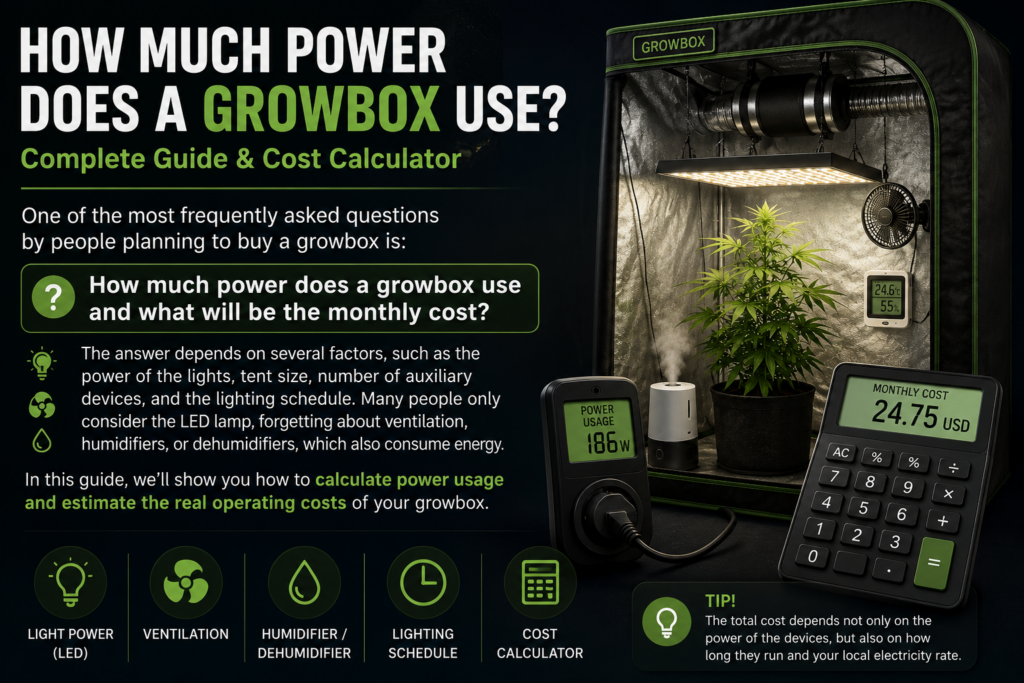
One of the most common questions asked by people planning to buy a grow tent is:
How much electricity does a grow tent use, and what will the monthly operating cost be?
The answer depends on several factors, including light wattage, tent size, additional equipment, and the lighting schedule used. Many growers focus only on the LED grow light and forget that ventilation systems, humidifiers, and dehumidifiers also consume electricity.
In this guide, you’ll learn how to calculate electricity consumption and estimate the real operating costs of a grow tent.
What Uses Electricity in a Grow Tent?
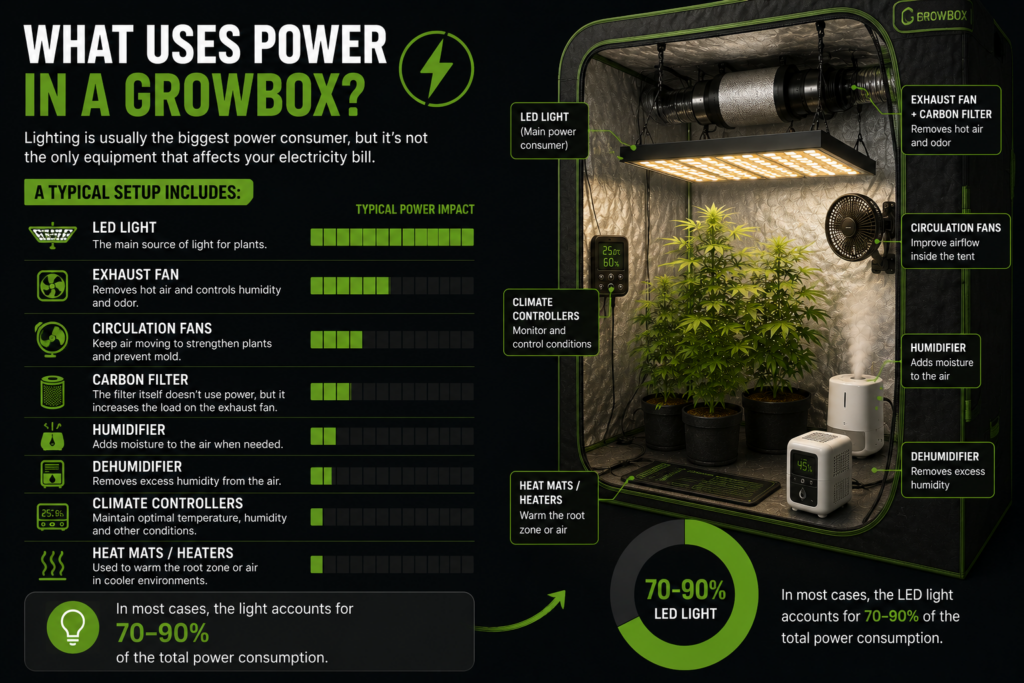
The largest electricity consumer is usually the grow light, but it’s not the only device affecting your power bill.
A typical grow tent setup includes:
LED grow light
Exhaust fan
Circulation fans
Carbon filter (the filter itself doesn’t use electricity, but it increases fan workload)
Humidifier
Dehumidifier
Environmental controllers
Heating mats or heaters
In most setups, the grow light accounts for approximately 70–90% of total power consumption.
How to Calculate Electricity Usage
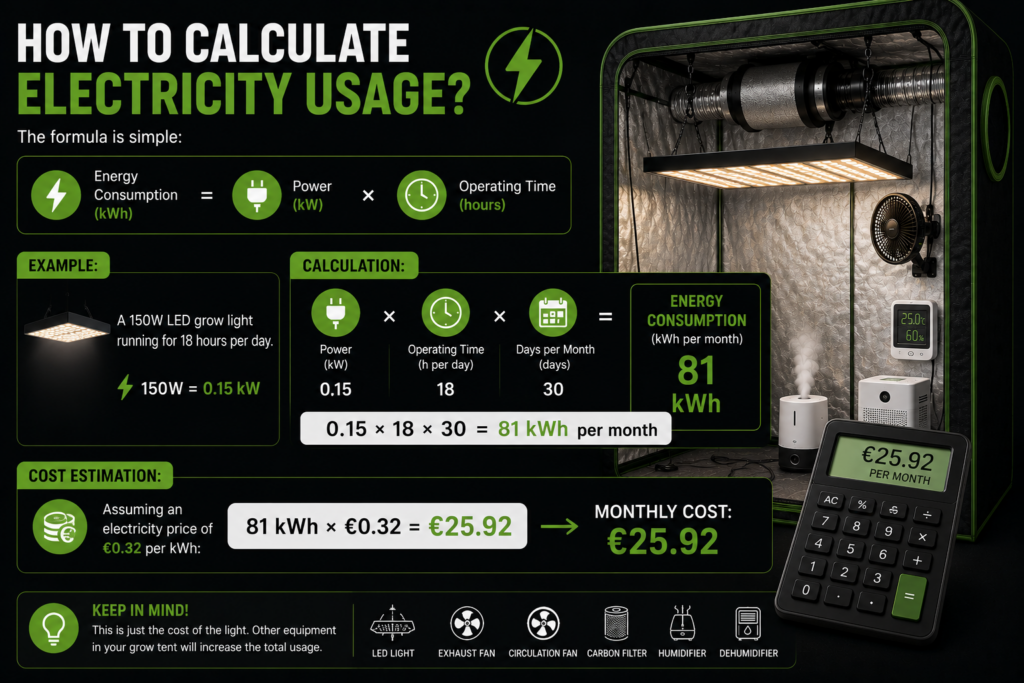
The formula is simple:
Energy Consumption (kWh) = Power (kW) × Operating Time (hours)
Example:
A 150W LED grow light running for 18 hours per day.
150W = 0.15 kW
Calculation:
0.15 × 18 × 30 = 81 kWh per month
Assuming an electricity price of €0.32 per kWh:
81 × €0.32 = €25.92 per month
Autoflowers vs Photoperiod Plants – Electricity Consumption Differences
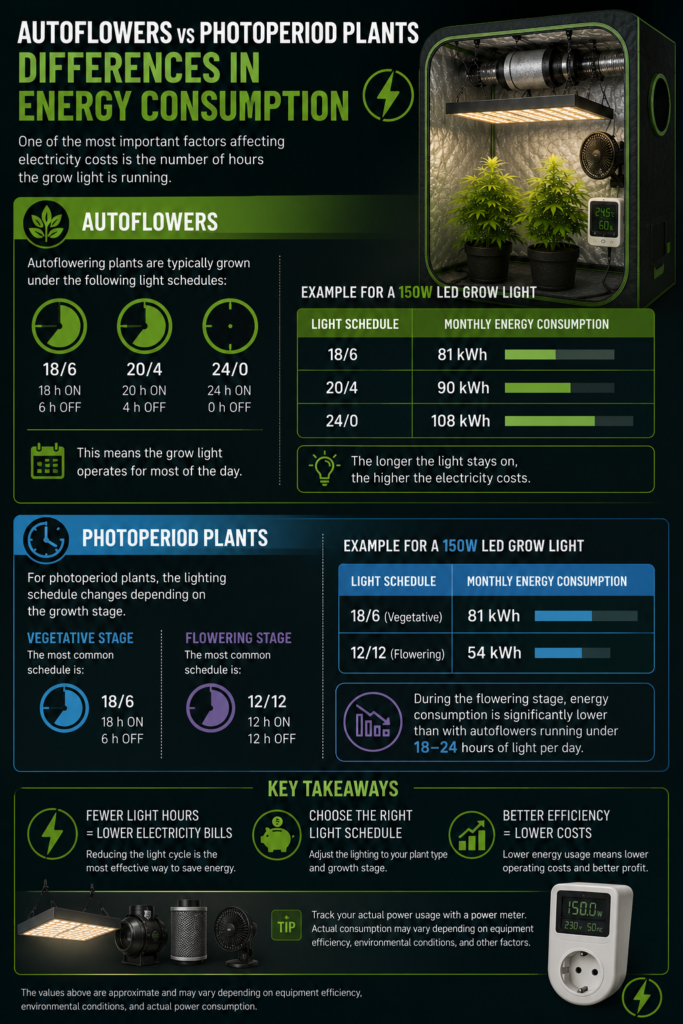
One of the biggest factors affecting your electricity bill is the number of hours your lights are running each day.
Autoflowering Plants
Autoflowers are commonly grown under the following light schedules:
18/6
20/4
24/0
This means the lights are running for most of the day.
Example using a 150W LED light:
Light Schedule
Monthly Consumption
Monthly Cost (€0.32/kWh)
18/6
81 kWh
€25.92
20/4
90 kWh
€28.80
24/0
108 kWh
€34.56
The longer the light runs, the higher the electricity cost.
Photoperiod Plants
Photoperiod plants require different lighting schedules depending on the growth stage.
Vegetative Stage
Most growers use:
18/6
Flowering Stage
Most growers use:
12/12
Example using a 150W LED light:
Light Schedule
Monthly Consumption
Monthly Cost (€0.32/kWh)
18/6
81 kWh
€25.92
12/12
54 kWh
€17.28
During flowering, electricity consumption is significantly lower than with autoflowers running 18–24 hours per day.
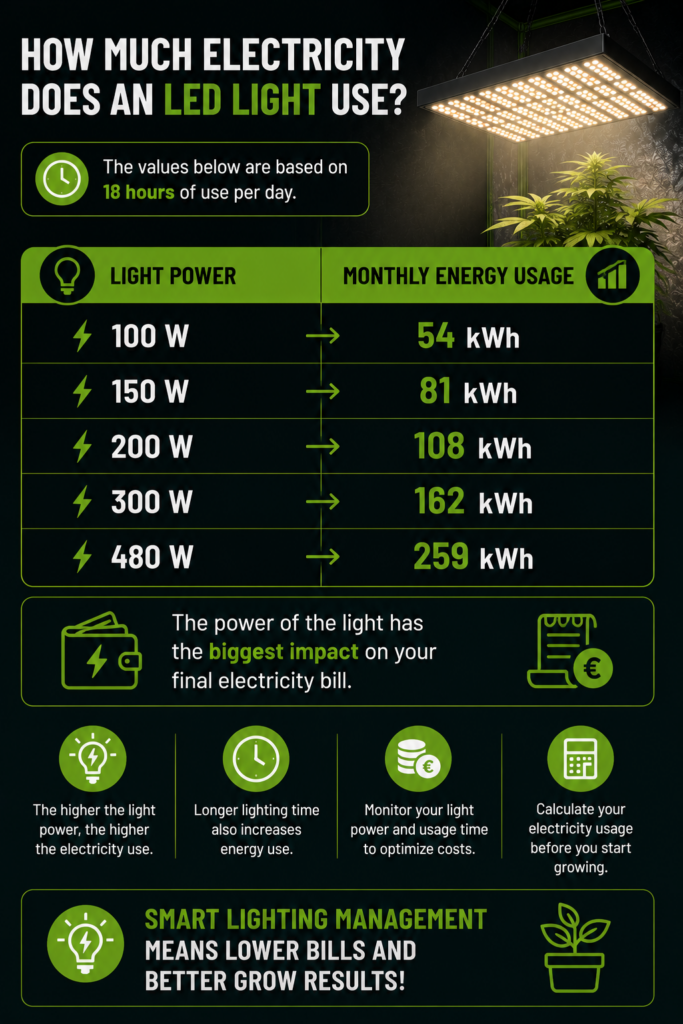
How Much Electricity Does an LED Grow Light Use?
The following figures assume an 18-hour daily light cycle.
LED Wattage
Monthly Consumption
Monthly Cost
100W
54 kWh
€17.28
150W
81 kWh
€25.92
200W
108 kWh
€34.56
300W
162 kWh
€51.84
480W
259 kWh
€82.88
As you can see, light wattage has the greatest impact on electricity costs.
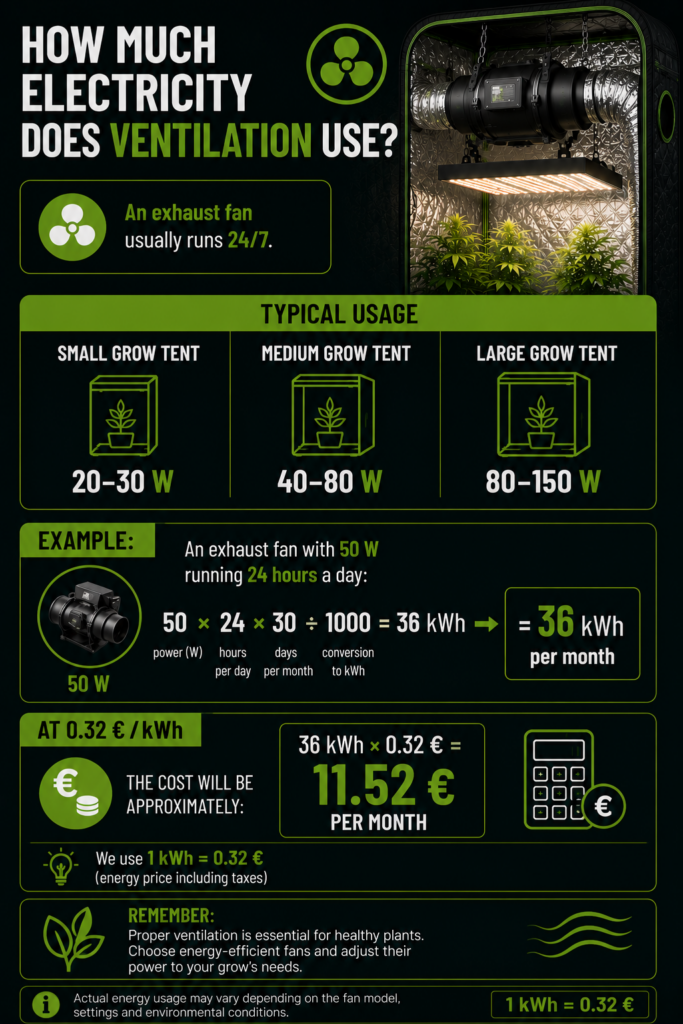
How Much Electricity Does Ventilation Use?
An exhaust fan typically runs 24 hours a day.
Common power ratings:
Small grow tents: 20–30W
Medium grow tents: 40–80W
Large grow tents: 80–150W
Example:
A 50W exhaust fan running continuously:
50 × 24 × 30 ÷ 1000 = 36 kWh per month
Cost:
36 × €0.32 = €11.52 per month
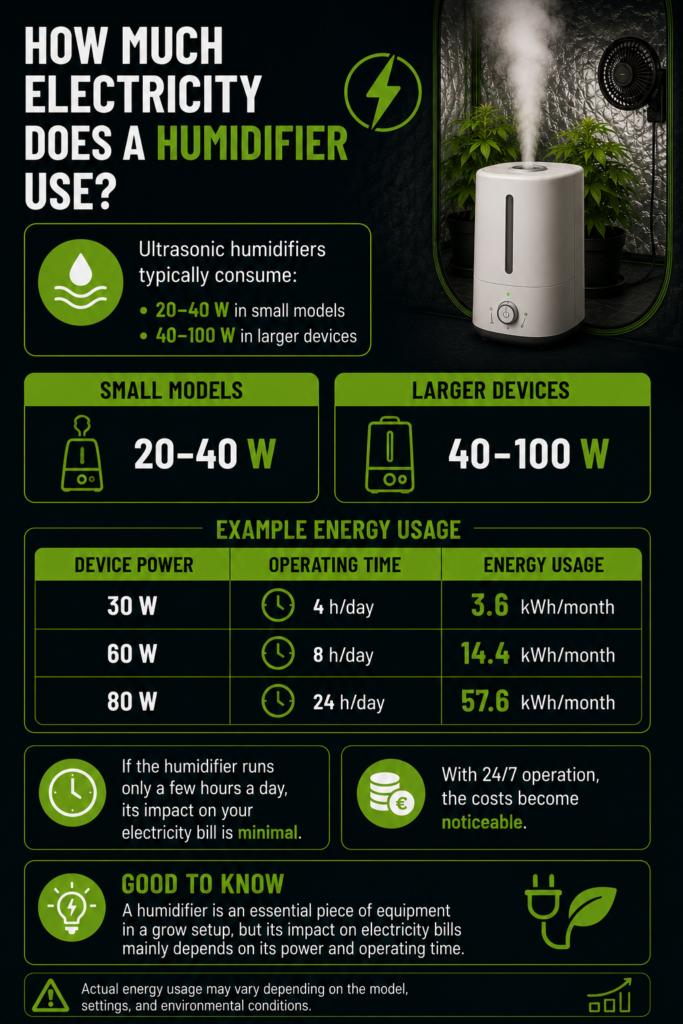
How Much Electricity Does a Humidifier Use?
Ultrasonic humidifiers typically consume:
20–40W for smaller units
40–100W for larger units
If used only a few hours per day, the impact on your electricity bill is relatively small. Continuous operation, however, can noticeably increase costs.
How Much Electricity Does a Dehumidifier Use?
A dehumidifier is often the second most power-hungry device in a grow room after the grow light.
Typical power consumption:
150–300W for small units
300–500W for larger units
If you’re constantly battling high humidity, running a dehumidifier can cost more than your entire ventilation system.
Important: Humidifiers and Dehumidifiers Do Not Run All the Time
It’s important to remember that the calculations above represent maximum power consumption, assuming the equipment runs continuously.
In reality, humidifiers and dehumidifiers are usually connected to a humidity controller or only switch on when needed. This means they remain turned off for most of the time.
For example:
A humidifier may run for only a few minutes every couple of hours.
A dehumidifier often activates only when humidity levels become too high.
In a well-tuned grow tent, these devices may operate for only a small percentage of the day.
Because of this, you should not assume that a 300W dehumidifier will consume 300W continuously, 24 hours a day, for an entire month.
Actual Costs Are Usually Lower
In most properly configured grow tents, the main sources of electricity consumption are:
LED grow lights
Exhaust fans
Circulation fans
Humidifiers and dehumidifiers typically account for only a small portion of the total electricity bill because they operate intermittently rather than continuously.
For example, an 80×80 cm grow tent equipped with a 150W LED light, an exhaust fan, and several circulation fans may cost around €25–40 per month to operate (depending on local electricity rates), even if a humidifier or dehumidifier is used occasionally. The actual cost will depend on the environmental conditions in the room and the climate-control settings used in the grow setup.
Typical Electricity Usage for Popular Grow Tent Sizes
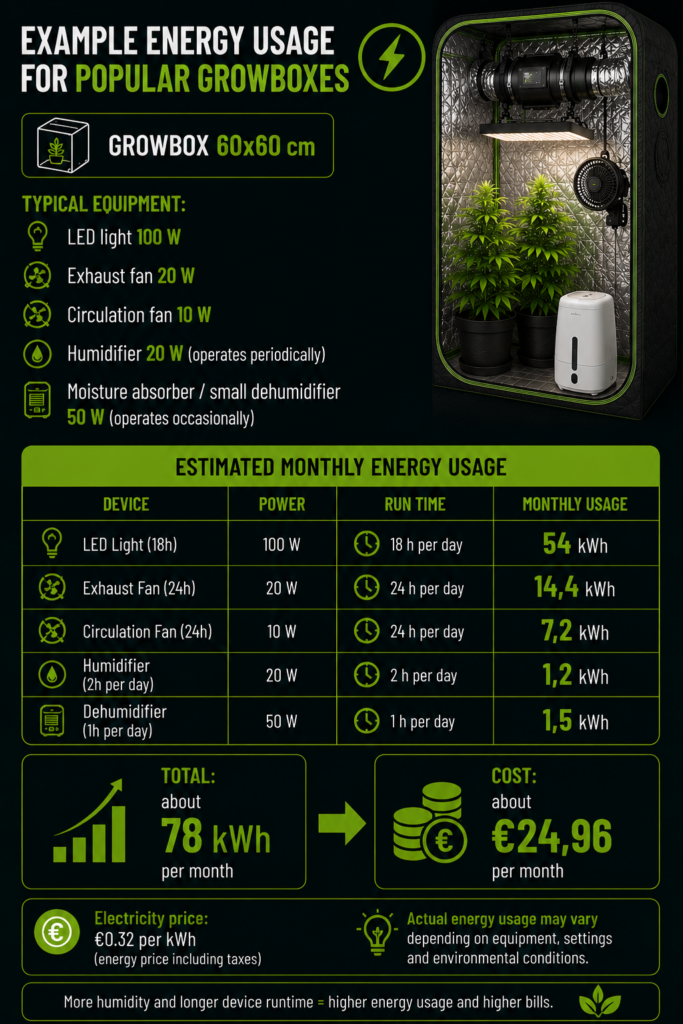
60x60 cm Grow Tent
Typical Equipment:
100W LED grow light
20W exhaust fan
10W circulation fan
20W humidifier (operates periodically)
50W moisture absorber / small dehumidifier (operates occasionally)
Estimated Monthly Energy Consumption:
Device
Energy Consumption
LED Grow Light (18h/day)
54 kWh
Exhaust Fan (24h/day)
14.4 kWh
Circulation Fan (24h/day)
7.2 kWh
Humidifier (2h/day)
1.2 kWh
Dehumidifier (1h/day)
1.5 kWh
Total: approximately 78 kWh per month
Estimated Monthly Electricity Cost
Assuming an electricity rate of €0.32 per kWh:
78 kWh × €0.32 = €24.96 per month
Estimated cost: approximately €25 per month.
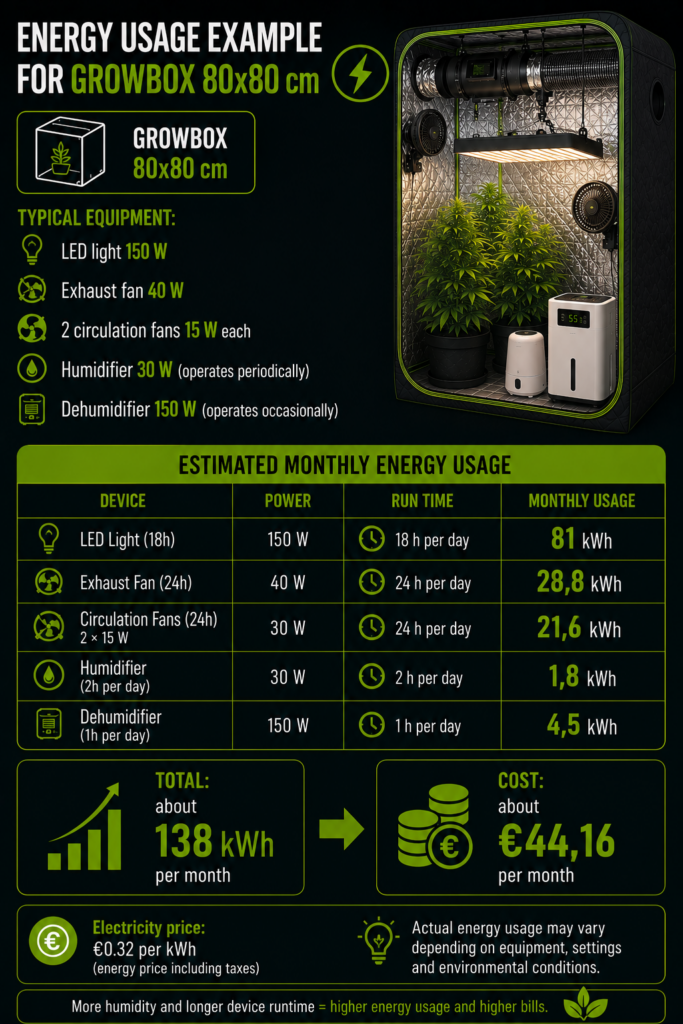
80x80 cm Grow Tent
Typical Equipment:
150W LED grow light
40W exhaust fan
2 circulation fans (15W each)
30W humidifier (operates periodically)
150W dehumidifier (operates occasionally)
Estimated Monthly Energy Consumption:
Device
Energy Consumption
LED Grow Light (18h/day)
81 kWh
Exhaust Fan (24h/day)
28.8 kWh
Circulation Fans (24h/day)
21.6 kWh
Humidifier (2h/day)
1.8 kWh
Dehumidifier (1h/day)
4.5 kWh
Total: approximately 138 kWh per month
Estimated Monthly Electricity Cost
Assuming an electricity rate of €0.32 per kWh:
138 kWh × €0.32 = €44.16 per month
Estimated cost: approximately €44 per month.
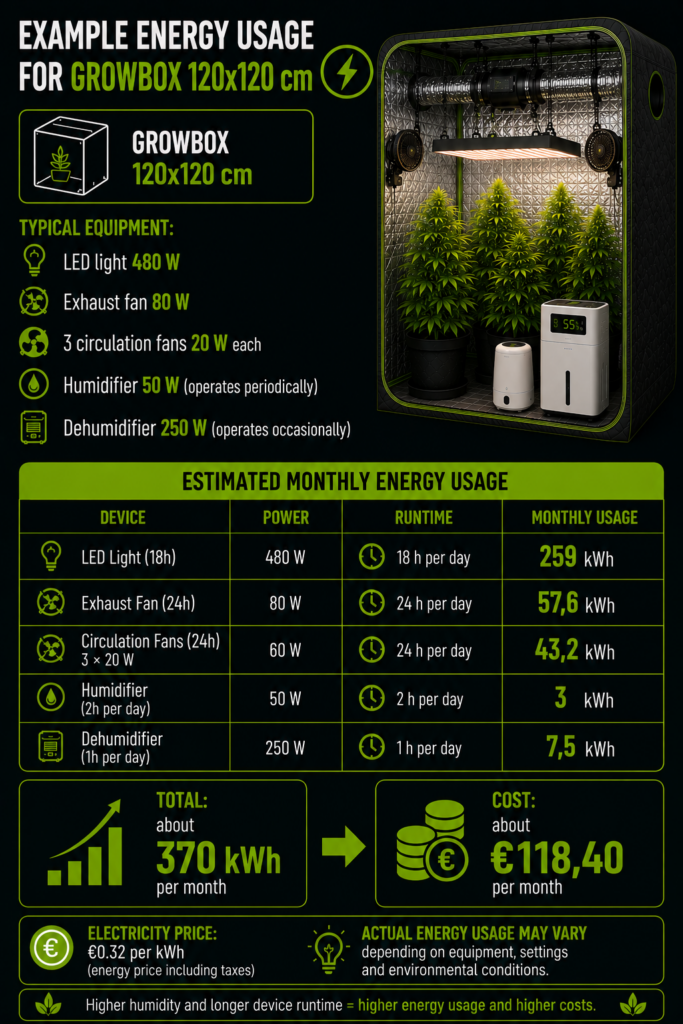
120x120 cm Grow Tent
Typical Equipment:
480W LED grow light
80W exhaust fan
3 circulation fans (20W each)
50W humidifier (operates periodically)
250W dehumidifier (operates occasionally)
Estimated Monthly Energy Consumption:
Device
Energy Consumption
LED Grow Light (18h/day)
259 kWh
Exhaust Fan (24h/day)
57.6 kWh
Circulation Fans (24h/day)
43.2 kWh
Humidifier (2h/day)
3 kWh
Dehumidifier (1h/day)
7.5 kWh
Total: approximately 370 kWh per month
Estimated Monthly Electricity Cost
Assuming an electricity rate of €0.32 per kWh:
370 kWh × €0.32 = €118.40 per month
Estimated cost: approximately €118 per month.
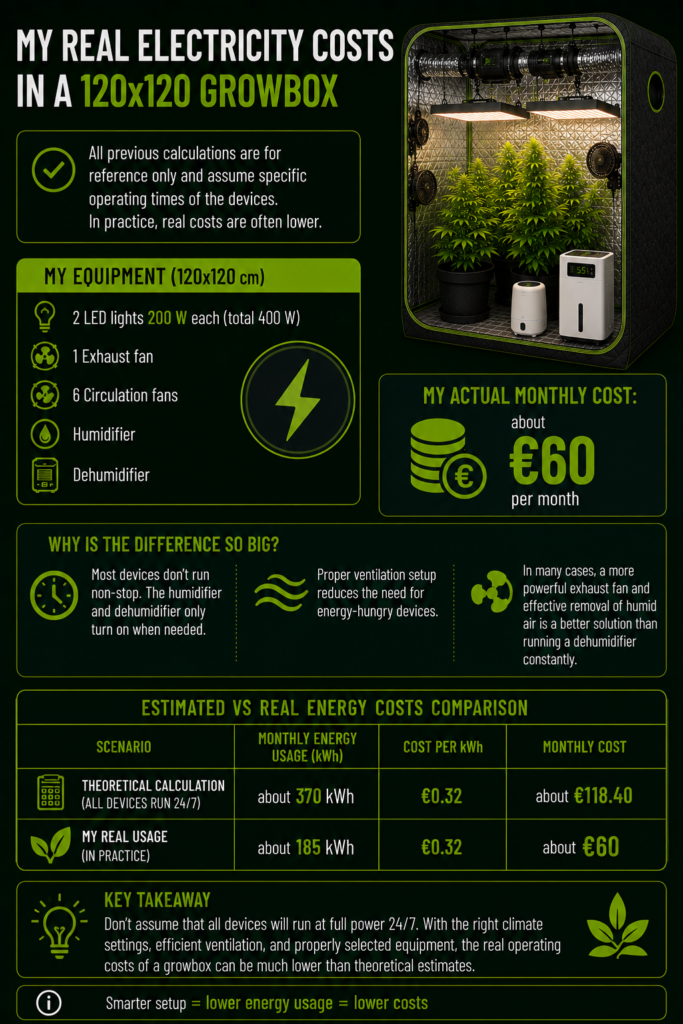
My Real Electricity Costs for a 120x120 Grow Tent
All of the calculations presented earlier are estimates based on typical equipment power ratings and operating times. In reality, actual electricity costs are often lower.
I personally run a 120×120 cm grow tent equipped with:
2 × 200W LED grow lights (400W total)
1 exhaust fan
6 circulation fans
A humidifier
A dehumidifier
Despite this setup, my actual electricity bill is significantly lower than what theoretical calculations might suggest. In practice, the total operating cost of my setup is around €60 per month.
Why is there such a difference?
The main reason is that most devices do not run continuously. Both the humidifier and dehumidifier only turn on when environmental conditions require it. In addition, a properly configured ventilation system can greatly reduce the need to run more power-hungry equipment.
In many cases, it makes more sense to increase the exhaust fan speed and remove excess humidity from the tent rather than relying heavily on a dehumidifier. A well-designed ventilation system not only helps maintain the proper humidity level but can also reduce overall electricity consumption.
For this reason, you should not assume that every device in your grow tent will be running 24 hours a day. With proper climate control, efficient ventilation, and correctly selected equipment, the real operating costs of a grow tent can be significantly lower than theoretical estimates suggest.
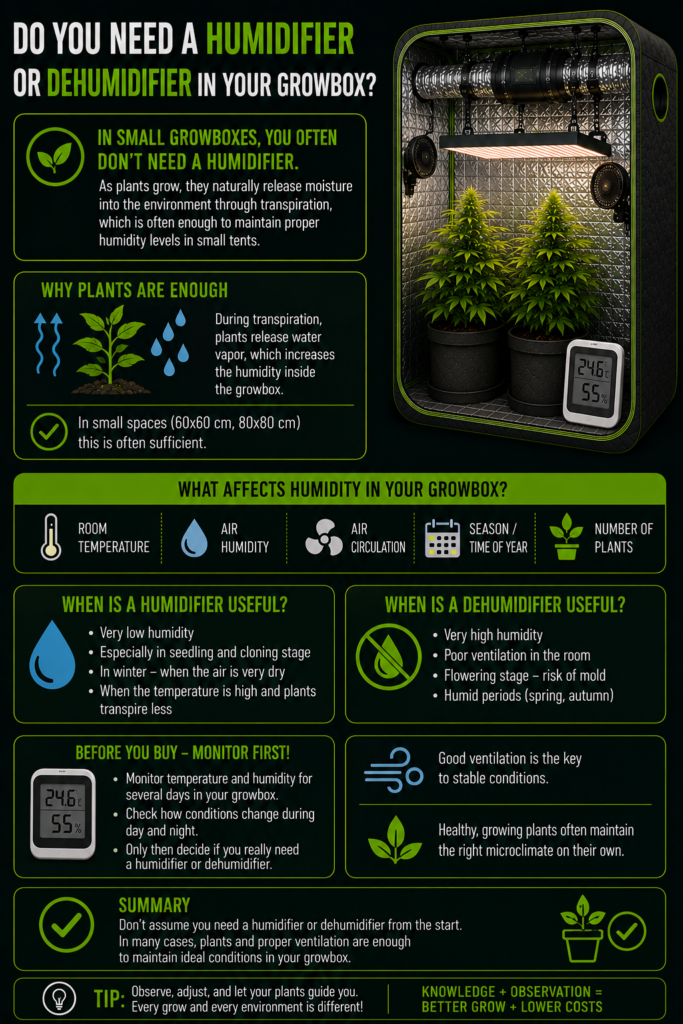
One thing I’ve noticed from my own experience is that small grow tents often don’t need a humidifier at all. Many beginners assume they need one from day one, but once plants start growing, they naturally release moisture into the air through transpiration. In a small tent such as a 60×60 cm or 80×80 cm setup, this is often enough to maintain adequate humidity levels without additional equipment.
Of course, every grow environment is different. The need for a humidifier or dehumidifier depends heavily on the conditions in the room where the grow tent is located. Factors such as room temperature, ambient humidity, airflow, season of the year, and the number of plants can all have a significant impact on the climate inside the tent.
For this reason, it’s usually best to monitor temperature and humidity levels before investing in additional climate-control equipment. In many cases, proper ventilation and healthy plant growth are enough to maintain stable conditions without the need for a dedicated humidifier or dehumidifier.
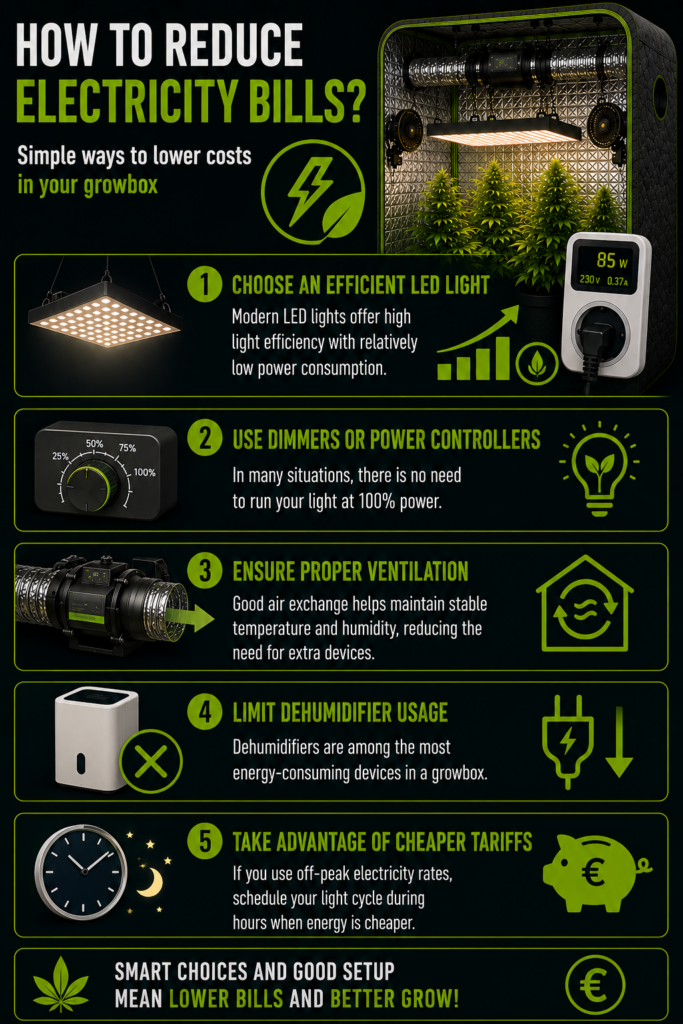
How to Reduce Electricity Costs
Choose an Efficient LED Grow Light
Modern LED fixtures provide excellent light output while consuming significantly less electricity than older technologies.
Use Dimming Features
Many grow lights don’t need to run at 100% power throughout the entire grow cycle.
Optimize Ventilation
Proper airflow management helps maintain temperature and humidity without relying heavily on additional equipment.
Minimize Dehumidifier Usage
Dehumidifiers are among the most energy-intensive devices in a grow environment.
Take Advantage of Off-Peak Electricity Rates
If your utility provider offers cheaper nighttime rates, consider scheduling your lighting cycle accordingly.
Frequently Asked Questions
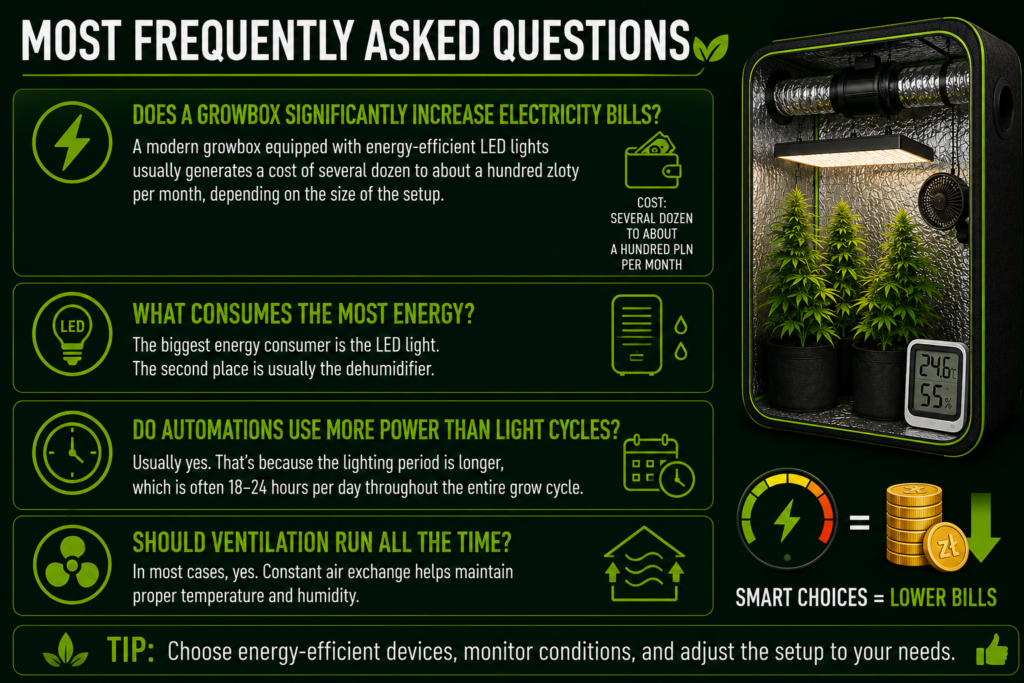
Does a Grow Tent Significantly Increase Electricity Bills?
Modern grow tents equipped with efficient LED lights typically cost anywhere from a few dozen euros to over €100 per month, depending on the setup size and equipment used.
What Uses the Most Electricity?
The LED grow light is usually the largest electricity consumer, followed by dehumidifiers.
Do Autoflowers Use More Electricity Than Photoperiod Plants?
Generally, yes. Autoflowers are often grown under longer light schedules, resulting in higher electricity consumption.
Should Ventilation Run 24/7?
In most cases, yes. Continuous air exchange helps maintain stable temperature and humidity levels while providing fresh air to the plants.
Conclusion
Electricity consumption in a grow tent depends primarily on the power of your grow light and the number of hours it operates each day. Ventilation systems, humidifiers, and dehumidifiers can also have a significant impact on your overall energy usage.
Autoflower setups generally consume more electricity than photoperiod grows due to longer lighting schedules. Before purchasing equipment, it’s worth calculating the total power draw of all devices and estimating their operating hours. Doing so will help you accurately predict monthly costs and choose a setup that fits your budget.
Check Out Our Other Guides
If you are still setting up your grow tent or looking to improve your growing conditions, be sure to explore our other guides as well: