Flowering Stage in a Grow Tent – Complete Beginner’s Guide

The flowering stage is one of the most important stages in a plant’s life cycle. During this period, the plant gradually shifts its focus away from producing new leaves and shoots and begins allocating more of its energy toward reproductive growth, including the development of flowers.

For beginner growers, this is also a stage when new challenges can appear: changing water requirements, increased sensitivity to environmental conditions, humidity issues, and nutrient deficiencies or excesses.

In this guide, we’ll explain what the flowering stage is, how to recognize when it begins, what happens to the plant during flowering, and what to watch for throughout the entire flowering period.

Note: Exact requirements vary depending on the species and cultivar. Always check the recommendations provided by the seed supplier or the specific plant variety.

Table of Contents

  1. What Is the Flowering Stage?

  2. When Does Flowering Begin?

  3. How to Recognize the Start of Flowering

  4. What Happens to the Plant During Flowering?

  5. Stages of Flowering

  6. Lighting During Flowering

  7. Temperature

  8. Humidity

  9. Ventilation

  10. Watering

  11. Nutrients and Feeding

  12. How to Monitor Your Plant

  13. Common Problems During Flowering

  14. Mold and Excessive Humidity

  15. Yellowing Leaves – When Is It Normal?

  16. Discoloration and Signs of Stress

  17. Can a Plant Stop Flowering?

  18. How to Prepare Your Grow Tent for Flowering

  19. Flowering Checklist

  20. Summary

  21. FAQ

1. What Is the Flowering Stage?

The flowering stage is the stage of a plant’s development when flowers and reproductive structures begin to form.

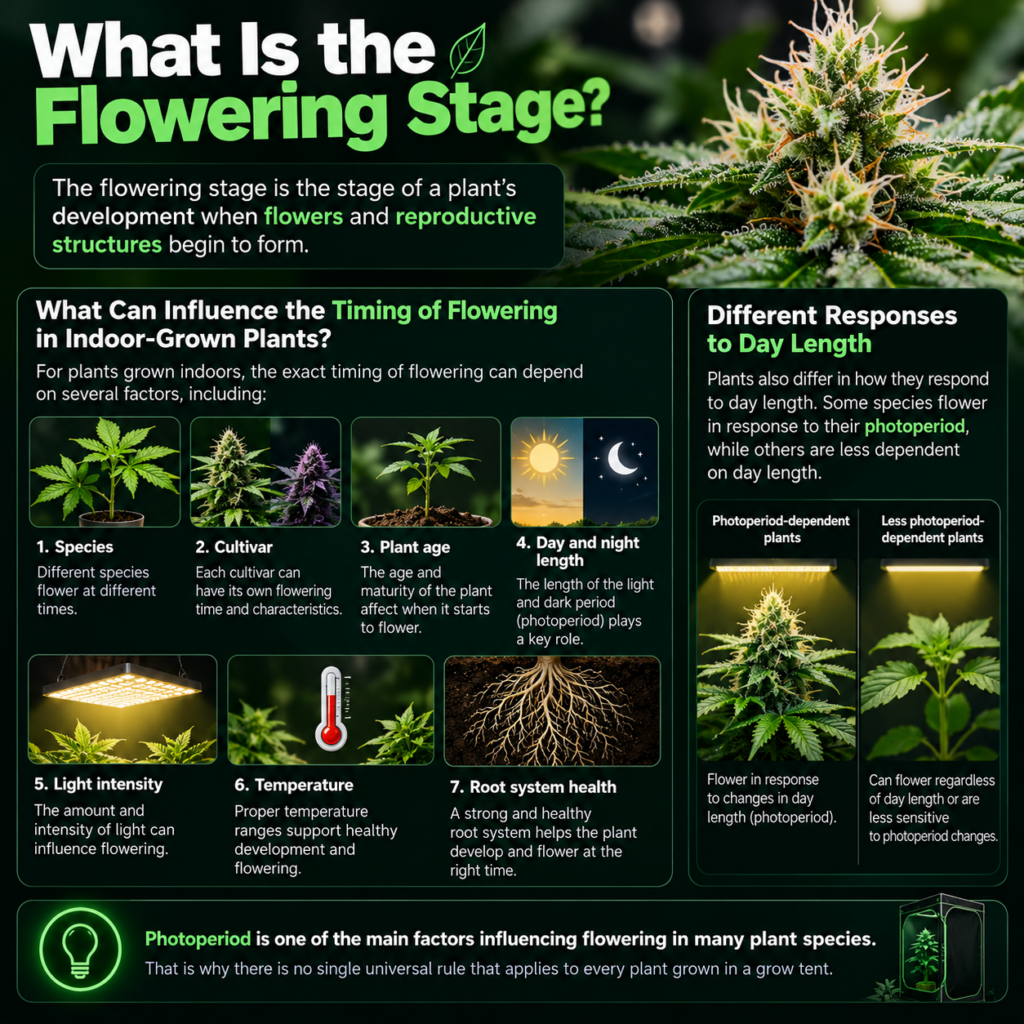
For plants grown indoors, the exact timing of flowering can depend on several factors, including:

  • species,

  • cultivar,

  • plant age,

  • day and night length,

  • light intensity,

  • temperature,

  • root system health.

Plants also differ in how they respond to day length. Some species flower in response to their photoperiod, while others are less dependent on day length. Photoperiod is one of the main factors influencing flowering in many plant species. Extension Minnesota

That is why there is no single universal rule that applies to every plant grown in a grow tent.

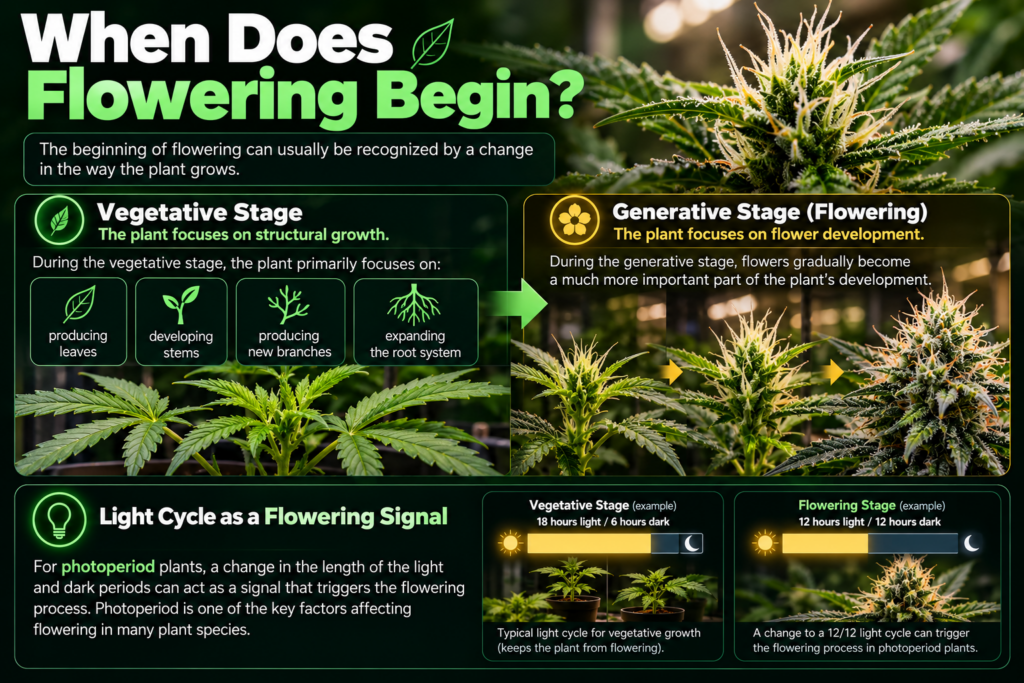
2. When Does Flowering Begin?

The beginning of flowering can usually be recognized by a change in the way the plant grows.

During the vegetative stage, the plant primarily focuses on:

  • producing leaves,

  • developing stems,

  • producing new branches,

  • expanding the root system.

During the generative stage, flowers gradually become a much more important part of the plant’s development.

For photoperiod plants, a change in the length of the light and dark periods can act as a signal that triggers the flowering process. Photoperiod is one of the key factors affecting flowering in many plant species. Extension Minnesota

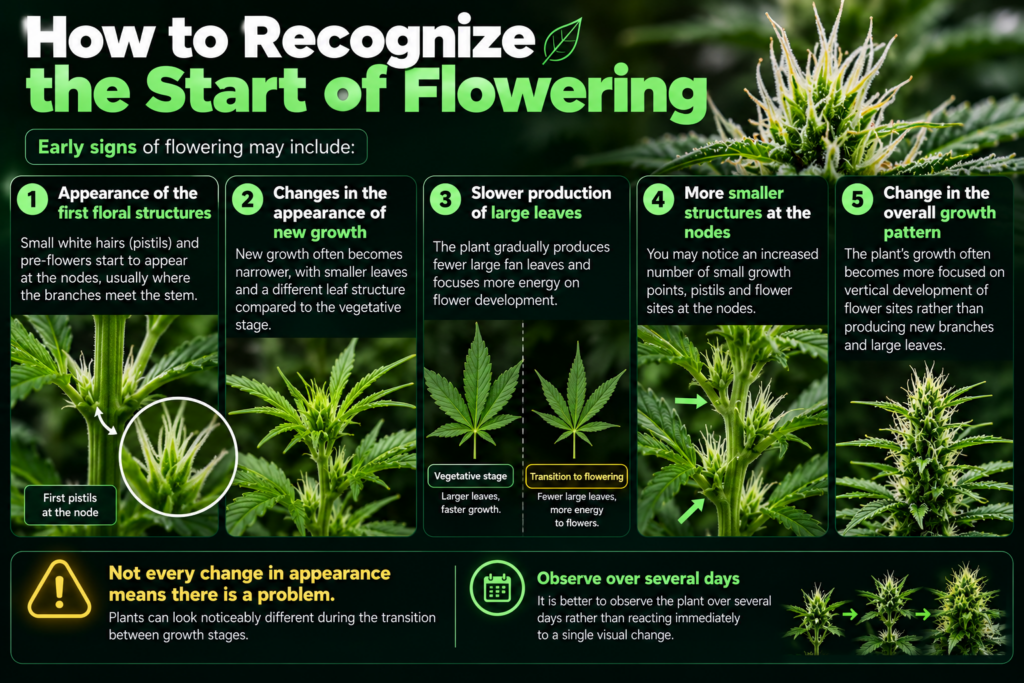
3. How to Recognize the Start of Flowering

Early signs of flowering may include:

  • the appearance of the first floral structures,

  • changes in the appearance of new growth,

  • slower production of large leaves,

  • an increased number of smaller structures at the nodes,

  • a change in the plant’s overall growth pattern.

However, it is important to remember that not every change in appearance means there is a problem.

Plants can look noticeably different during the transition between growth stages. It is therefore better to observe the plant over several days rather than reacting immediately to a single visual change.


4. What Happens to the Plant During Flowering?

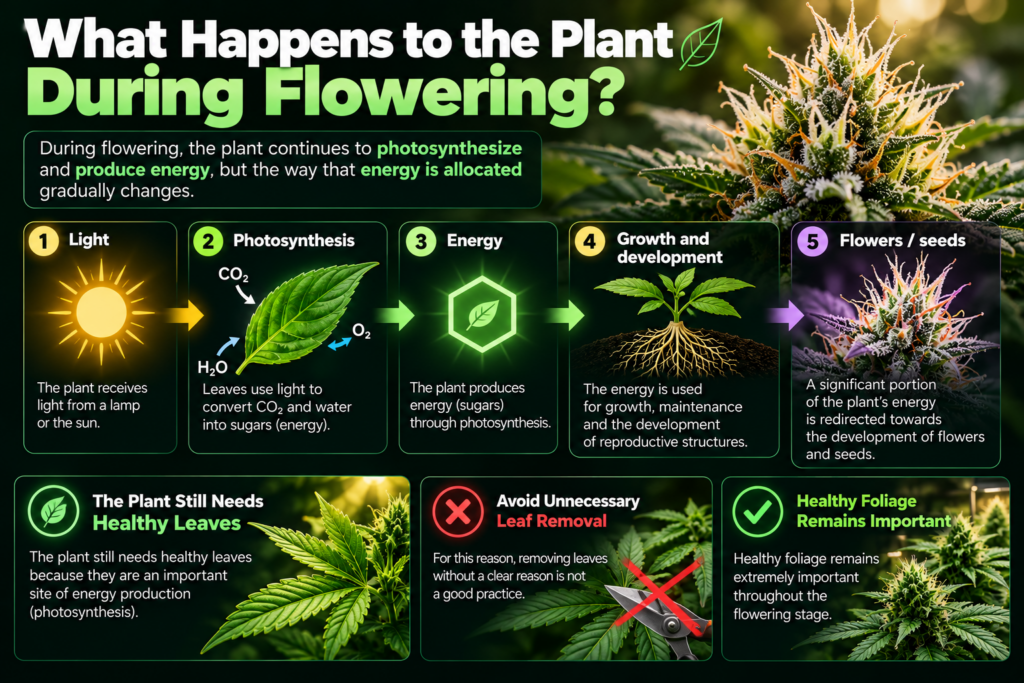
During flowering, the plant continues to photosynthesize and produce energy, but the way that energy is allocated gradually changes.

This can be simplified as:

light → photosynthesis → energy → growth and development → flowers/seeds

The plant still needs healthy leaves because they are an important site of energy production.

For this reason, removing leaves without a clear reason is not a good practice.

Healthy foliage remains extremely important throughout the flowering stage.

5. Stages of Flowering

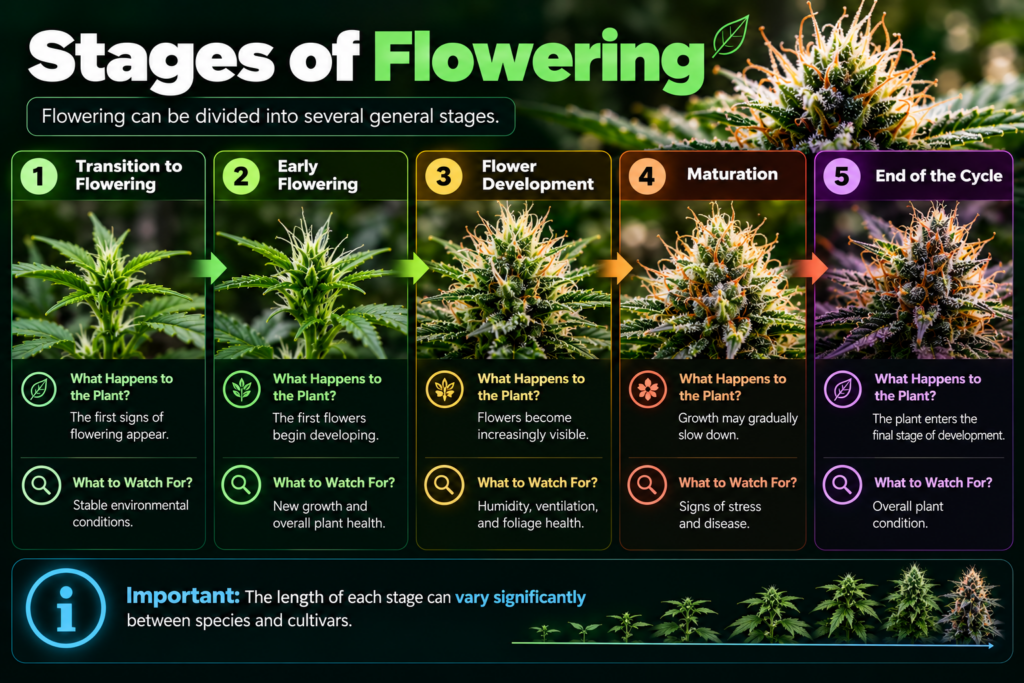
Flowering can be divided into several general stages.

StageWhat Happens to the Plant?What to Watch For?
Transition to floweringThe first signs of flowering appearStable environmental conditions
Early floweringThe first flowers begin developingNew growth and overall plant health
Flower developmentFlowers become increasingly visibleHumidity, ventilation, and foliage health
MaturationGrowth may gradually slow downSigns of stress and disease
End of the cycleThe plant enters the final stage of developmentOverall plant condition

Important: The length of each stage can vary significantly between species and cultivars.

6. Lighting During Flowering

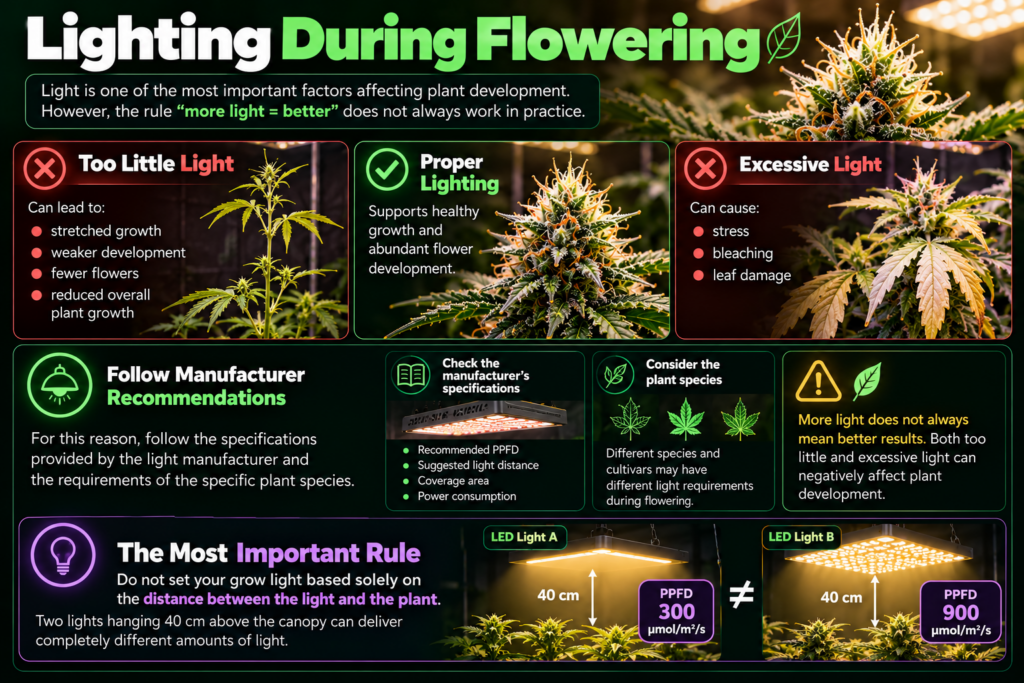
Light is one of the most important factors affecting plant development.

However, the rule “more light = better” does not always work in practice.

Too little light can lead to:

  • stretched growth,

  • weaker development,

  • fewer flowers,

  • reduced overall plant growth.

On the other hand, excessive light intensity can cause stress, bleaching, or leaf damage.

For this reason, follow the specifications provided by the light manufacturer and the requirements of the specific plant species.

The Most Important Rule

Do not set your grow light based solely on the distance between the light and the plant.

Two lights hanging 40 cm above the canopy can deliver completely different amounts of light.


7. Temperature

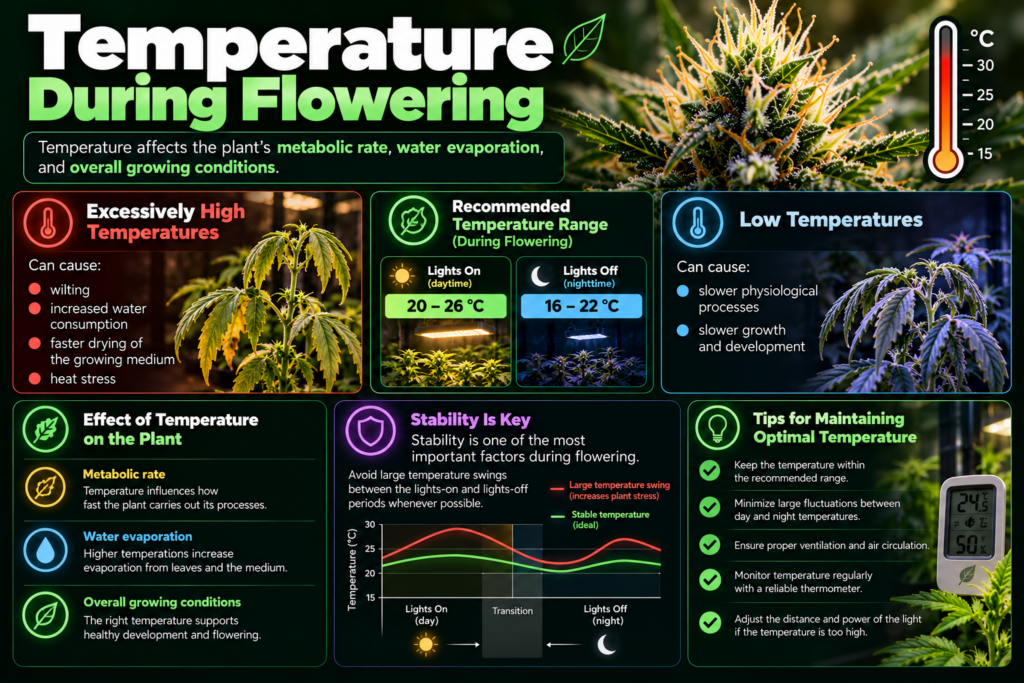
Temperature affects the plant’s metabolic rate, water evaporation, and overall growing conditions.

Excessively high temperatures can cause:

  • wilting,

  • increased water consumption,

  • faster drying of the growing medium,

  • heat stress.

Low temperatures, on the other hand, can slow down physiological processes.

That is why stability is one of the most important factors.

Avoid large temperature swings between the lights-on and lights-off periods whenever possible

8. Humidity

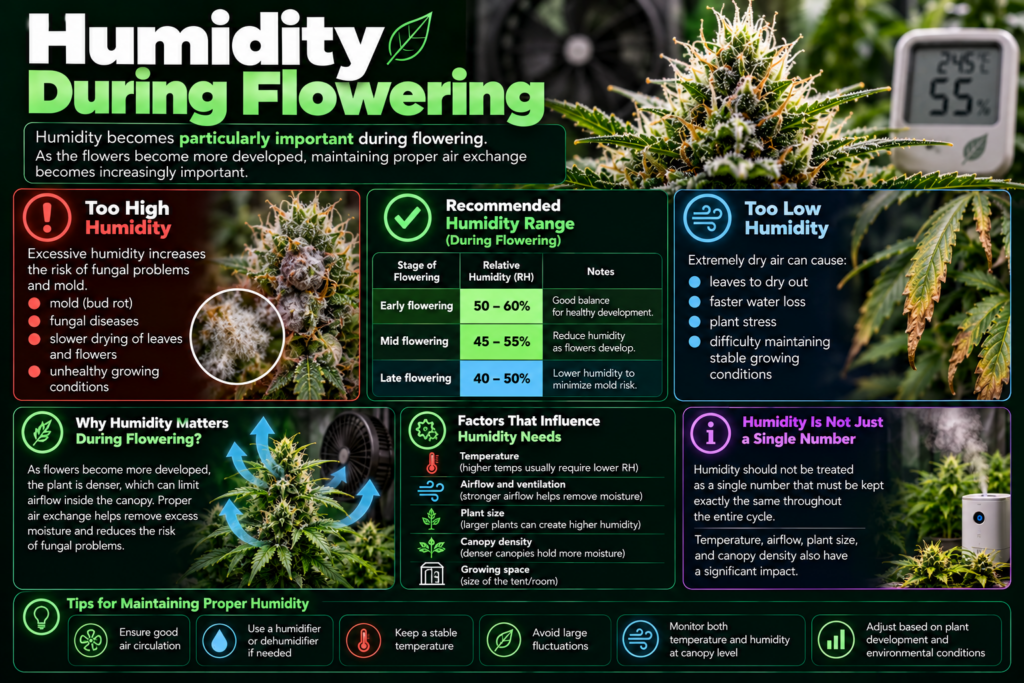
Humidity becomes particularly important during flowering.

As the flowers become more developed, maintaining proper air exchange becomes increasingly important.

Excessive humidity increases the risk of fungal problems and mold.

On the other hand, extremely dry air can cause:

  • leaves to dry out,

  • faster water loss,

  • plant stress,

  • difficulty maintaining stable growing conditions.

Humidity should therefore not be treated as a single number that must be kept exactly the same throughout the entire cycle.

Temperature, airflow, plant size, and canopy density also have a significant impact.

9. Ventilation

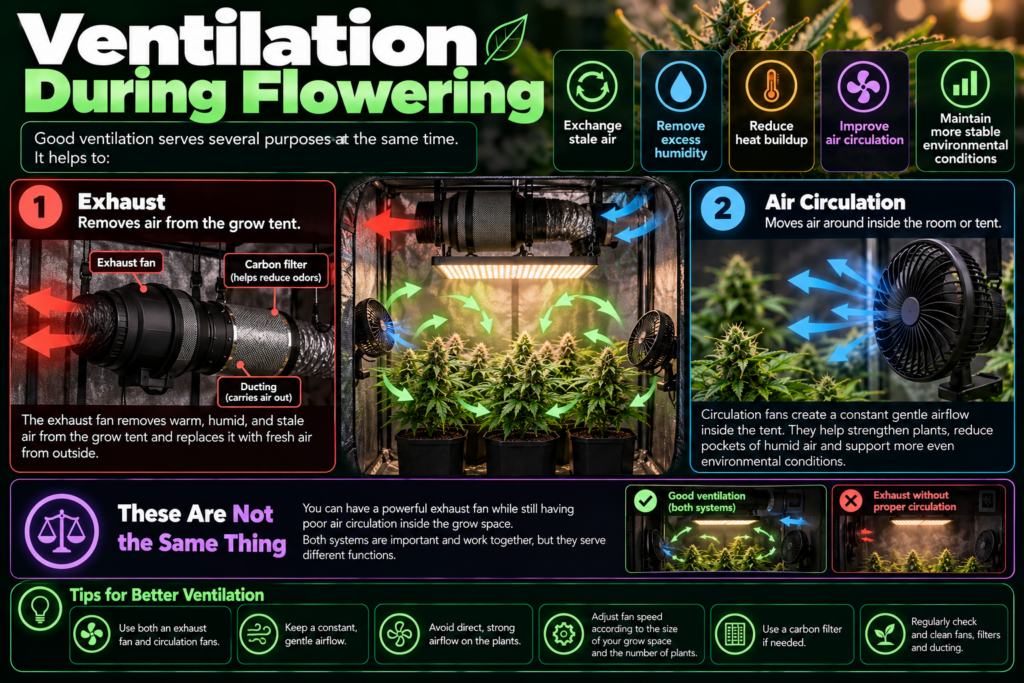
Good ventilation serves several purposes at the same time.

It helps to:

  • exchange stale air,

  • remove excess humidity,

  • reduce heat buildup,

  • improve air circulation,

  • maintain more stable environmental conditions.

Two different systems are particularly important:

Exhaust

The exhaust fan removes air from the grow tent.

Air Circulation

Circulation fans move air around inside the room or tent.

These are not exactly the same thing.

You can have a powerful exhaust fan while still having poor air circulation inside the grow space.

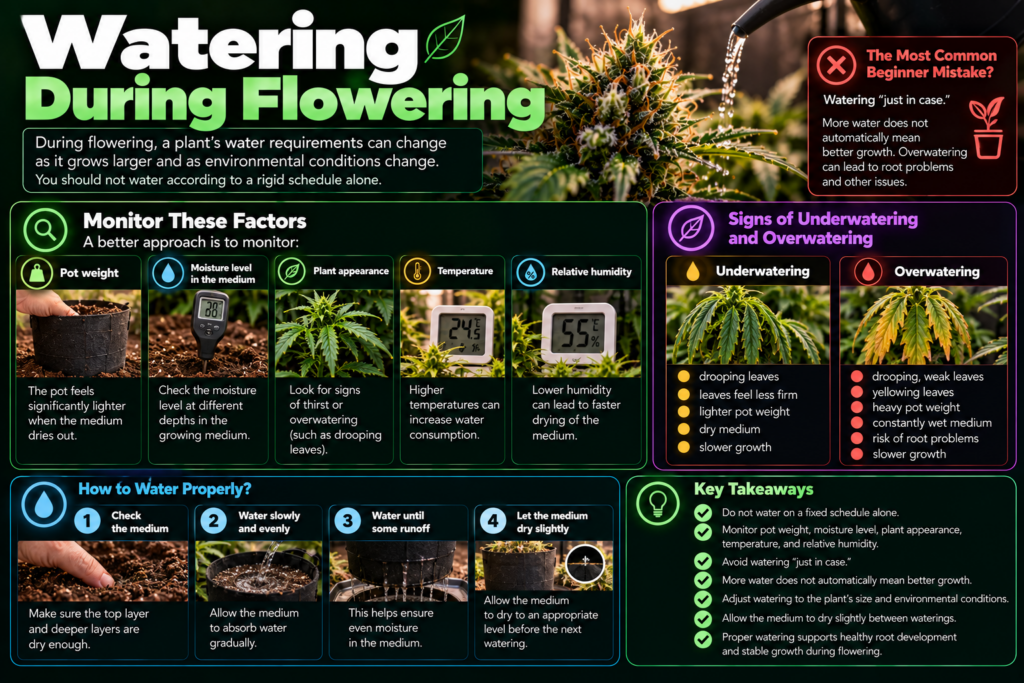
10. Watering

During flowering, a plant’s water requirements can change as it grows larger and as environmental conditions change.

However, you should not water according to a rigid schedule alone.

A better approach is to monitor:

  • pot weight,

  • moisture level in the growing medium,

  • plant appearance,

  • temperature,

  • relative humidity.

The most common beginner mistake?

Watering “just in case.”

More water does not automatically mean better growth.

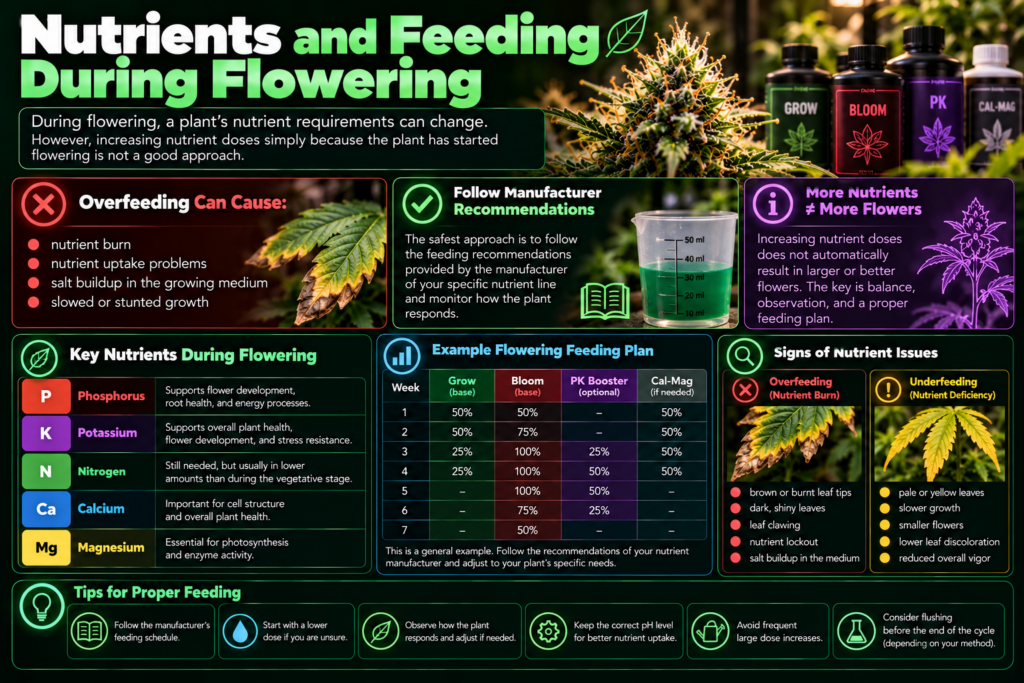
11. Nutrients and Feeding

During flowering, a plant’s nutrient requirements can change.

However, increasing nutrient doses simply because the plant has started flowering is not a good approach.

Overfeeding can cause:

  • nutrient burn,

  • nutrient uptake problems,

  • salt buildup in the growing medium,

  • slowed or stunted growth.

The safest approach is to follow the feeding recommendations provided by the manufacturer of your specific nutrient line and monitor how the plant responds.

More nutrients ≠ more flowers.

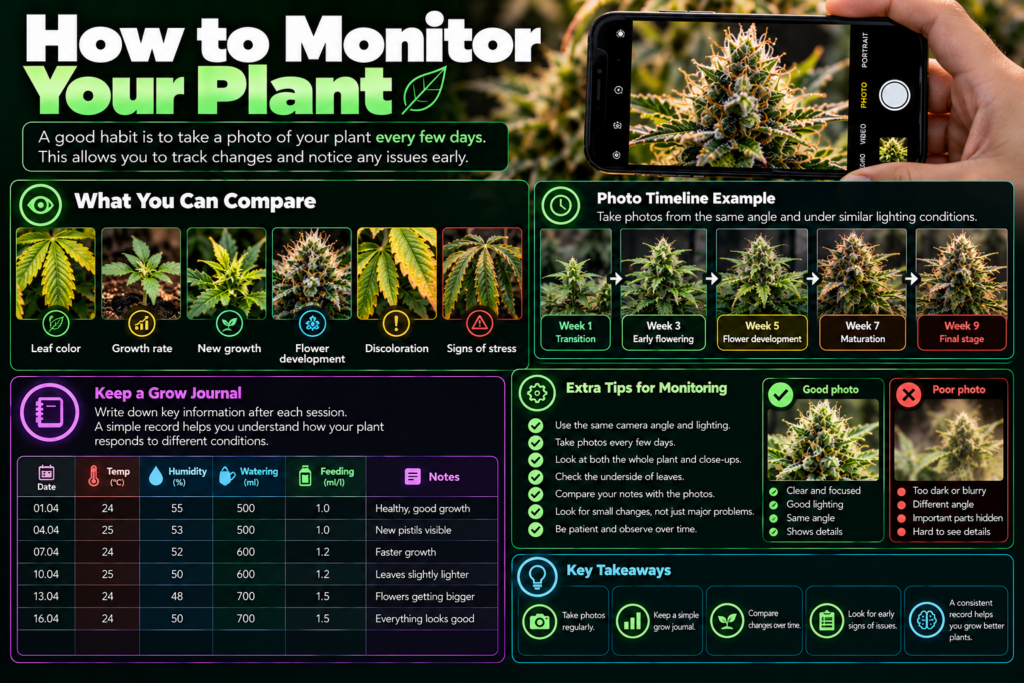
12. How to Monitor Your Plant

A good habit is to take a photo of your plant every few days.

This allows you to compare:

  • leaf color,

  • growth rate,

  • new growth,

  • flower development,

  • any discoloration,

  • signs of stress.

It is also useful to keep a simple grow journal:

Date → temperature → humidity → watering → feeding → notes

After a few weeks, you will have a very useful record of how your plant responds to different conditions.

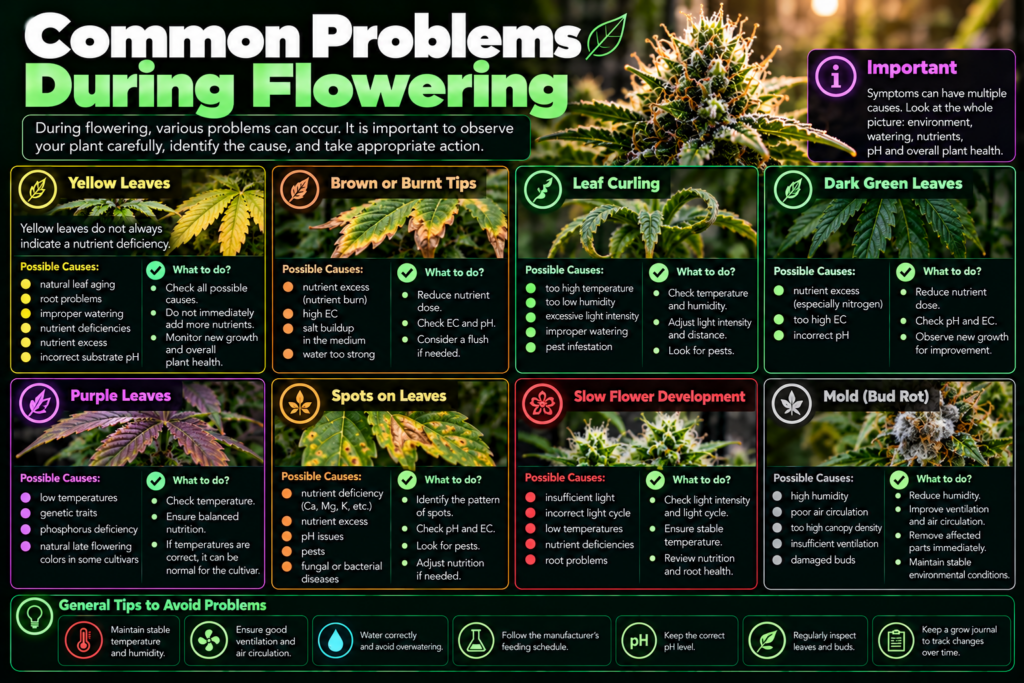
13. Common Problems During Flowering

Yellow Leaves

Yellow leaves do not always indicate a nutrient deficiency.

Possible causes include:

  • natural leaf aging,

  • root problems,

  • improper watering,

  • nutrient deficiencies,

  • nutrient excess,

  • incorrect substrate pH.

For this reason, you should not immediately add more nutrients.


Brown or Dry Leaf Tips

Possible causes include:

  • excessive nutrient levels,

  • environmental stress,

  • watering issues,

  • excessive light intensity,

  • root-zone problems.


Curling Leaves

Leaf curling can be associated with:

  • high temperatures,

  • watering problems,

  • excessive light intensity,

  • root problems.

Always check several environmental parameters at the same time rather than assuming there is only one possible cause.

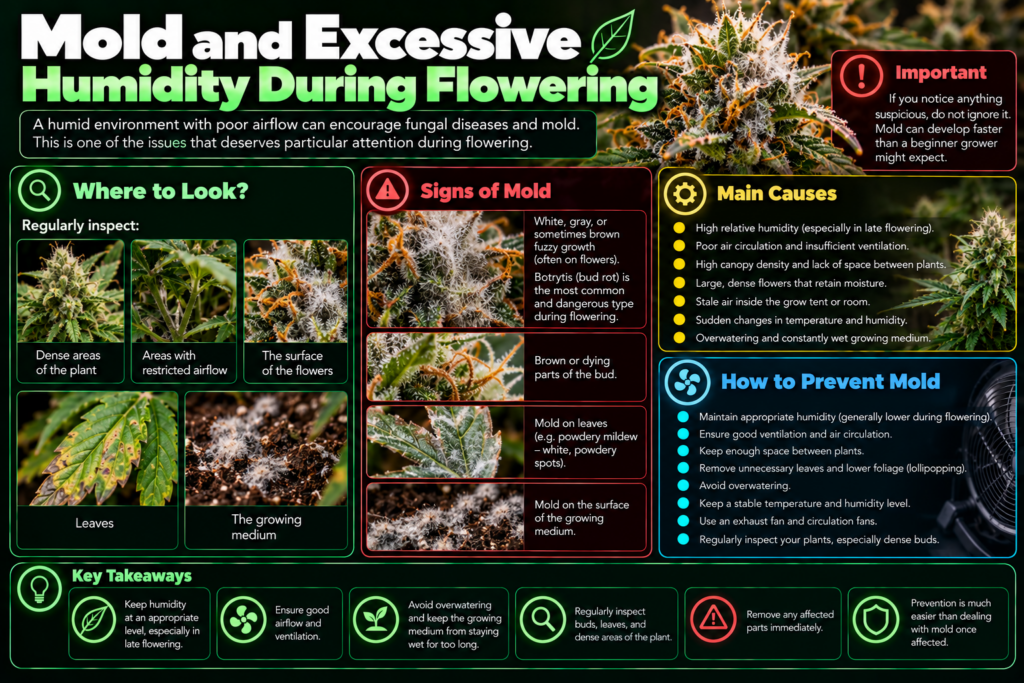
14. Mold and Excessive Humidity

This is one of the issues that deserves particular attention during flowering.

A humid environment with poor airflow can encourage fungal diseases and mold.

Regularly inspect:

  • dense areas of the plant,

  • areas with restricted airflow,

  • the surface of the flowers,

  • leaves,

  • the growing medium.

If you notice anything suspicious, do not ignore it.

Mold can develop faster than a beginner grower might expect.

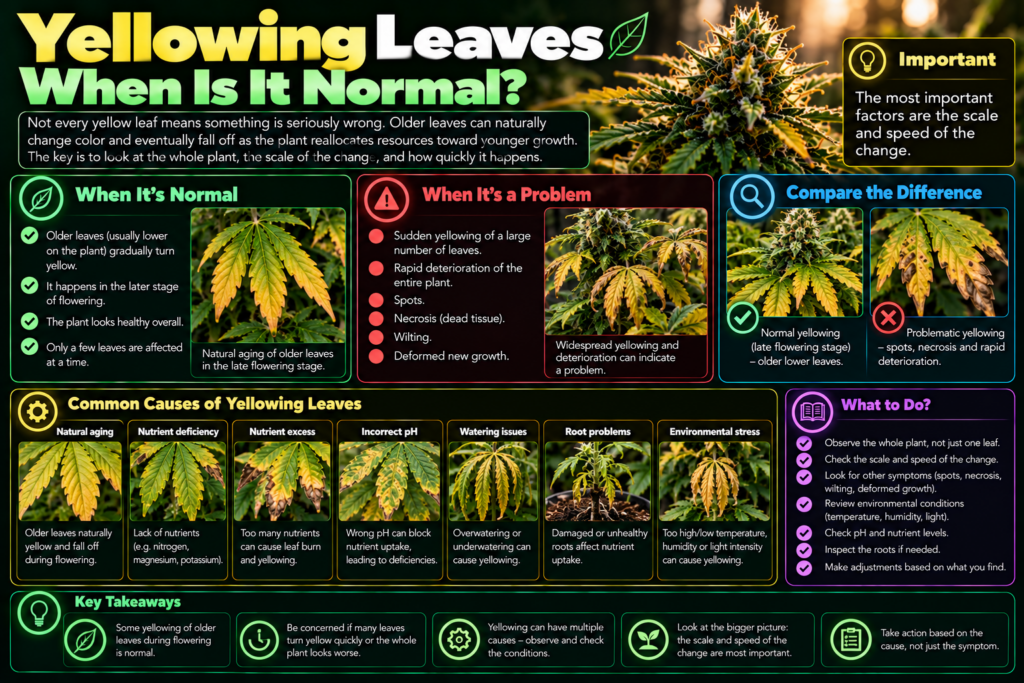
15. Yellowing Leaves – When Is It Normal?

Not every yellow leaf means something is seriously wrong.

Older leaves can naturally change color and eventually fall off as the plant reallocates resources toward younger growth.

More concerning signs include:

  • sudden yellowing of a large number of leaves,

  • rapid deterioration of the entire plant,

  • spots,

  • necrosis,

  • wilting,

  • deformed new growth.

The most important factors are the scale and speed of the change.

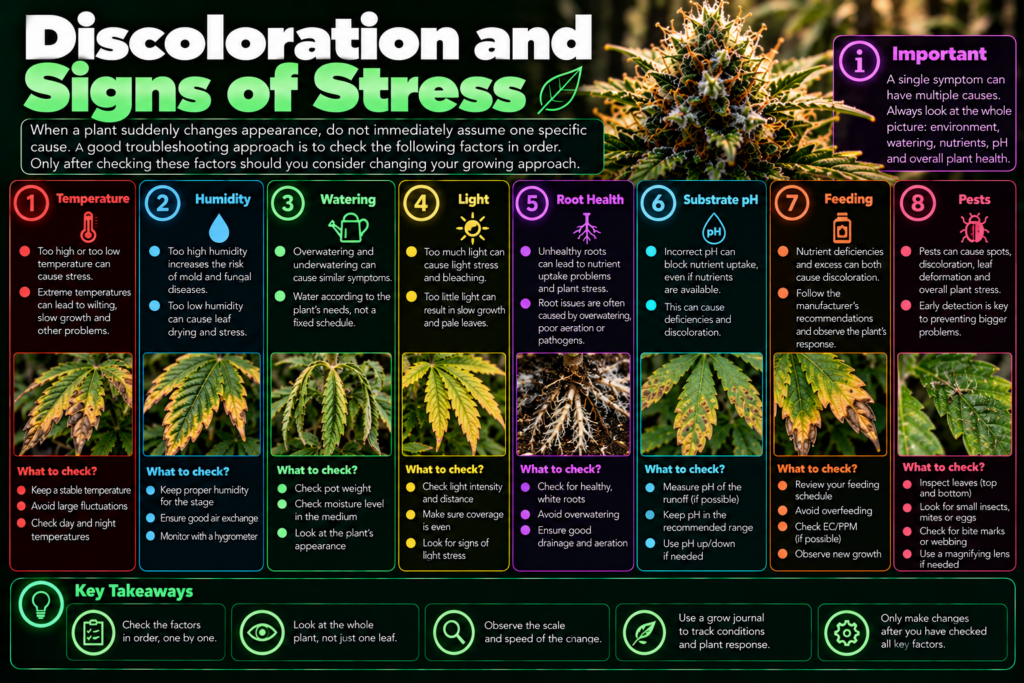
16. Discoloration and Signs of Stress

When a plant suddenly changes appearance, do not immediately assume one specific cause.

A good troubleshooting approach is to check the following in order:

  1. temperature,

  2. humidity,

  3. watering,

  4. light,

  5. root health,

  6. substrate pH,

  7. feeding,

  8. presence of pests.

Only after checking these factors should you consider changing your growing approach.

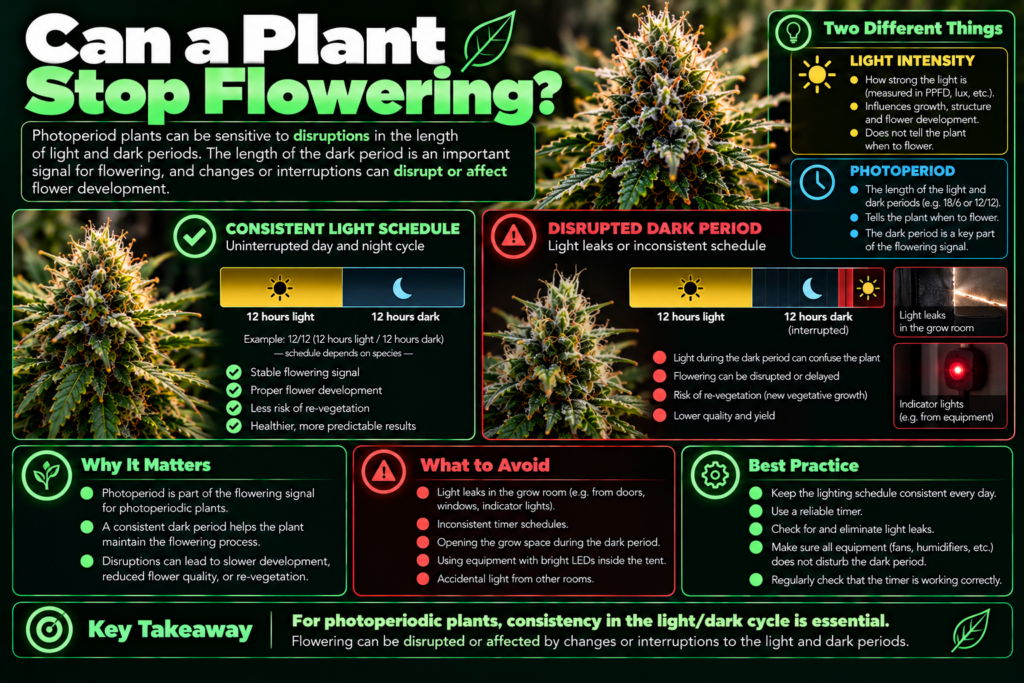
17. Can a Plant Stop Flowering?

Photoperiod plants can be particularly sensitive to disruptions in the length of the light and dark periods.

For these plants, light matters not only in terms of intensity but also in terms of photoperiod.

For photoperiodic plants, maintaining an appropriate dark period is part of the signal that regulates flowering. 

For this reason, growers should pay close attention to maintaining a consistent lighting schedule in the grow tent.

18. Flowering Checklist

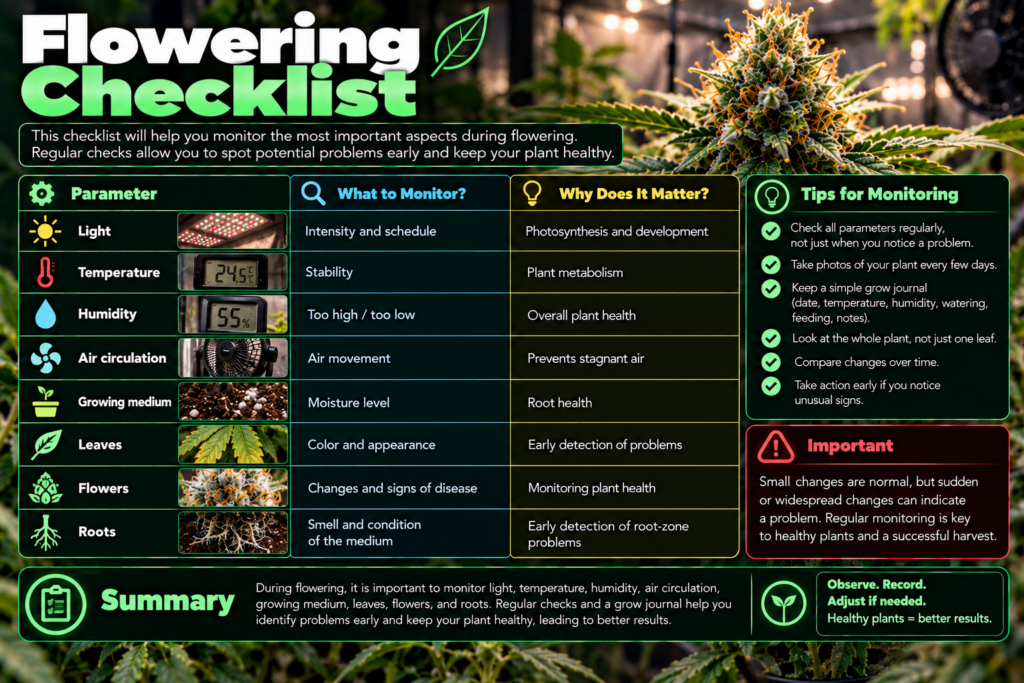
ParameterWhat to Monitor?Why Does It Matter?
LightIntensity and schedulePhotosynthesis and development
TemperatureStabilityPlant metabolism
HumidityToo high / too lowOverall plant health
Air circulationAir movementPrevents stagnant air
Growing mediumMoisture levelRoot health
LeavesColor and appearanceEarly detection of problems
FlowersChanges and signs of diseaseMonitoring plant health
RootsSmell and condition of the mediumEarly detection of root-zone problems

19. Summary

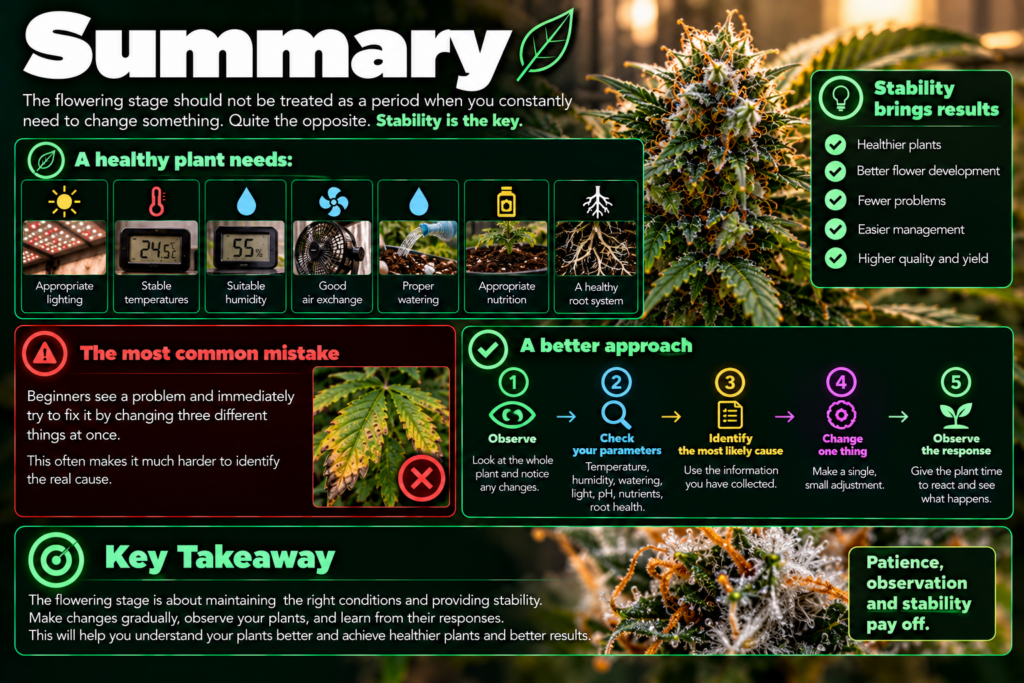
The flowering stage should not be treated as a period when you constantly need to change something.

Quite the opposite.

Stability is the key.

A healthy plant needs:

  • appropriate lighting,

  • stable temperatures,

  • suitable humidity,

  • good air exchange,

  • proper watering,

  • appropriate nutrition,

  • a healthy root system.

Beginners often make one fundamental mistake:

They see a problem and immediately try to fix it by changing three different things at once.

This often makes it much harder to identify the real cause.

A better approach is:

observe → check your parameters → identify the most likely cause → change one thing → observe the response.

This makes it much easier to learn how to read and understand your plants.

FAQ – Frequently Asked Questions

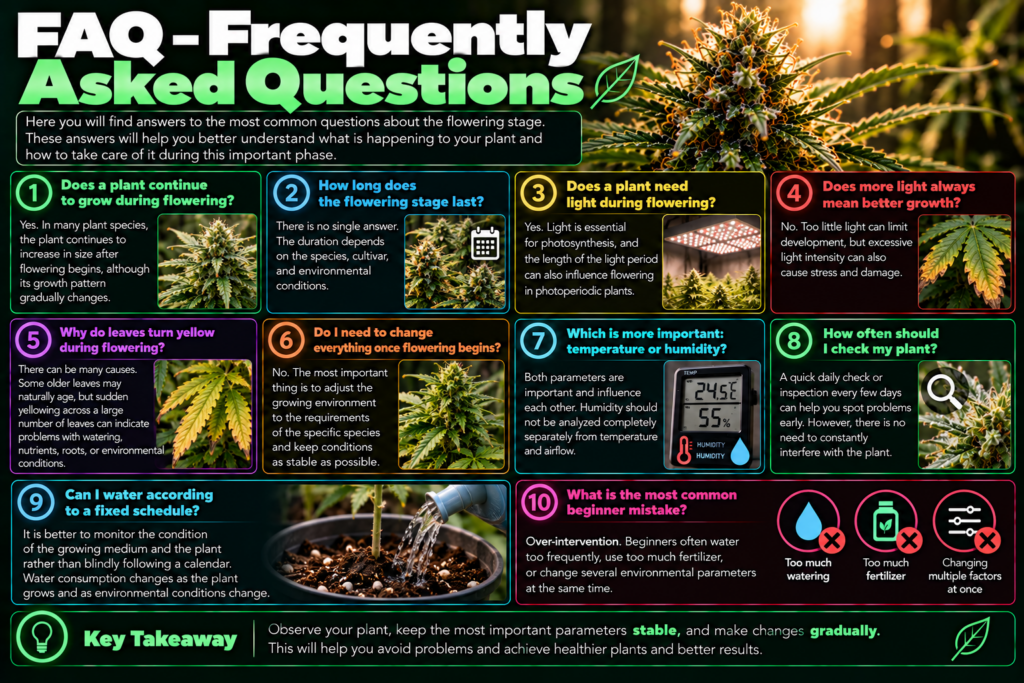
Does a plant continue to grow during flowering?

Yes. In many plant species, the plant continues to increase in size after flowering begins, although its growth pattern gradually changes.

How long does the flowering stage last?

There is no single answer. The duration depends on the species, cultivar, and environmental conditions.

Does a plant need light during flowering?

Yes. Light is essential for photosynthesis, and the length of the light period can also influence flowering in photoperiodic plants.

Does more light always mean better growth?

No. Too little light can limit development, but excessive light intensity can also cause stress and damage.

Why do leaves turn yellow during flowering?

There can be many causes. Some older leaves may naturally age, but sudden yellowing across a large number of leaves can indicate problems with watering, nutrients, roots, or environmental conditions.

Do I need to change everything once flowering begins?

No. The most important thing is to adjust the growing environment to the requirements of the specific species and keep conditions as stable as possible.

Which is more important: temperature or humidity?

Both parameters are important and influence each other. Humidity should not be analyzed completely separately from temperature and airflow.

How often should I check my plant?

A quick daily check or inspection every few days can help you spot problems early. However, there is no need to constantly interfere with the plant.

Can I water according to a fixed schedule?

It is better to monitor the condition of the growing medium and the plant rather than blindly following a calendar. Water consumption changes as the plant grows and as environmental conditions change.

What is the most common beginner mistake?

Over-intervention. Beginners often water too frequently, use too much fertilizer, or change several environmental parameters at the same time.

The Most Important Rule

Healthy plant + stable environment + regular observation = far fewer problems during flowering.

Flowering should not be a battle against the plant. It should primarily be about observing its natural development and responding when a genuine problem appears.

Shopping Cart
Scroll to Top