
How to Water in a Grow Box? A Complete Beginner’s Guide
Watering seems like one of the simplest tasks in a grow box. Just pour water into the pot and you’re done — right?
In practice, watering is actually one of the most common sources of problems for beginners. Overwatering, watering too frequently, letting the growing medium dry out too much, or giving the plant a small amount of water every single day can lead to root problems and stunted growth.
The most important thing is to understand one basic rule:
Don’t water according to the calendar. Water when the plant and growing medium need it.
As the plant grows, its water requirements also change. A small seedling needs very little water, while a large plant in the middle of flowering may use several times more water within a single day.
In this guide, we will show you step by step how to water from the moment the seedling appears all the way through the end of flowering.
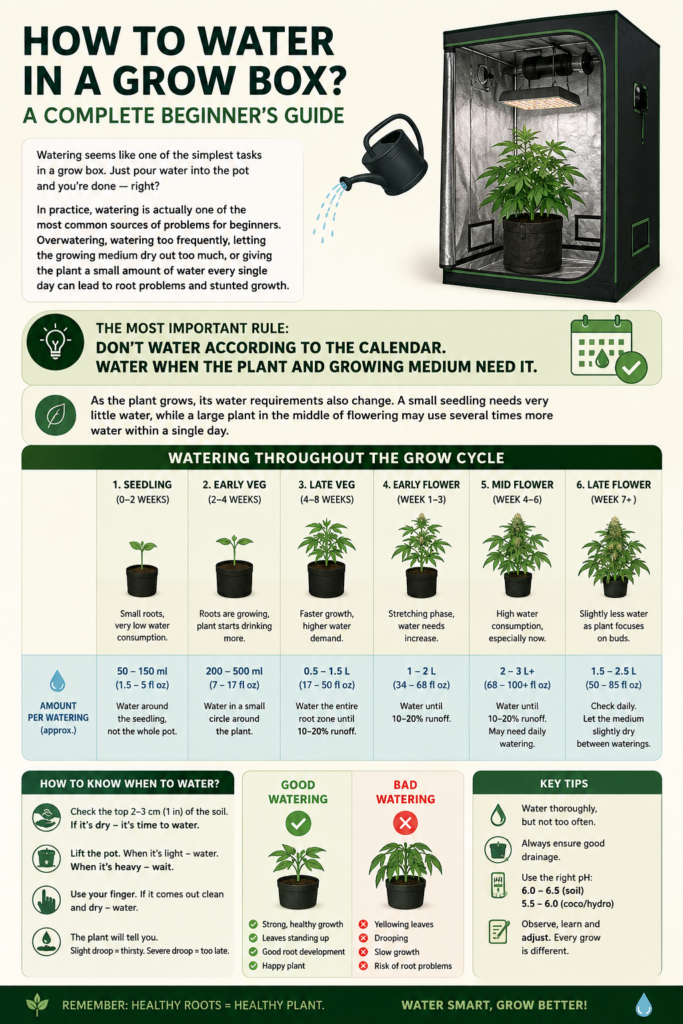
Table of Contents
- Why Is Proper Watering So Important?
- How Much Water Does a Plant Need?
- How to Check Whether You Need to Water
- Watering a Seedling
- Watering a Young Plant
- Watering During the Vegetative Stage
- Watering During Flowering
- How Much Water to Give During Each Stage?
- How to Properly Water a Pot
- Should You Water Until Runoff?
- What Does Runoff Mean?
- How Often Should You Water?
- The Effect of Temperature, Humidity and VPD
- Watering After Transplanting
- Watering in Different Growing Media
- The Most Common Beginner Mistakes
- Overwatering or Underwatering — How to Tell the Difference?
- What to Do When the Growing Medium Is Completely Dry?
- What Should the Temperature and pH of the Water Be?
- Watering Towards the End of Flowering
- The Most Important Rule: Observe the Plant
- FAQ – Frequently Asked Questions
1. Why Is Proper Watering So Important?
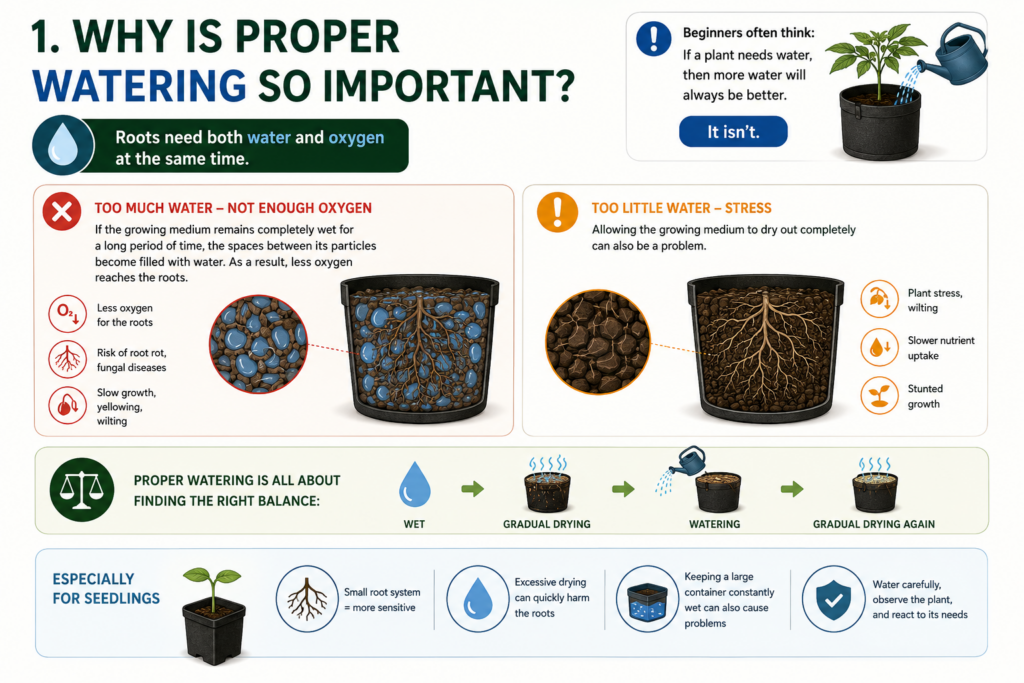
Roots need both water and oxygen at the same time.
This is very important because beginners often assume that if a plant needs water, then more water will always be better.
It isn’t.
If the growing medium remains completely wet for a long period of time, the spaces between its particles become filled with water. As a result, less oxygen reaches the roots.
On the other hand, allowing the growing medium to dry out completely can also be a problem.
That is why proper watering is primarily about finding the right balance:
wet → gradual drying → watering → gradual drying again.
Young seedlings are especially sensitive. Their root system is small, so both excessive drying and keeping an entire large container constantly wet can cause problems.
2. How Much Water Does a Plant Need?
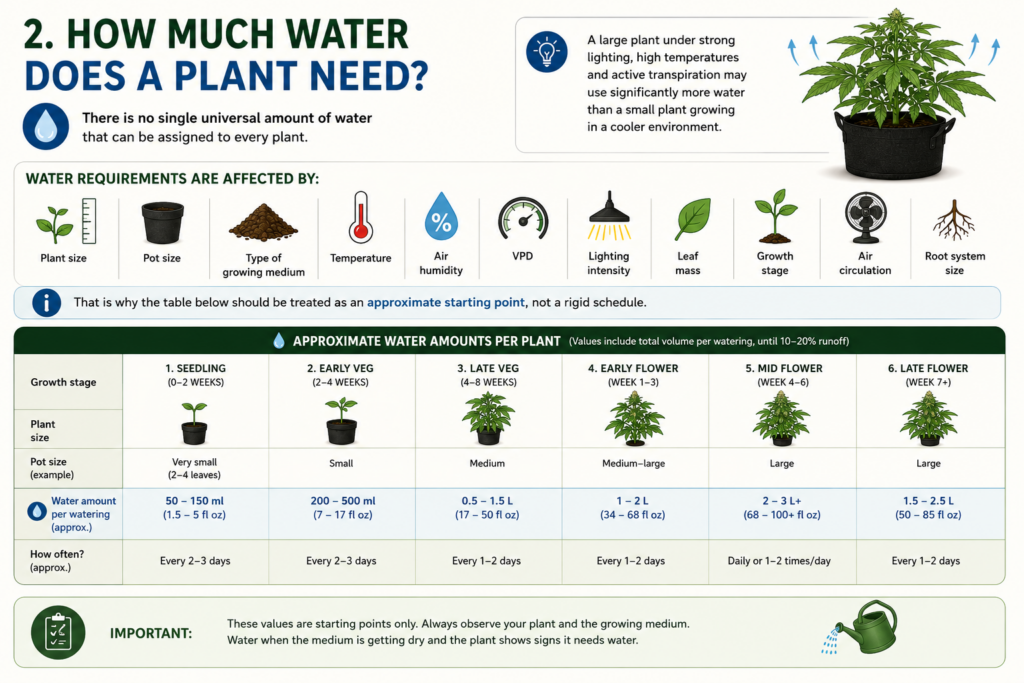
There is no single universal amount of water that can be assigned to every plant.
Water requirements are affected by, among other things:
- plant size,
- pot size,
- type of growing medium,
- temperature,
- air humidity,
- VPD,
- lighting intensity,
- leaf mass,
- growth stage,
- air circulation,
- root system size.
A large plant under strong lighting, high temperatures and active transpiration may use significantly more water than a small plant growing in a cooler environment.
That is why the table below should be treated as an approximate starting point, not a rigid schedule.
3. Approximate Water Requirements During Different Stages
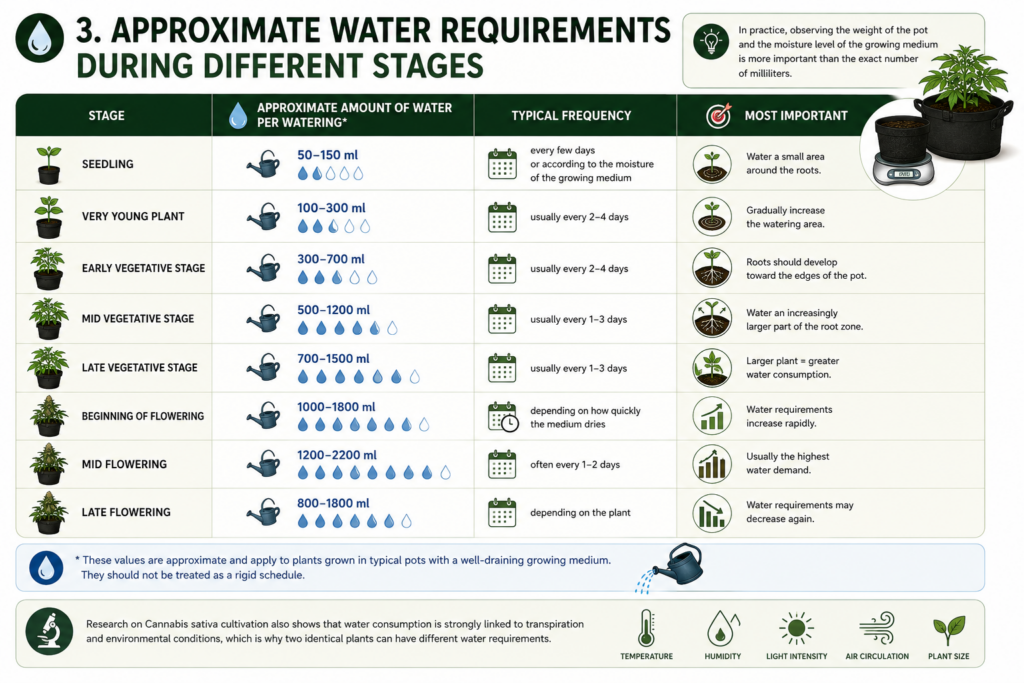
| Stage | Approximate amount of water per watering* | Typical frequency | Most important |
|---|---|---|---|
| Seedling | 50–150 ml | every few days or according to the moisture of the growing medium | Water a small area around the roots |
| Very young plant | 100–300 ml | usually every 2–4 days | Gradually increase the watering area |
| Early vegetative stage | 300–700 ml | usually every 2–4 days | Roots should develop toward the edges of the pot |
| Mid vegetative stage | 500–1200 ml | usually every 1–3 days | Water an increasingly larger part of the root zone |
| Late vegetative stage | 700–1500 ml | usually every 1–3 days | Larger plant = greater water consumption |
| Beginning of flowering | 1000–1800 ml | depending on how quickly the medium dries | Water requirements increase rapidly |
| Mid flowering | 1200–2200 ml | often every 1–2 days | Usually the highest water demand |
| Late flowering | 800–1800 ml | depending on the plant | Water requirements may decrease again |
* These values are approximate and apply to plants grown in typical pots with a well-draining growing medium. They should not be treated as a rigid schedule.
In practice, observing the weight of the pot and the moisture level of the growing medium is more important than the exact number of milliliters.
Research on Cannabis sativa cultivation also shows that water consumption is strongly linked to transpiration and environmental conditions, which is why two identical plants can have different water requirements.
4. Watering a Seedling
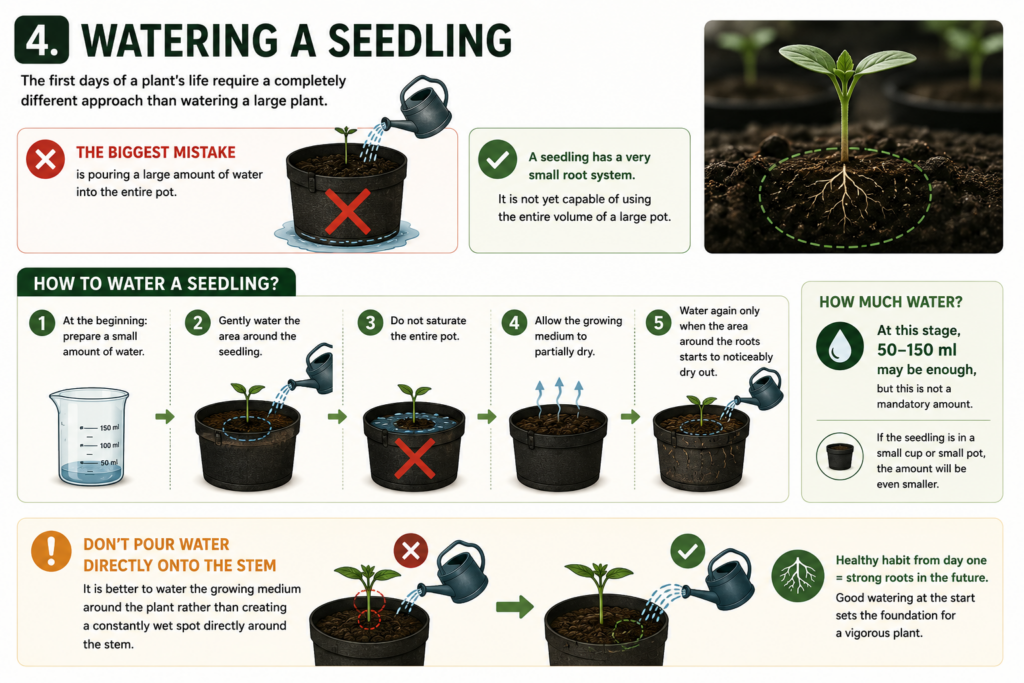
The first days of a plant’s life require a completely different approach than watering a large plant.
The biggest mistake is pouring a large amount of water into the entire pot.
A seedling has a very small root system. It is not yet capable of using the entire volume of a large pot.
How to water a seedling?
At the beginning:
- prepare a small amount of water,
- gently water the area around the seedling,
- do not saturate the entire pot,
- allow the growing medium to partially dry,
- water again only when the area around the roots starts to noticeably dry out.
At this stage, 50–150 ml may be enough, but this is not a mandatory amount.
If the seedling is in a small cup or small pot, the amount will be even smaller.
Don’t pour water directly onto the stem
It is better to water the growing medium around the plant rather than creating a constantly wet spot directly around the stem.
5. Watering a Young Plant
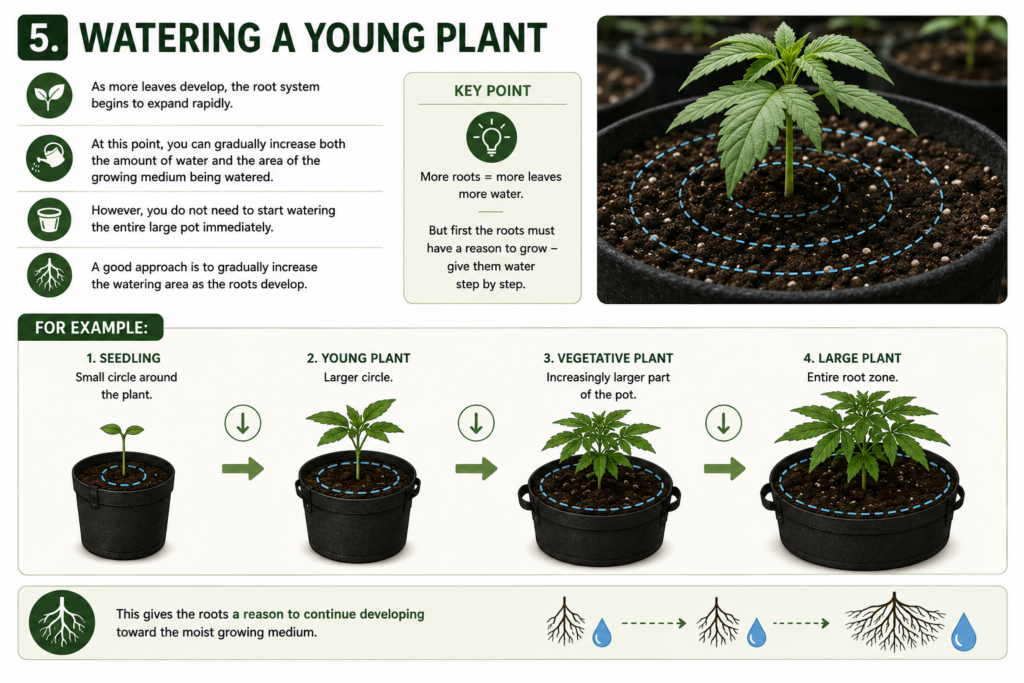
As more leaves develop, the root system begins to expand rapidly.
At this point, you can gradually increase both the amount of water and the area of the growing medium being watered.
However, you do not need to start watering the entire large pot immediately.
A good approach is to gradually increase the watering area as the roots develop.
For example:
seedling → small circle around the plant
↓
young plant → larger circle
↓
vegetative plant → increasingly larger part of the pot
↓
large plant → entire root zone
This gives the roots a reason to continue developing toward the moist growing medium.
6. Watering During the Vegetative Stage
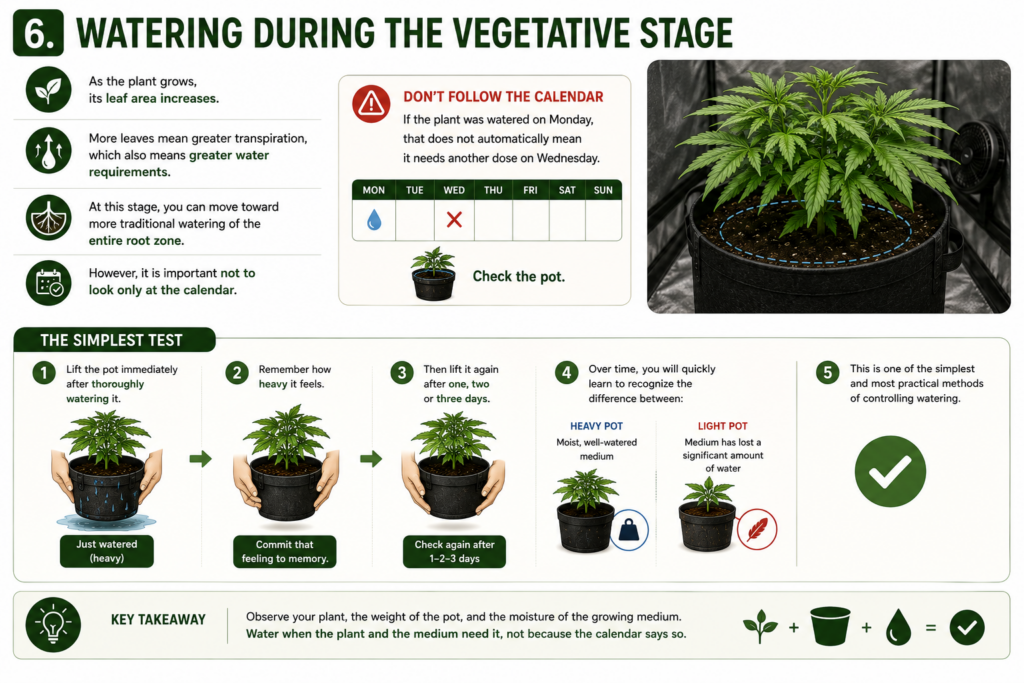
As the plant grows, its leaf area increases.
More leaves mean greater transpiration, which also means greater water requirements.
At this stage, you can move toward more traditional watering of the entire root zone.
However, it is important not to look only at the calendar.
If the plant was watered on Monday, that does not automatically mean it needs another dose on Wednesday.
Check the pot.
The simplest test
Lift the pot immediately after thoroughly watering it.
Remember how heavy it feels.
Then lift it again after one, two or three days.
Over time, you will quickly learn to recognize the difference between a heavy, moist pot and a light pot in which the growing medium has lost a significant amount of water.
This is one of the simplest and most practical methods of controlling watering.
7. Watering During Flowering
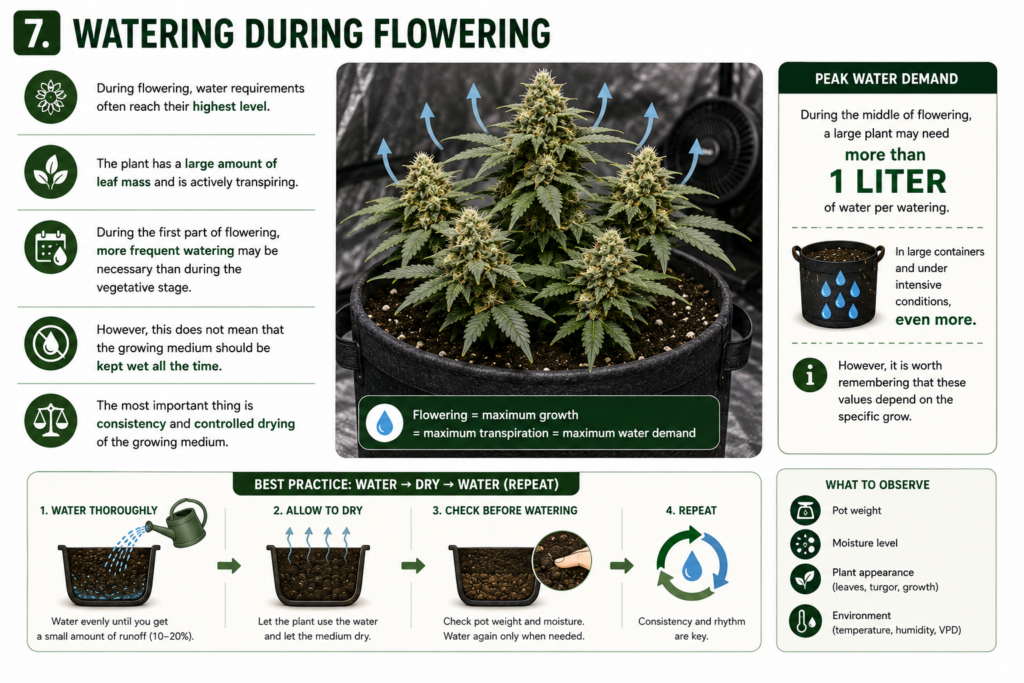
During flowering, water requirements often reach their highest level.
The plant has a large amount of leaf mass and is actively transpiring.
During the first part of flowering, more frequent watering may be necessary than during the vegetative stage.
However, this does not mean that the growing medium should be kept wet all the time.
The most important thing is consistency and controlled drying of the growing medium.
During the middle of flowering, a large plant may need more than a liter of water per watering, and in large containers and under intensive conditions, even more.
However, it is worth remembering that these values depend on the specific grow.
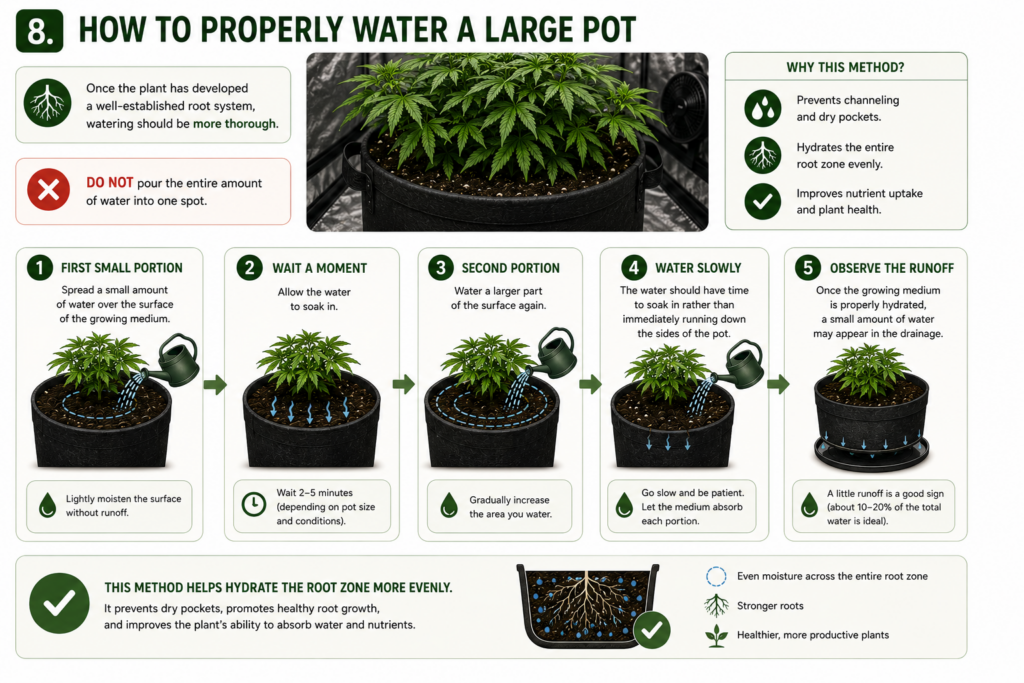
8. How to Properly Water a Large Pot
Once the plant has developed a well-established root system, watering should be more thorough.
Do not pour the entire amount of water into one spot.
A better method:
Step 1 – First small portion
Spread a small amount of water over the surface of the growing medium.
Step 2 – Wait a moment
Allow the water to soak in.
Step 3 – Second portion
Water a larger part of the surface again.
Step 4 – Water slowly
The water should have time to soak in rather than immediately running down the sides of the pot.
Step 5 – Observe the runoff
Once the growing medium is properly hydrated, a small amount of water may appear in the drainage.
This method helps hydrate the root zone more evenly.
9. Should You Water Until Runoff?
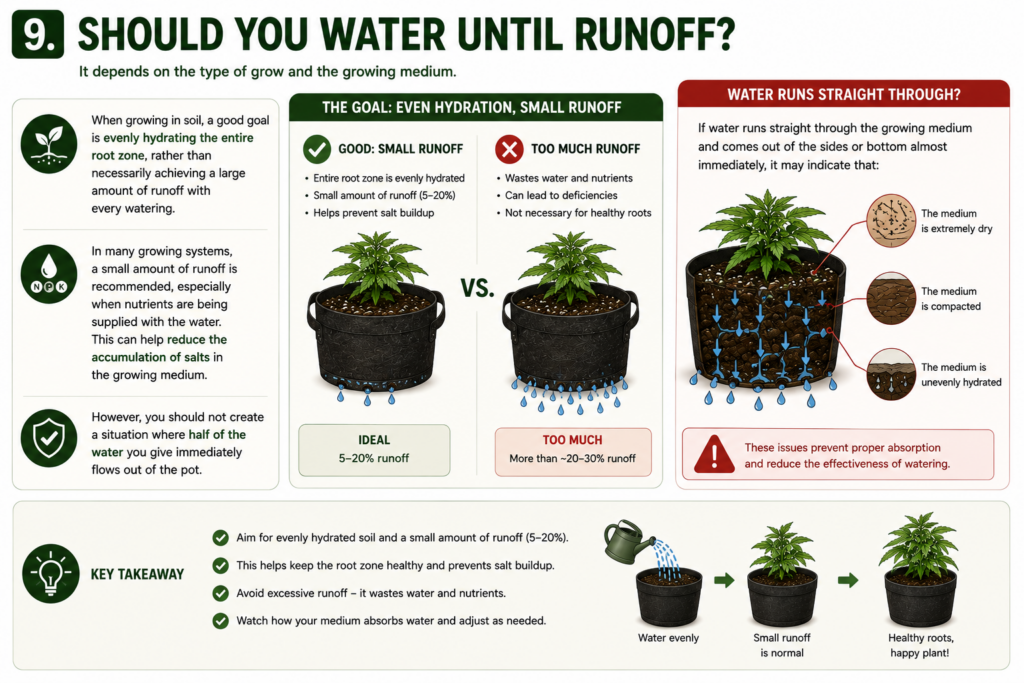
It depends on the type of grow and the growing medium.
When growing in soil, a good goal is evenly hydrating the entire root zone, rather than necessarily achieving a large amount of runoff with every watering.
In many growing systems, a small amount of runoff is recommended, especially when nutrients are being supplied with the water. This can help reduce the accumulation of salts in the growing medium.
However, you should not create a situation where half of the water you give immediately flows out of the pot.
If water runs straight through the growing medium and comes out of the sides or bottom almost immediately, it may indicate that the medium is extremely dry, compacted, or unevenly hydrated.
10. How Often Should You Water?
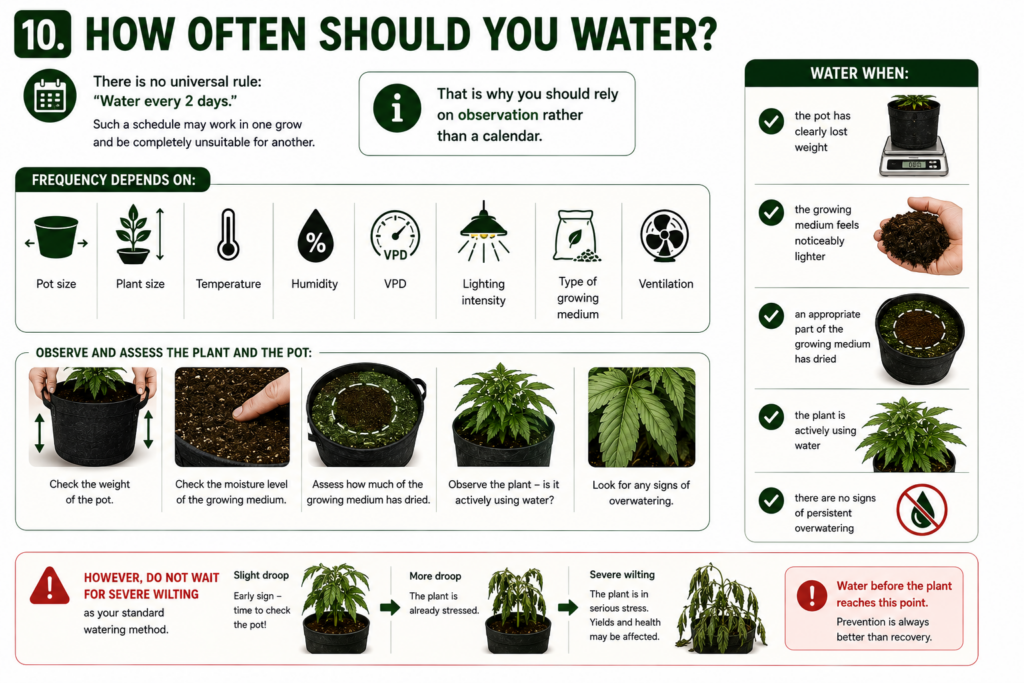
There is no universal rule:
“Water every 2 days.”
Such a schedule may work in one grow and be completely unsuitable for another.
Frequency depends on factors such as:
- pot size,
- plant size,
- temperature,
- humidity,
- VPD,
- lighting intensity,
- type of growing medium,
- ventilation.
That is why you should rely on observation rather than a calendar.
Water when:
- the pot has clearly lost weight,
- the growing medium feels noticeably lighter,
- an appropriate part of the growing medium has dried,
- the plant is actively using water,
- there are no signs of persistent overwatering.
However, do not wait for severe wilting as your standard watering method.
11. Temperature, Humidity and VPD vs. Watering
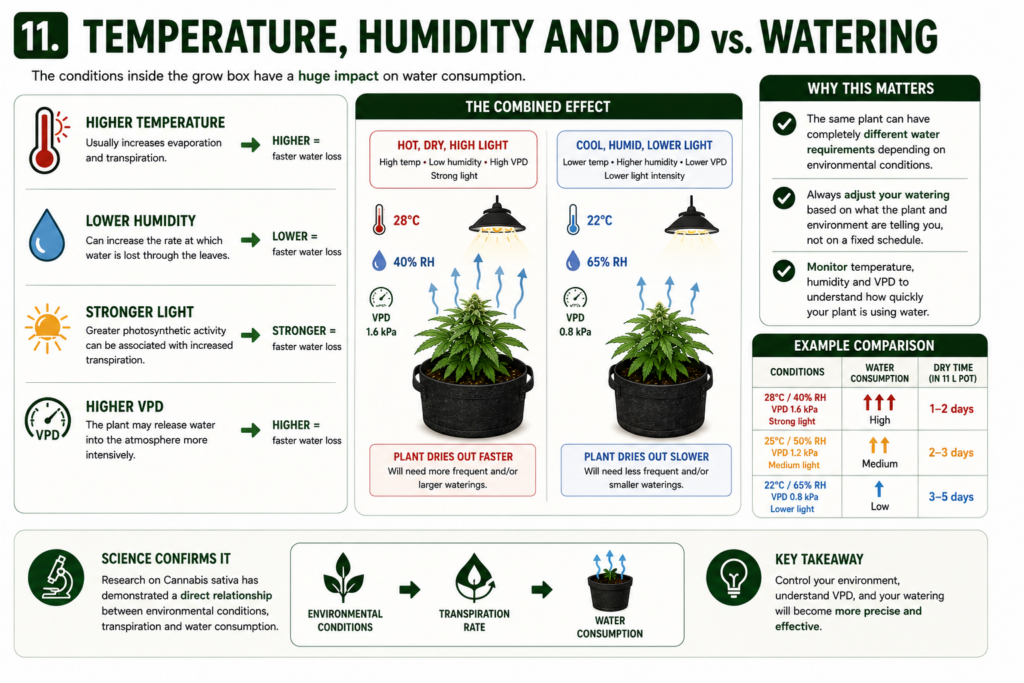
The conditions inside the grow box have a huge impact on water consumption.
Higher temperature
Usually increases evaporation and transpiration.
Lower humidity
Can increase the rate at which water is lost through the leaves.
Stronger light
Greater photosynthetic activity can be associated with increased transpiration.
Higher VPD
The plant may release water into the atmosphere more intensively.
That is why a plant growing at 28°C, low humidity and under strong light may dry out significantly faster than an identical plant in a cooler and more humid environment.
Research on Cannabis sativa has demonstrated a direct relationship between environmental conditions, transpiration and water consumption.
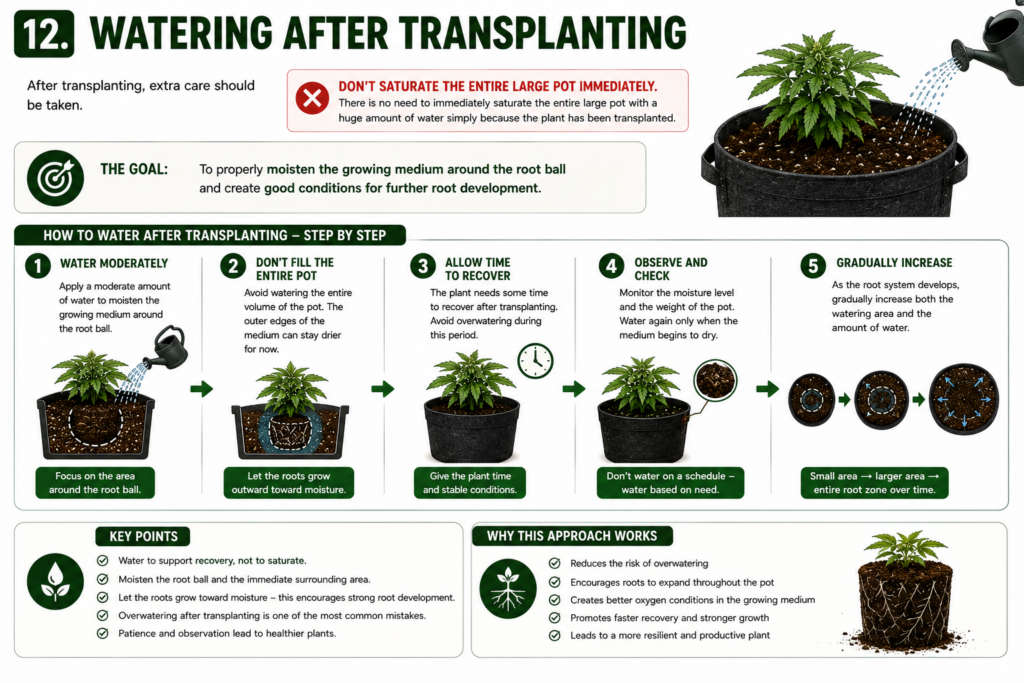
12. Watering After Transplanting
After transplanting, extra care should be taken.
There is no need to immediately saturate the entire large pot with a huge amount of water simply because the plant has been transplanted.
The goal is to properly moisten the growing medium around the root ball and create good conditions for further root development.
As the root system develops, you can gradually increase both the watering area and the amount of water supplied.
13. Watering in Different Growing Media
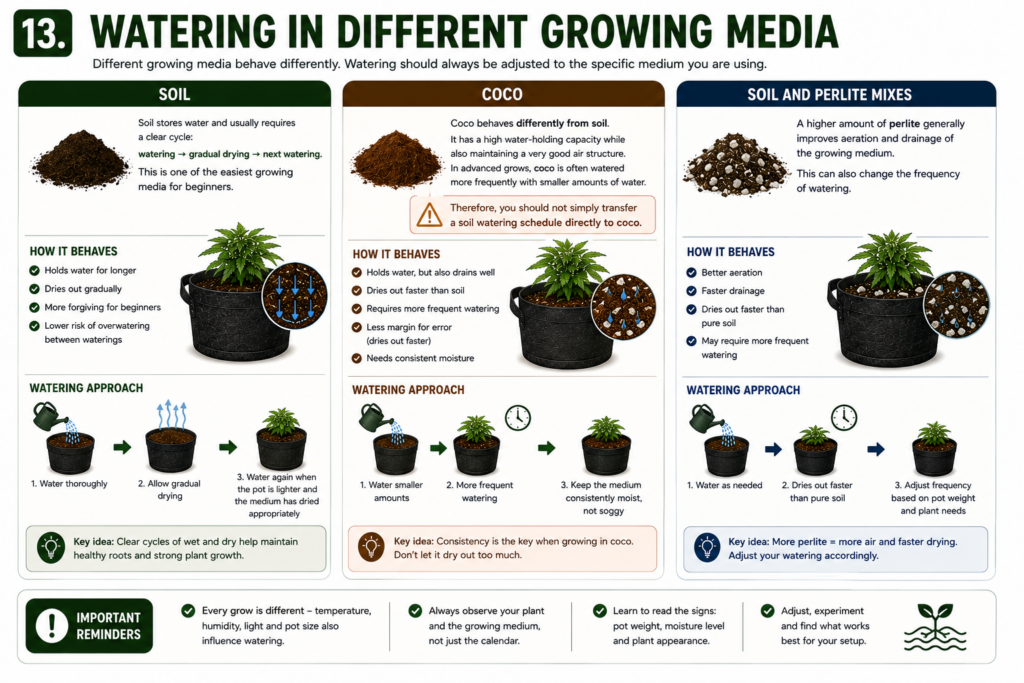
Soil
Soil stores water and usually requires a clear cycle:
watering → gradual drying → next watering.
This is one of the easiest growing media for beginners.
Coco
Coco behaves differently from soil.
It has a high water-holding capacity while also maintaining a very good air structure. In advanced grows, coco is often watered more frequently with smaller amounts of water.
Therefore, you should not simply transfer a soil watering schedule directly to coco.
Soil and Perlite Mixes
A higher amount of perlite generally improves aeration and drainage of the growing medium.
This can also change the frequency of watering.
That is why you should always take the specific mix into account.
14. The Most Common Beginner Mistakes
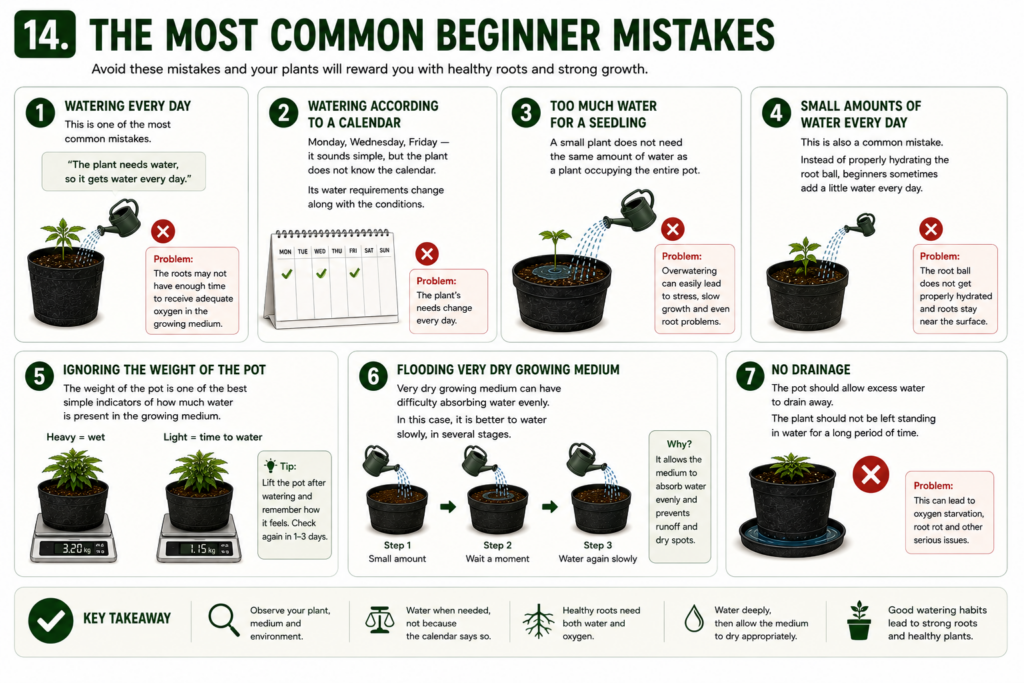
1. Watering Every Day
This is one of the most common mistakes.
“The plant needs water, so it gets water every day.”
The problem is that the roots may not have enough time to receive adequate oxygen in the growing medium.
2. Watering According to a Calendar
Monday, Wednesday, Friday — it sounds simple, but the plant does not know the calendar.
Its water requirements change along with the conditions.
3. Too Much Water for a Seedling
A small plant does not need the same amount of water as a plant occupying the entire pot.
4. Small Amounts of Water Every Day
This is also a common mistake.
Instead of properly hydrating the root ball, beginners sometimes add a little water every day.
5. Ignoring the Weight of the Pot
The weight of the pot is one of the best simple indicators of how much water is present in the growing medium.
6. Flooding Very Dry Growing Medium
Very dry growing medium can have difficulty absorbing water evenly.
In this case, it is better to water slowly, in several stages.
7. No Drainage
The pot should allow excess water to drain away.
The plant should not be left standing in water for a long period of time.
15. Overwatering or Underwatering?
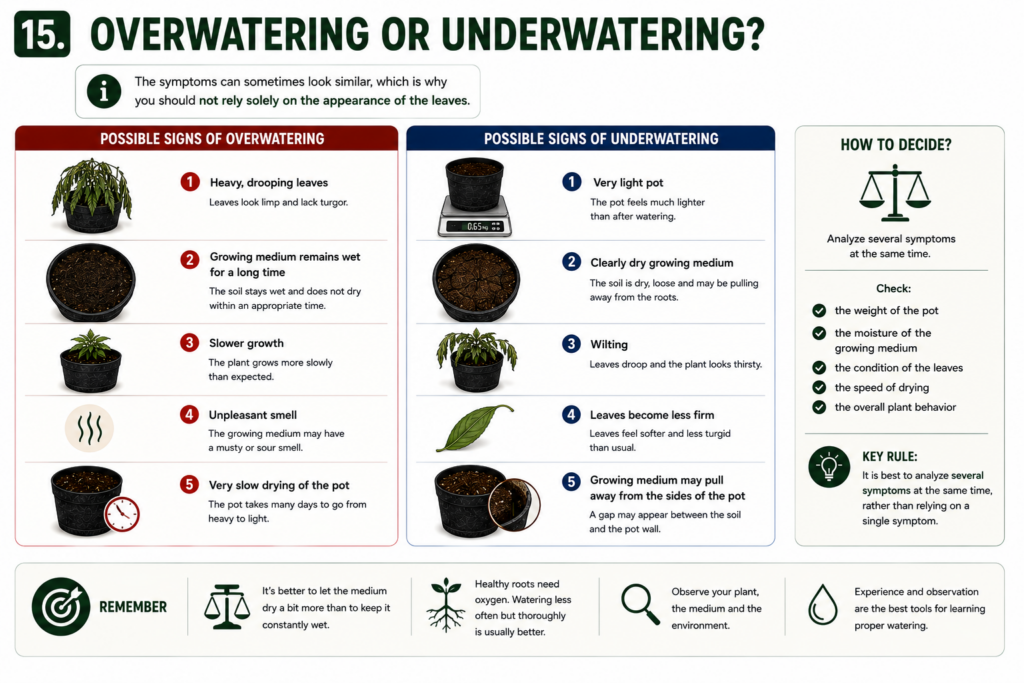
The symptoms can sometimes look similar, which is why you should not rely solely on the appearance of the leaves.
Possible signs of overwatering:
- heavy, drooping leaves,
- growing medium remains wet for a long time,
- slower growth,
- unpleasant smell from the growing medium,
- very slow drying of the pot.
Possible signs of underwatering:
- very light pot,
- clearly dry growing medium,
- wilting,
- leaves become less firm,
- growing medium may pull away from the sides of the pot.
It is best to analyze several symptoms at the same time, rather than relying on a single symptom.
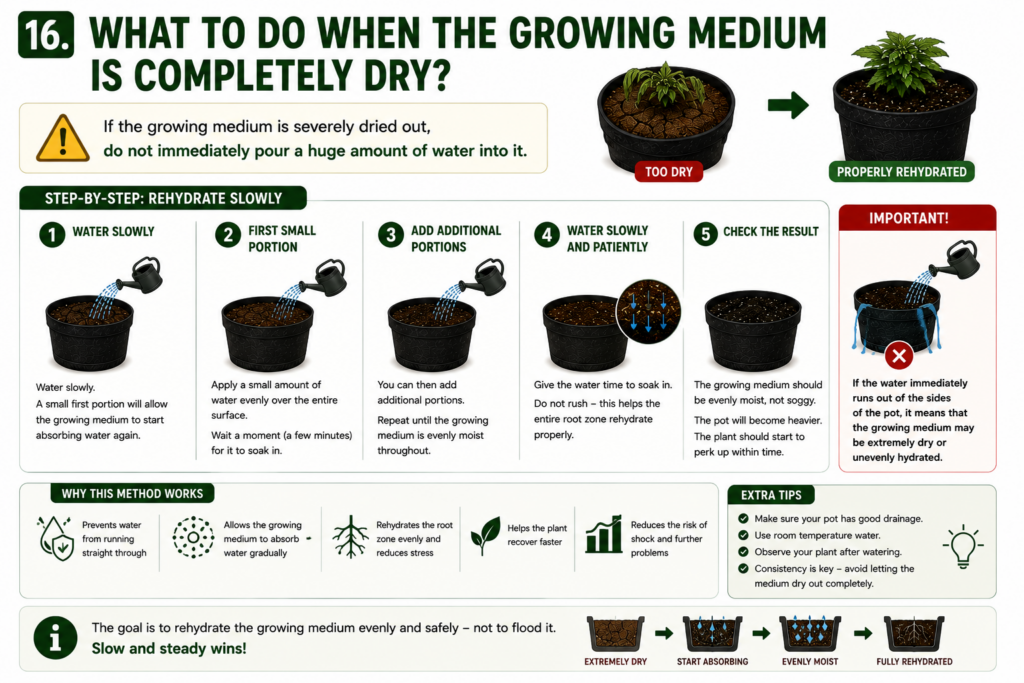
16. What to Do When the Growing Medium Is Completely Dry?
If the growing medium is severely dried out, do not immediately pour a huge amount of water into it.
Water slowly.
A small first portion will allow the growing medium to start absorbing water again.
You can then add additional portions.
If the water immediately runs out of the sides of the pot, it means that the growing medium may be extremely dry or unevenly hydrated.
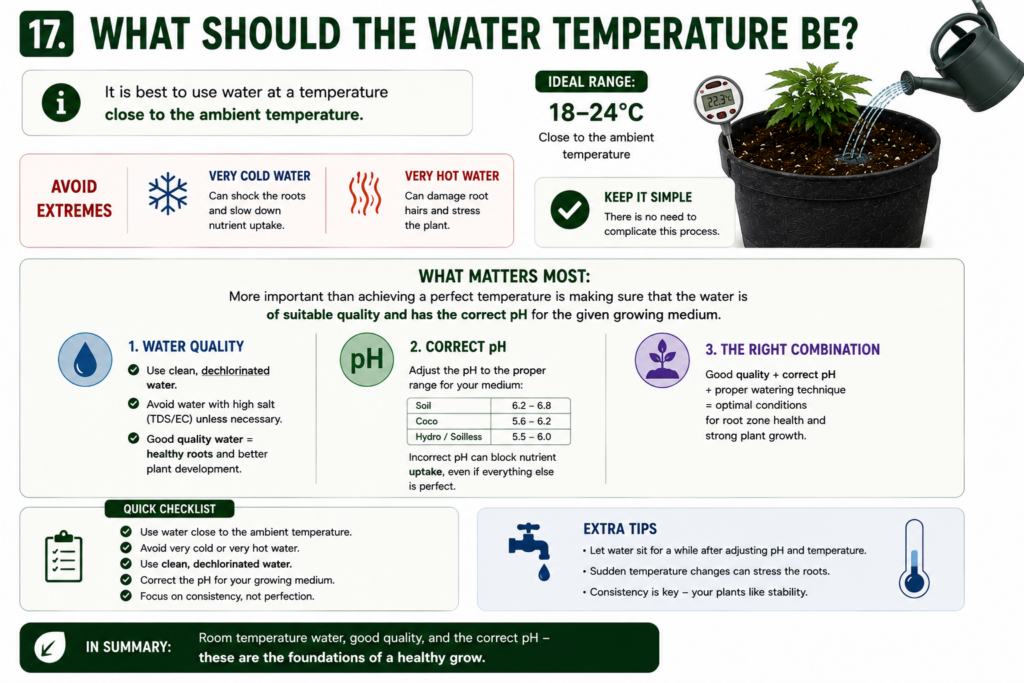
17. What Should the Water Temperature Be?
It is best to use water at a temperature close to the ambient temperature.
Avoid very cold or very hot water.
There is no need to complicate this process.
More important than achieving a perfect temperature is making sure that the water is of suitable quality and has the correct pH for the given growing medium.
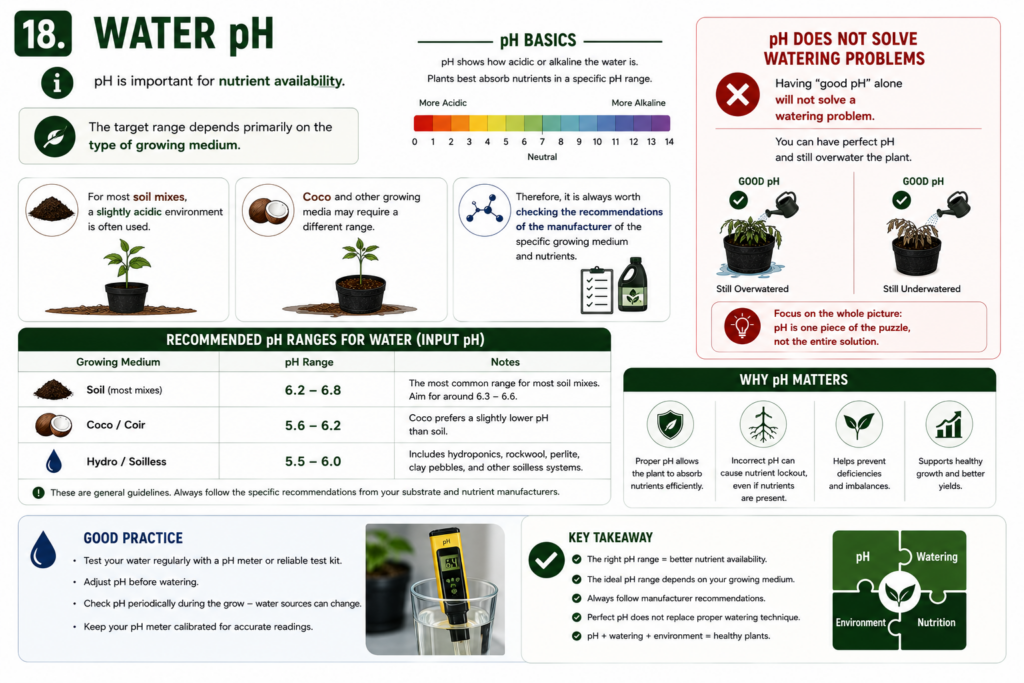
18. Water pH
pH is important for nutrient availability.
The target range depends primarily on the type of growing medium.
For most soil mixes, a slightly acidic environment is often used, while coco and other growing media may require a different range.
Therefore, it is always worth checking the recommendations of the manufacturer of the specific growing medium and nutrients.
Having “good pH” alone will not solve a watering problem.
You can have perfect pH and still overwater the plant.
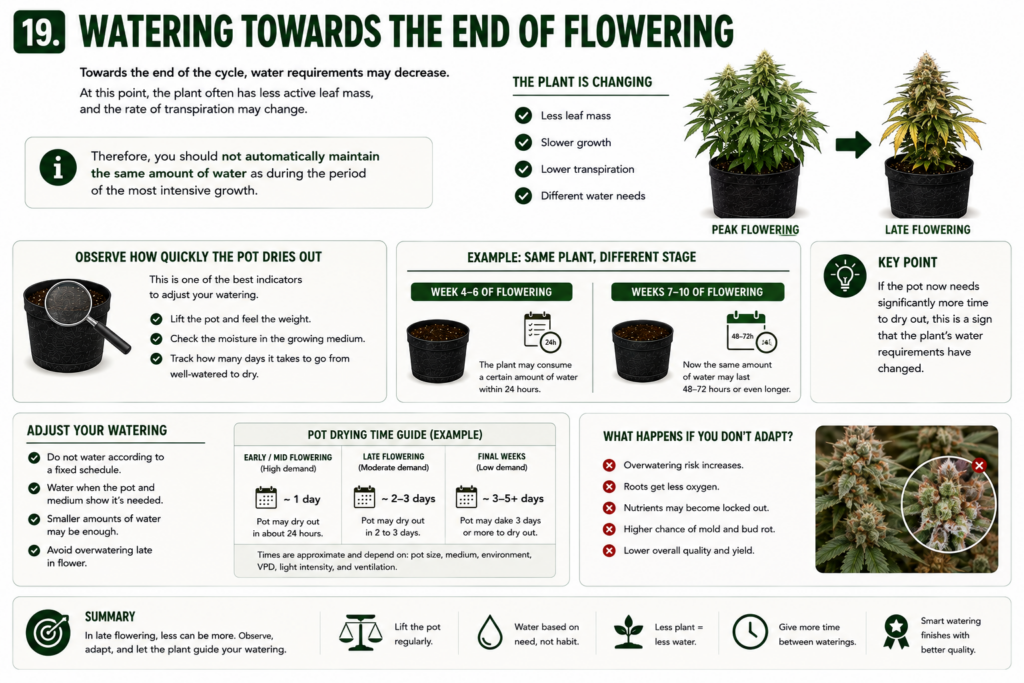
19. Watering Towards the End of Flowering
Towards the end of the cycle, water requirements may decrease.
At this point, the plant often has less active leaf mass, and the rate of transpiration may change.
Therefore, you should not automatically maintain the same amount of water as during the period of the most intensive growth.
Observe how quickly the pot dries out.
If the plant previously consumed a certain amount of water within 24 hours, but now needs significantly more time, this is a sign that its water requirements have changed.
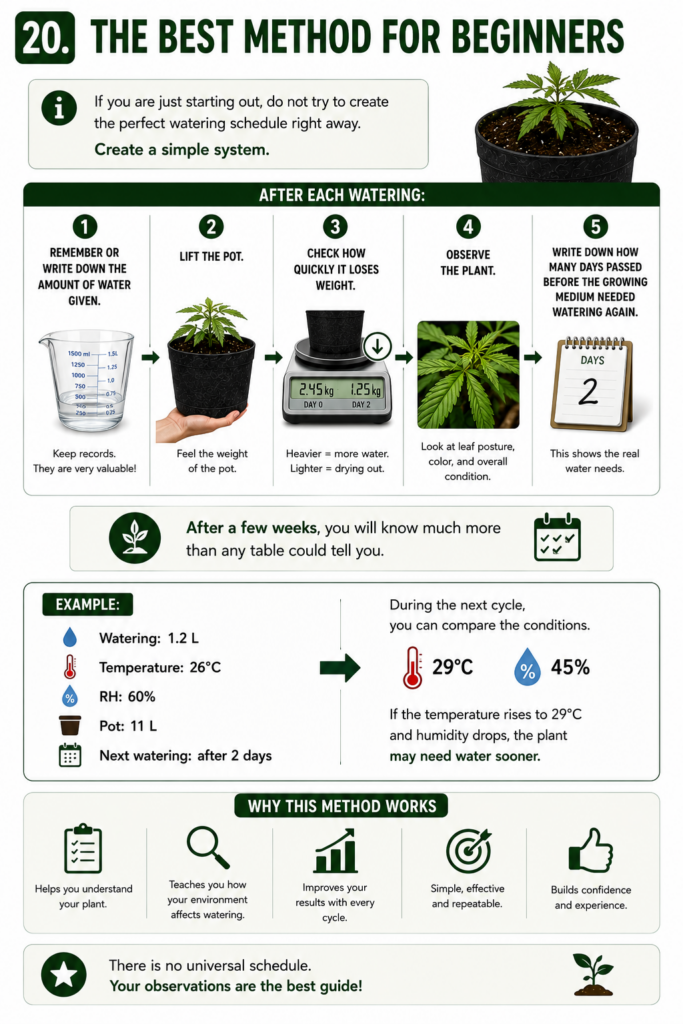
20. The Best Method for Beginners
If you are just starting out, do not try to create the perfect watering schedule right away.
Create a simple system.
After each watering:
1. Remember or write down the amount of water given.
2. Lift the pot.
3. Check how quickly it loses weight.
4. Observe the plant.
5. Write down how many days passed before the growing medium needed watering again.
After a few weeks, you will know much more than any table could tell you.
Example:
Watering: 1.2 L
Temperature: 26°C
RH: 60%
Pot: 11 L
Next watering: after 2 days
During the next cycle, you can compare the conditions.
If the temperature rises to 29°C and humidity drops, the plant may need water sooner.
21. The Most Important Rule
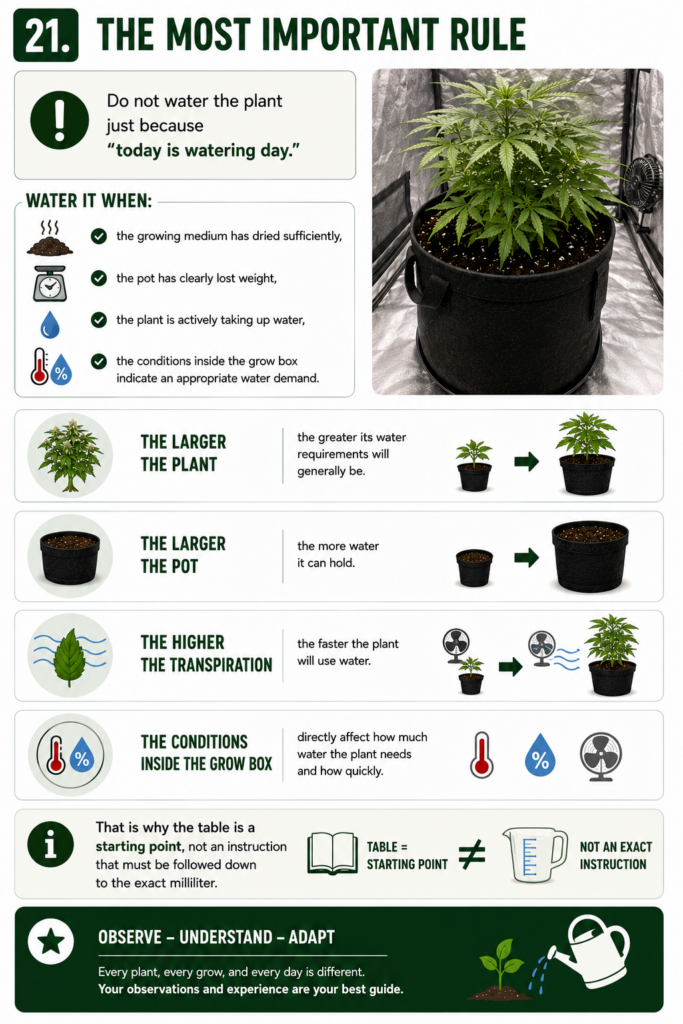
Do not water the plant just because “today is watering day.”
Water it when:
- the growing medium has dried sufficiently,
- the pot has clearly lost weight,
- the plant is actively taking up water,
- the conditions inside the grow box indicate an appropriate water demand.
The larger the plant, the greater its water requirements will generally be.
The larger the pot, the more water it can hold.
The higher the transpiration, the faster the plant will use water.
That is why the table is a starting point, not an instruction that must be followed down to the exact milliliter.
FAQ – Frequently Asked Questions
Does the plant need to be watered every day?
No. Watering frequency depends on the size of the plant, pot, growing medium and conditions inside the grow box.
How much water does a seedling need?
Usually very little. During the initial period, around 50–150 ml is often enough, but the most important thing is to water a small area around the root system rather than following a rigid amount.
Should I water until water comes out of the pot?
For mature plants, you can allow a small amount of runoff, but you should not treat a large amount of runoff as a mandatory goal with every watering.
Can you overwater a plant?
Yes. Excess water can limit oxygen availability to the roots and lead to problems with the root system.
Can you underwater a plant?
Yes. Young plants in particular are sensitive to prolonged lack of water.
How do I know when I need to water?
The simplest methods are checking the moisture of the growing medium and lifting the pot to assess its weight.
Should I water in the morning or evening?
In a grow box, the specific time of day is less important than watering in a way that allows the plant to use the water properly and prevents the growing medium from remaining constantly saturated.
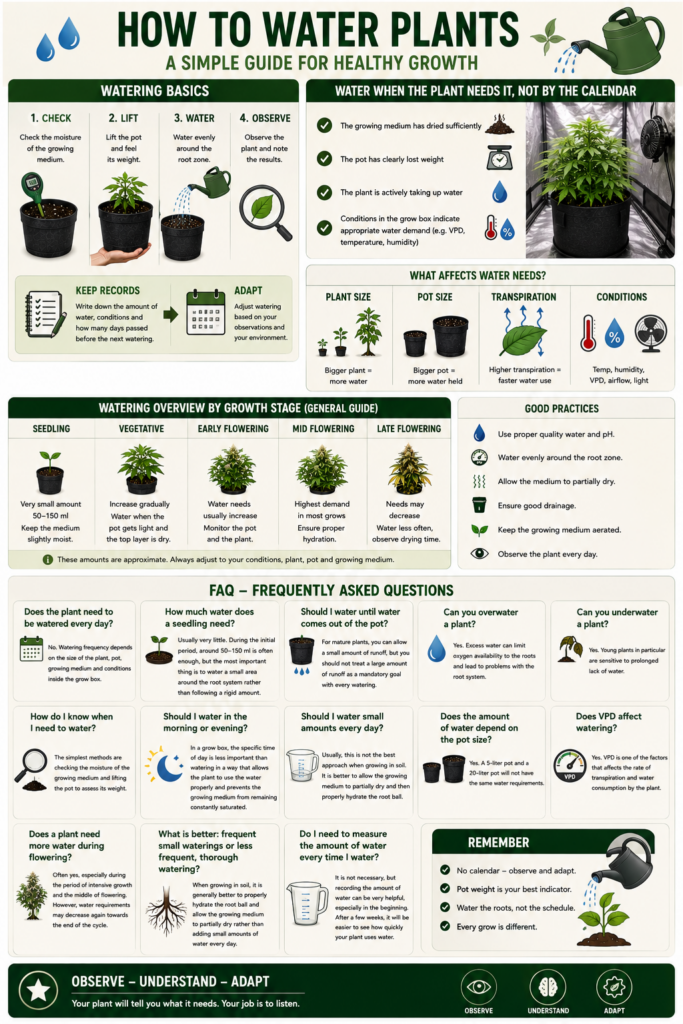
Should I water small amounts every day?
Usually, this is not the best approach when growing in soil. It is better to allow the growing medium to partially dry and then properly hydrate the root ball.
Does the amount of water depend on the pot size?
Yes. A 5-liter pot and a 20-liter pot will not have the same water requirements.
Does VPD affect watering?
Yes. VPD is one of the factors that affects the rate of transpiration and water consumption by the plant.
Does a plant need more water during flowering?
Often yes, especially during the period of intensive growth and the middle of flowering. However, water requirements may decrease again towards the end of the cycle.
What is better: frequent small waterings or less frequent, thorough watering?
When growing in soil, it is generally better to properly hydrate the root ball and allow the growing medium to partially dry rather than adding small amounts of water every day.
Do I need to measure the amount of water every time I water?
It is not necessary, but recording the amount of water can be very helpful, especially in the beginning. After a few weeks, it will be easier to see how quickly your plant uses water.
Summary
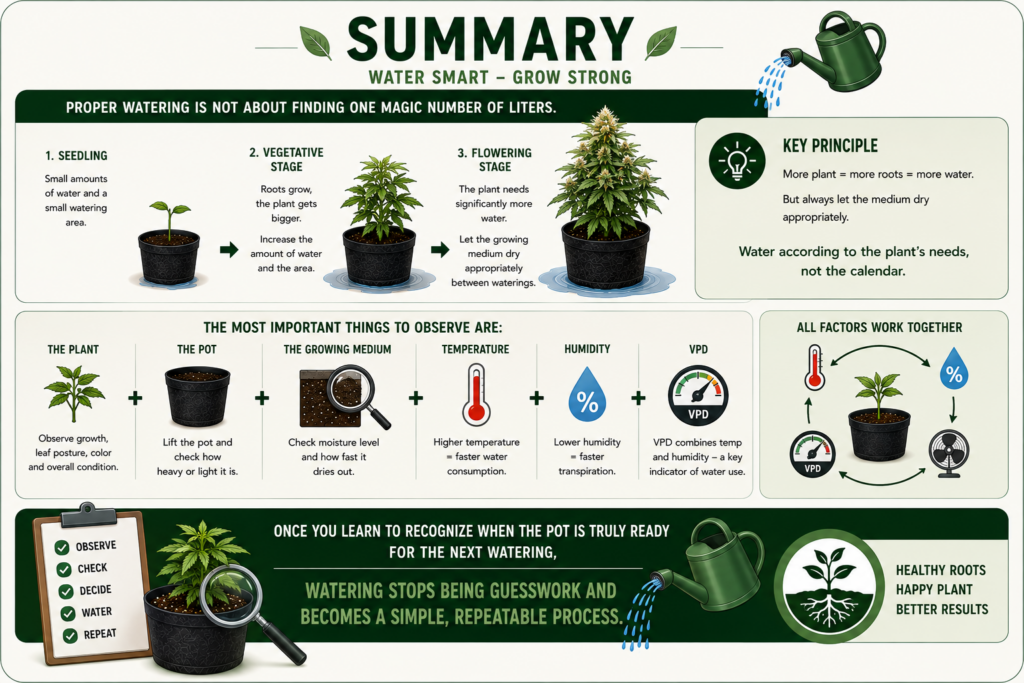
Proper watering is not about finding one magic number of liters.
A seedling needs small amounts of water and a small watering area. As the root system develops, we increase the amount of water and the area being watered. A large plant during flowering may need significantly more water, but the growing medium should still be allowed to dry appropriately.
The most important things to observe are:
the plant + the pot + the growing medium + temperature + humidity + VPD.
Once you learn to recognize when the pot is truly ready for the next watering, watering stops being guesswork and becomes a simple, repeatable process.
Check Out Our Other Guides
If you are still setting up your grow tent or looking to improve your growing conditions, be sure to explore our other guides as well: