
Vegetative Stage in a Grow Tent – Temperature, Humidity, Light and Watering
The vegetative stage, also known as the growth stage, is one of the most important stages of plant development when growing in a grow tent. During this stage, the plant focuses on developing its root system, stems, branches and leaves while preparing for the next stage of growth.
Proper environmental conditions are extremely important during the vegetative stage. Temperature, relative humidity, light intensity, watering, ventilation and the quality of the growing medium all affect the rate and quality of plant growth.
In this guide, we explain how to care for your plants during the vegetative stage, what to pay attention to and which mistakes beginners most commonly make.
Table of Contents
- What Is the Vegetative Stage?
- How Long Does the Vegetative Stage Last?
- Temperature in a Grow Tent During the Vegetative Stage
- Relative Humidity During Vegetative Growth
- VPD During the Vegetative Stage
- Lighting During the Vegetative Stage
- How to Water Plants During the Vegetative Stage
- Growing Medium and Pot Size
- Ventilation in a Grow Tent
- Feeding During the Vegetative Stage
- How to Recognize Problems During Vegetative Growth
- Most Common Beginner Mistakes
- Vegetative Stage Environment Chart
- Summary
- FAQ – Frequently Asked Questions
What Is the Vegetative Stage?
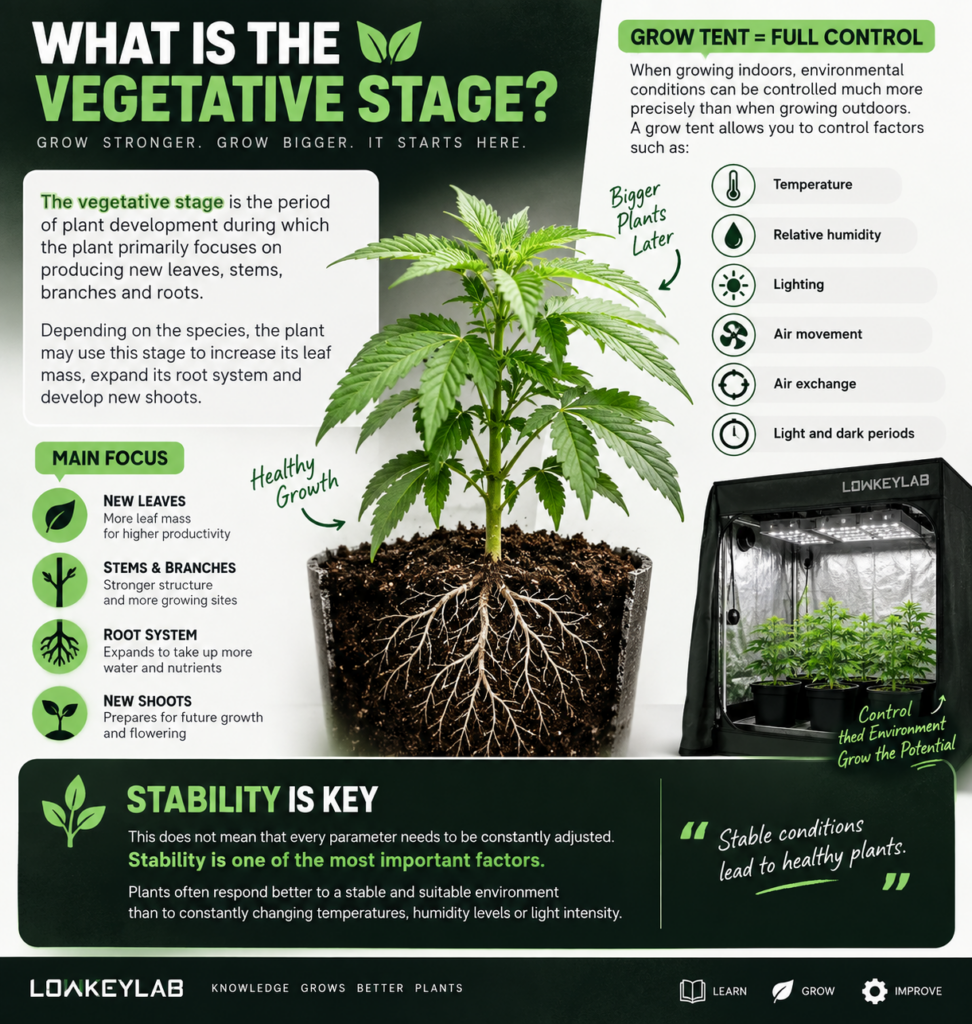
The vegetative stage is the period of plant development during which the plant primarily focuses on producing new leaves, stems, branches and roots. Depending on the species, the plant may use this stage to increase its leaf mass, expand its root system and develop new shoots.
When growing indoors, environmental conditions can be controlled much more precisely than when growing outdoors. A grow tent allows you to control factors such as:
- temperature,
- relative humidity,
- lighting,
- air movement,
- air exchange,
- light and dark periods.
This does not mean that every parameter needs to be constantly adjusted.
Stability is one of the most important factors.
Plants often respond better to a stable and suitable environment than to constantly changing temperatures, humidity levels or light intensity.
How Long Does the Vegetative Stage Last?
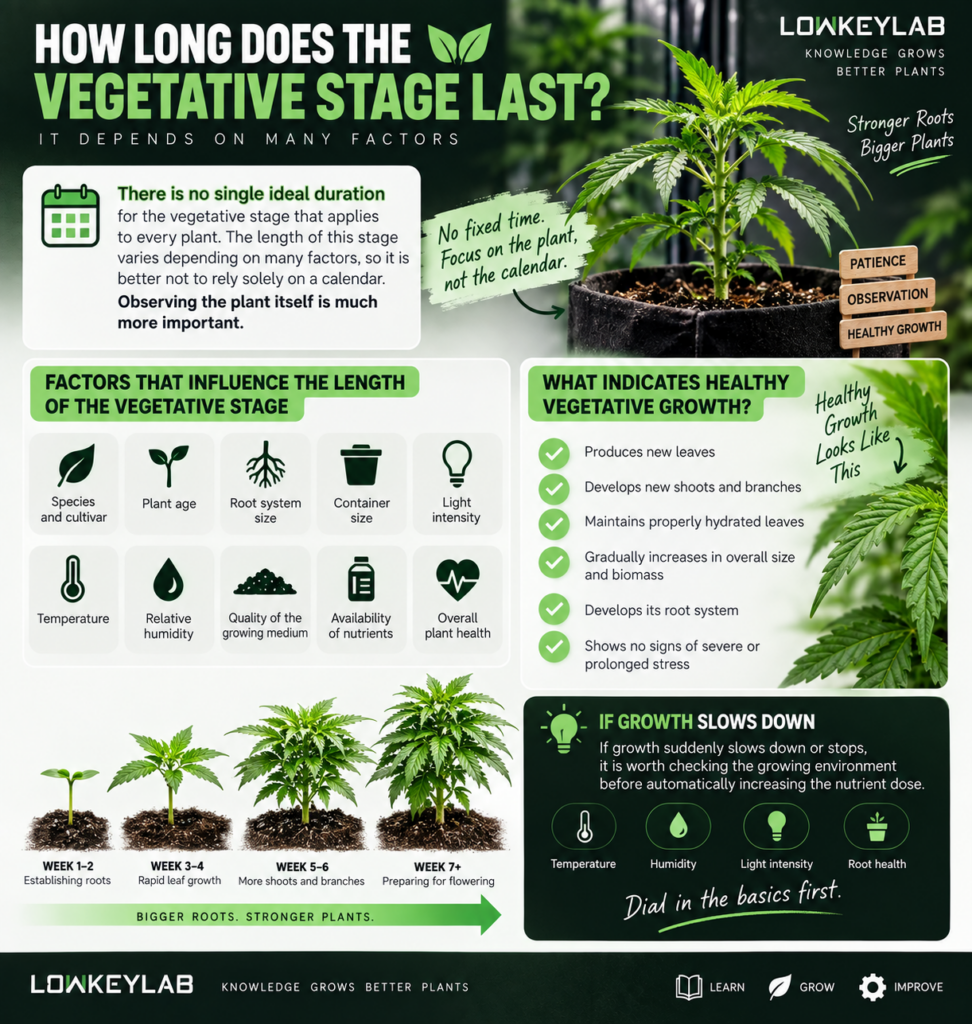
There is no single ideal duration for the vegetative stage that applies to every plant.
The length of the vegetative stage depends on factors such as:
- species and cultivar,
- plant age,
- root system size,
- container size,
- light intensity,
- temperature,
- relative humidity,
- quality of the growing medium,
- availability of nutrients,
- overall plant health.
For this reason, it is better not to rely solely on a calendar.
Observing the plant itself is much more important.
What Indicates Healthy Vegetative Growth?
A healthy plant during the vegetative stage will generally:
- produce new leaves,
- develop new shoots and branches,
- maintain properly hydrated leaves,
- gradually increase in overall size and biomass,
- develop its root system,
- show no signs of severe or prolonged stress.
If growth suddenly slows down or stops, it is worth checking the growing environment before automatically increasing the nutrient dose.
Temperature in a Grow Tent During the Vegetative Stage
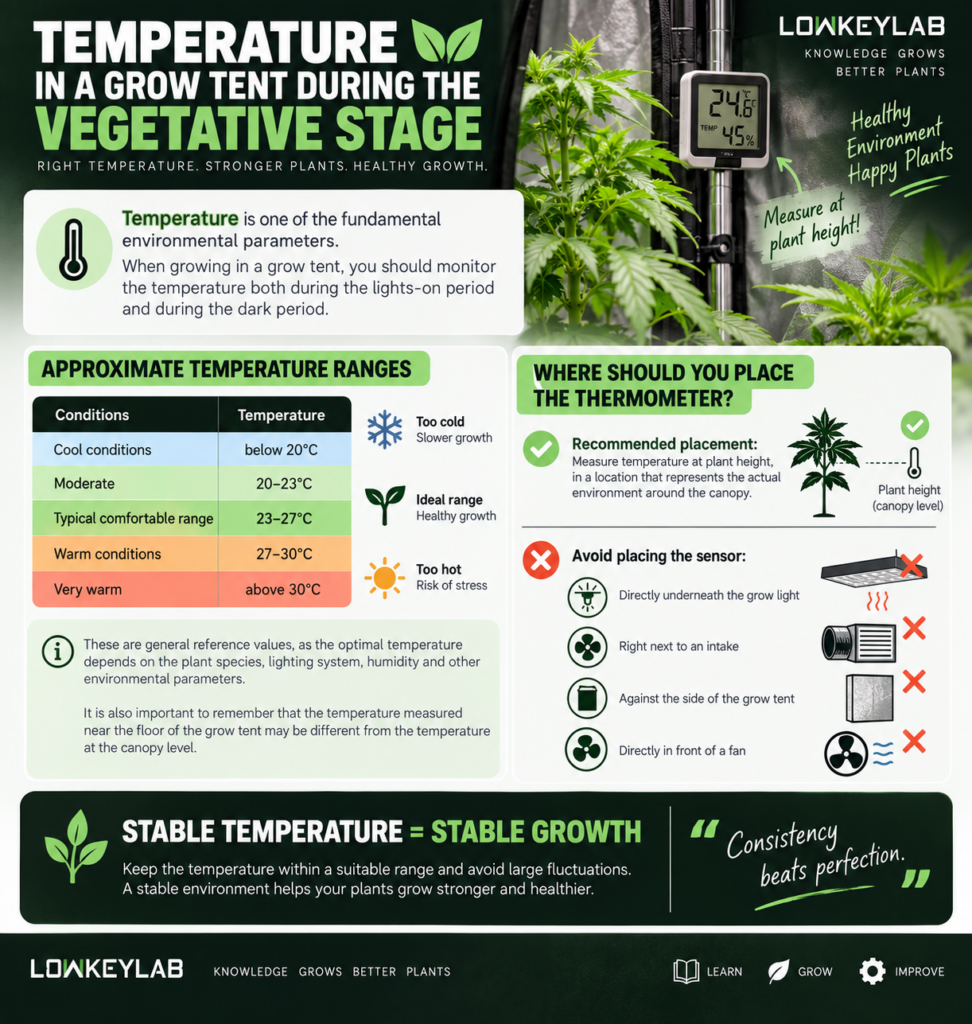
Temperature is one of the fundamental environmental parameters.
When growing in a grow tent, you should monitor the temperature both during the lights-on period and during the dark period.
Approximate Temperature Ranges
| Conditions | Temperature |
|---|---|
| Cool conditions | below 20°C |
| Moderate | 20–23°C |
| Typical comfortable range | 23–27°C |
| Warm conditions | 27–30°C |
| Very warm | above 30°C |
These are general reference values, as the optimal temperature depends on the plant species, lighting system, humidity and other environmental parameters.
It is also important to remember that the temperature measured near the floor of the grow tent may be different from the temperature at the canopy level.
Where Should You Place the Thermometer?
Ideally, measure temperature at plant height, in a location that represents the actual environment around the canopy.
Avoid placing the sensor:
- directly underneath the grow light,
- right next to an intake,
- against the side of the grow tent,
- directly in front of a fan.
Such locations can produce readings that do not accurately represent the conditions surrounding the plants.
Relative Humidity During Vegetative Growth
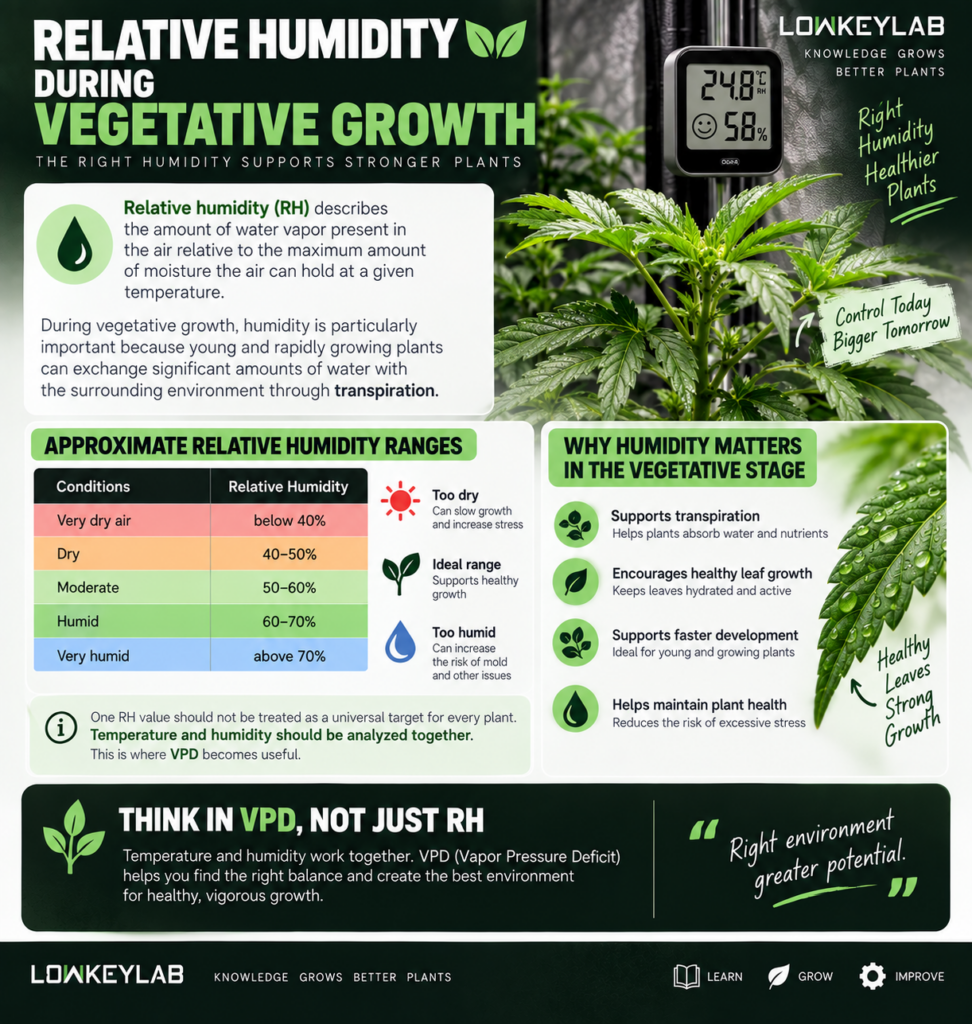
Relative humidity, or RH, describes the amount of water vapor present in the air relative to the maximum amount of moisture the air can hold at a given temperature.
During vegetative growth, humidity is particularly important because young and rapidly growing plants can exchange significant amounts of water with the surrounding environment through transpiration.
Approximate Relative Humidity Ranges
| Conditions | Relative Humidity |
|---|---|
| Very dry air | below 40% |
| Dry | 40–50% |
| Moderate | 50–60% |
| Humid | 60–70% |
| Very humid | above 70% |
However, one RH value should not be treated as a universal target for every plant.
Temperature and humidity should be analyzed together.
This is where VPD becomes useful.
VPD During the Vegetative Stage
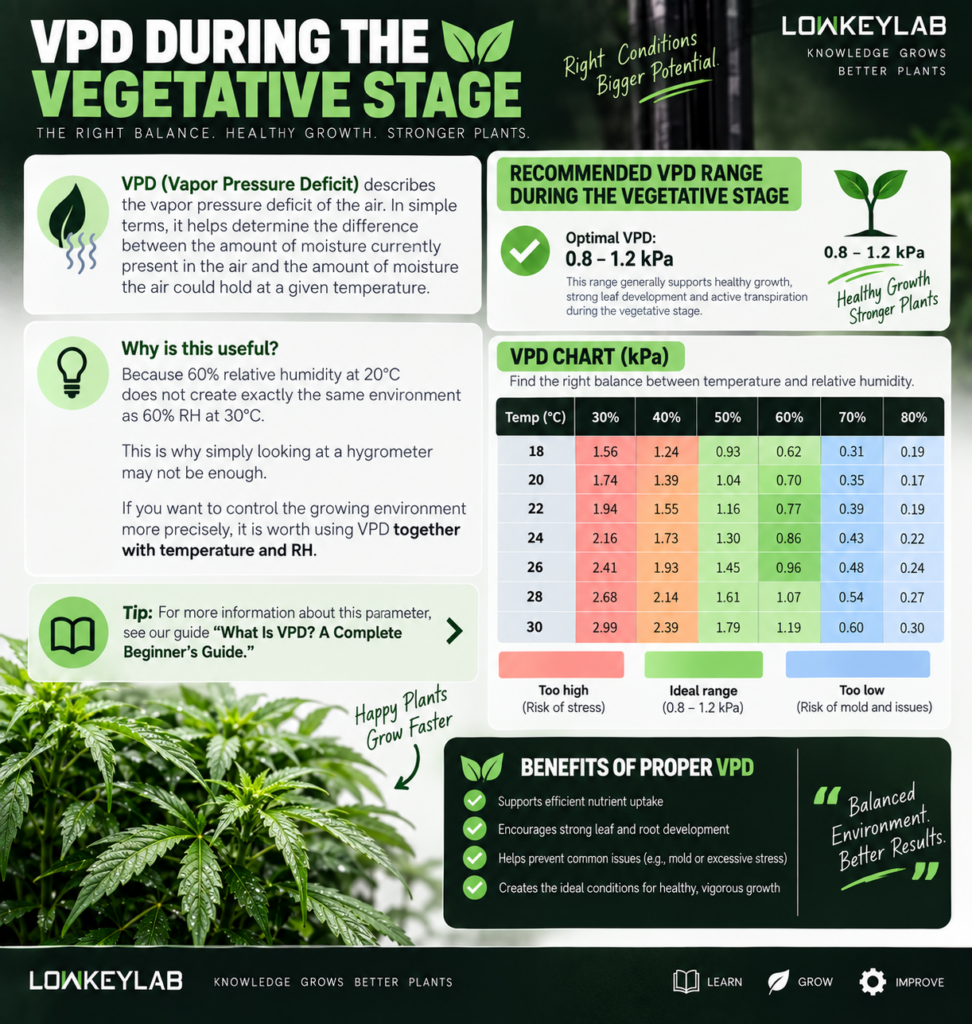
VPD (Vapor Pressure Deficit) describes the vapor pressure deficit of the air. In simple terms, it helps determine the difference between the amount of moisture currently present in the air and the amount of moisture the air could hold at a given temperature.
Why is this useful?
Because 60% relative humidity at 20°C does not create exactly the same environment as 60% RH at 30°C.
This is why simply looking at a hygrometer may not be enough.
If you want to control the growing environment more precisely, it is worth using VPD together with temperature and RH.
Tip: For more information about this parameter, see our guide “What Is VPD? A Complete Beginner’s Guide.”
Lighting During the Vegetative Stage
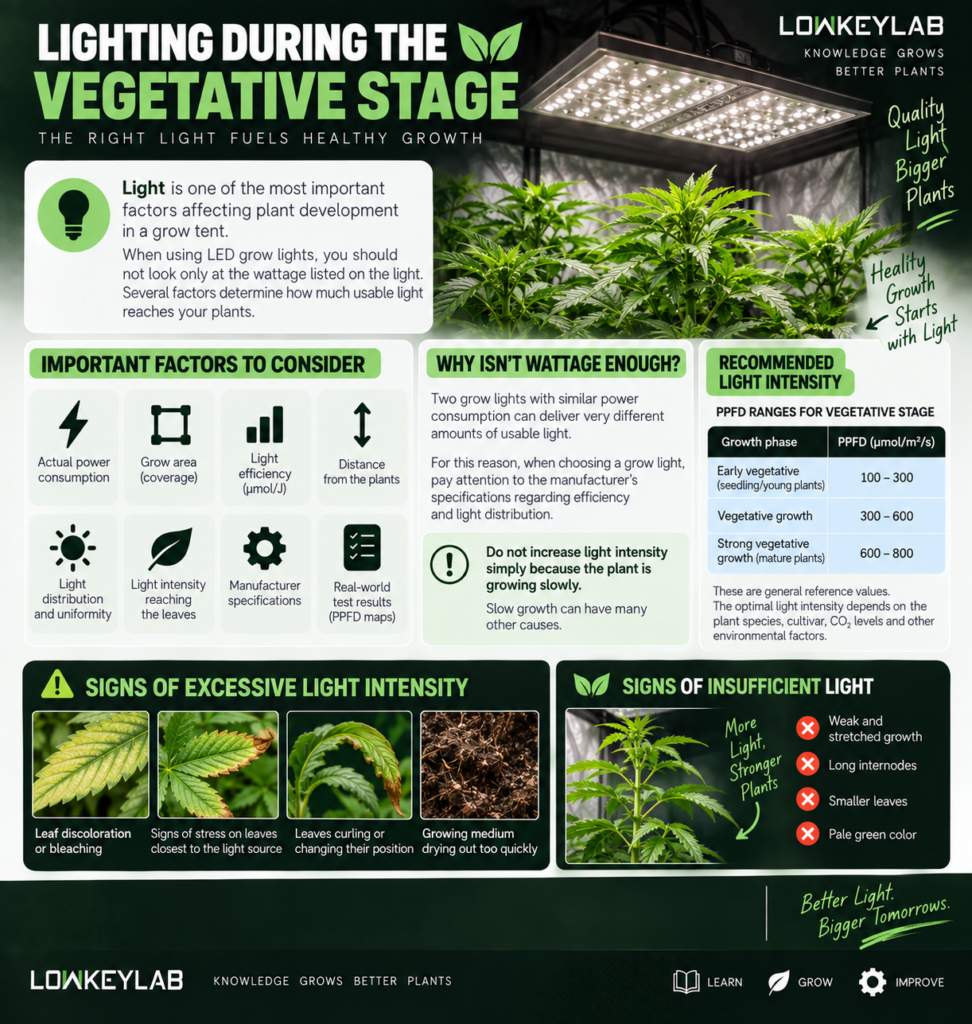
Light is one of the most important factors affecting plant development in a grow tent.
When using LED grow lights, you should not look only at the wattage listed on the light.
Important factors include:
- actual power consumption,
- grow area,
- light efficiency,
- distance from the plants,
- light distribution and uniformity,
- light intensity reaching the leaves.
Why Isn’t Wattage Enough?
Two grow lights with similar power consumption can deliver very different amounts of usable light.
For this reason, when choosing a grow light, pay attention to the manufacturer’s specifications regarding efficiency and light distribution.
Do not increase light intensity simply because the plant is growing slowly.
Slow growth can have many other causes.
Signs of Excessive Light Intensity
Possible symptoms include:
- unusual leaf discoloration or bleaching,
- signs of stress on leaves closest to the light source,
- leaves curling or changing their position,
- the growing medium drying out excessively quickly.
On the other hand, insufficient light can result in weak and excessively stretched growth.
How to Water Plants During the Vegetative Stage
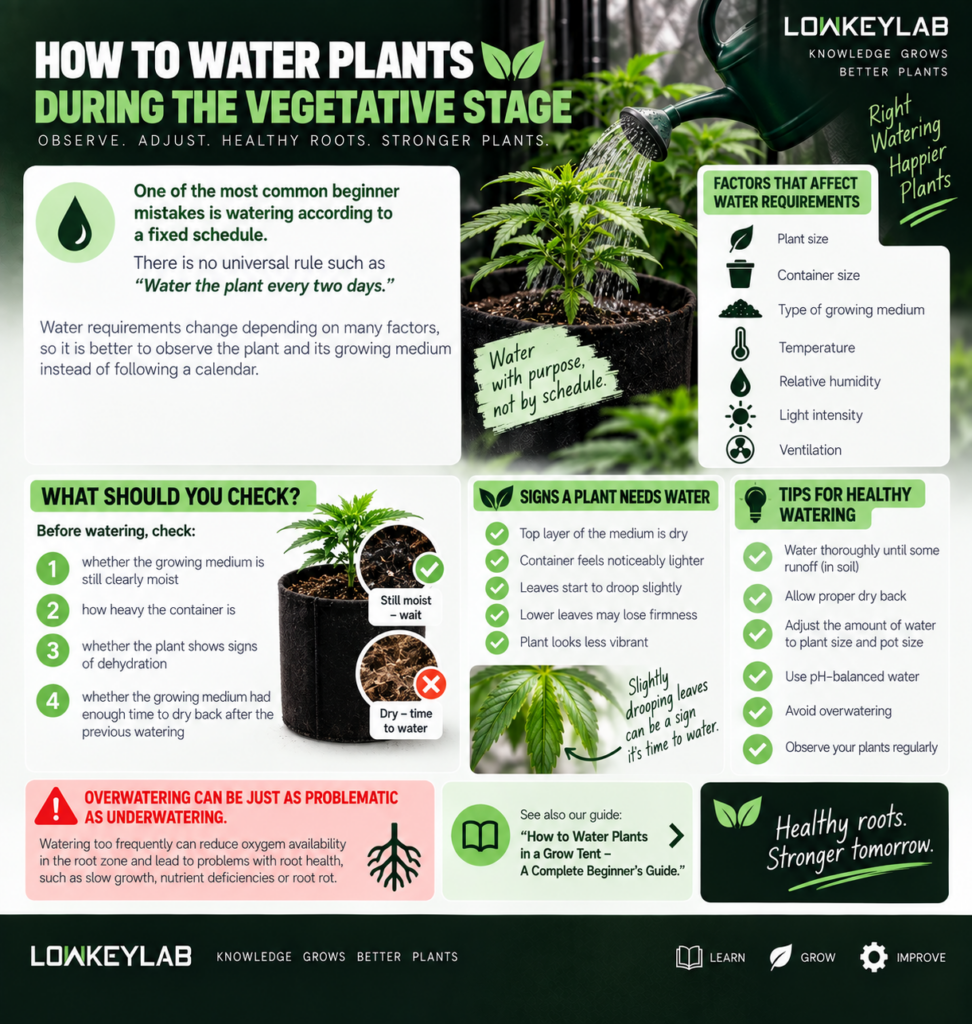
One of the most common beginner mistakes is watering according to a fixed schedule.
There is no universal rule such as:
“Water the plant every two days.”
Water requirements change depending on:
- plant size,
- container size,
- type of growing medium,
- temperature,
- relative humidity,
- light intensity,
- ventilation.
For this reason, it is better to observe the plant and its growing medium.
What Should You Check?
Before watering, check:
- whether the growing medium is still clearly moist,
- how heavy the container is,
- whether the plant shows signs of dehydration,
- whether the growing medium had enough time to dry back after the previous watering.
Overwatering can be just as problematic as underwatering.
Watering too frequently can reduce oxygen availability in the root zone and lead to problems with root health.
See also our guide “How to Water Plants in a Grow Tent – A Complete Beginner’s Guide.”
Growing Medium and Pot Size
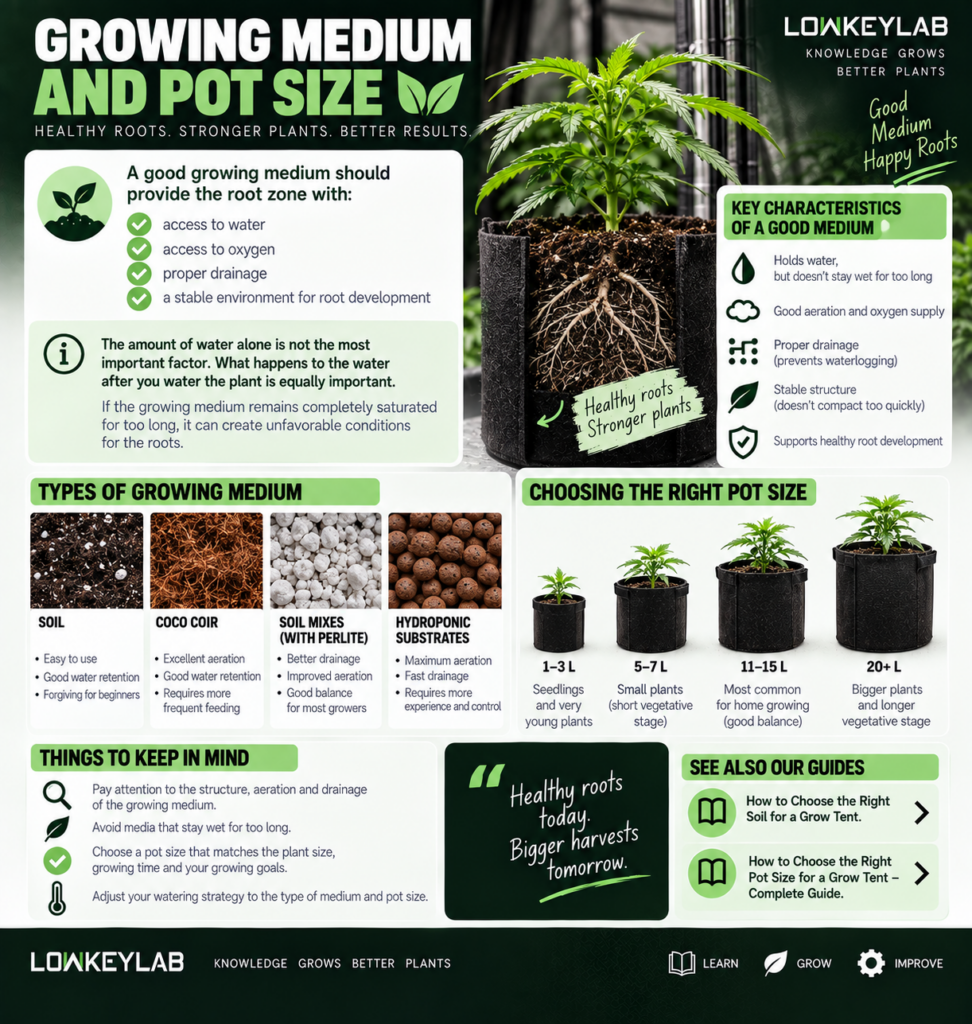
A good growing medium should provide the root zone with:
- access to water,
- access to oxygen,
- proper drainage,
- a stable environment for root development.
The amount of water alone is not the most important factor.
What happens to the water after you water the plant is equally important.
If the growing medium remains completely saturated for too long, it can create unfavorable conditions for the roots.
When choosing a growing medium, pay attention to its structure, aeration and drainage.
See also: “How to Choose the Right Soil for a Grow Tent.”
and
“How to Choose the Right Pot Size for a Grow Tent – Complete Guide.”
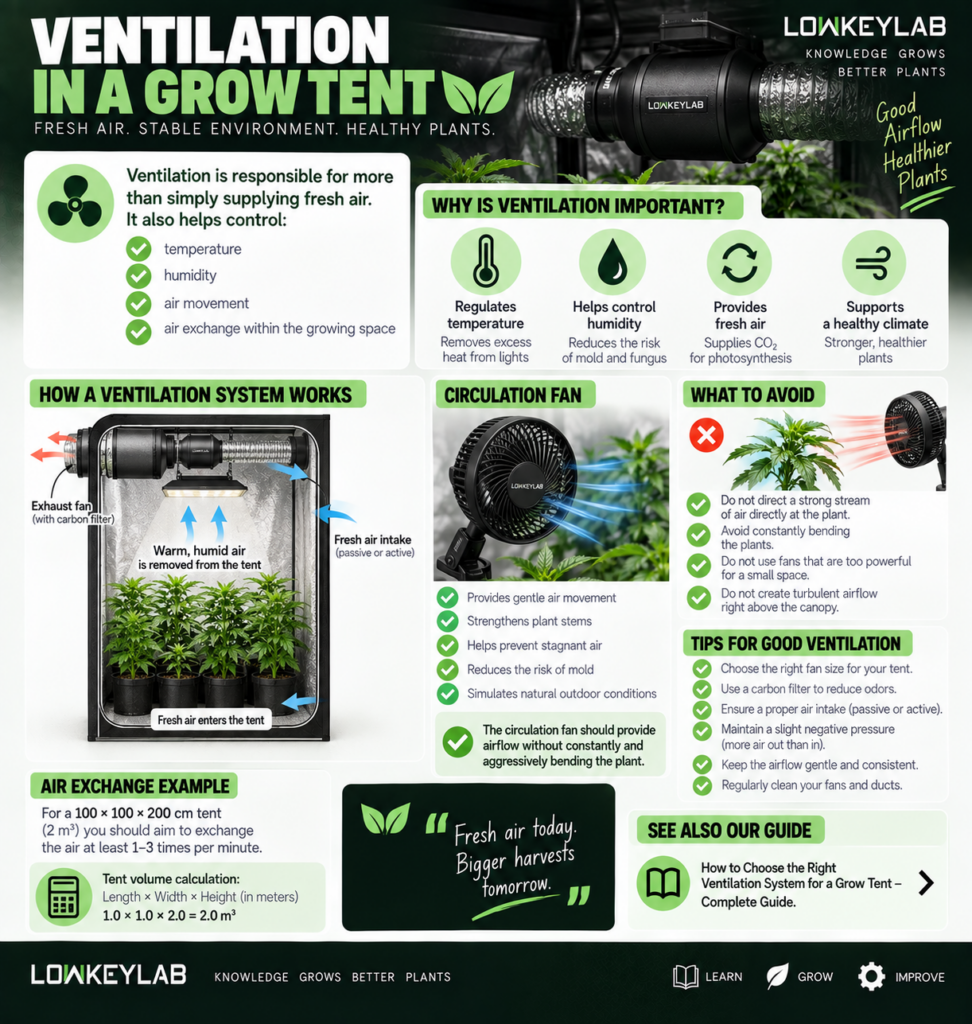
Ventilation in a Grow Tent
Ventilation is responsible for more than simply supplying fresh air.
It also helps control:
- temperature,
- humidity,
- air movement,
- air exchange within the growing space.
Gentle airflow around the plants can be beneficial, but directing a very strong stream of air directly at the plant is not a good solution.
The circulation fan should provide airflow without constantly and aggressively bending the plant.
For more information, see our guide “How to Choose the Right Ventilation System for a Grow Tent – Complete Guide.”
Feeding During the Vegetative Stage
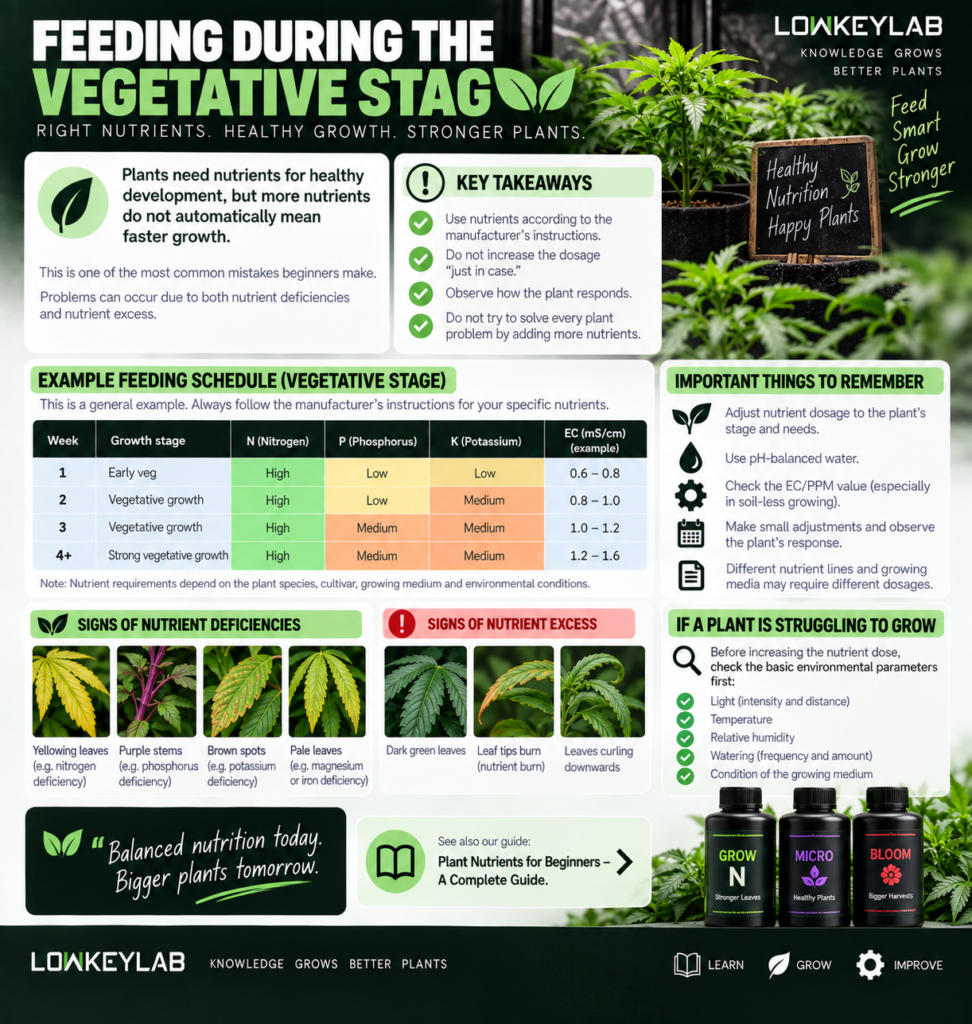
Plants need nutrients for healthy development, but more nutrients do not automatically mean faster growth.
This is one of the most common mistakes beginners make.
Problems can occur due to both nutrient deficiencies and nutrient excess.
Therefore:
- use nutrients according to the manufacturer’s instructions,
- do not increase the dosage “just in case,”
- observe how the plant responds,
- do not try to solve every plant problem by adding more nutrients.
If a plant is struggling to grow, first check the basic environmental parameters: light, temperature, humidity, watering and the condition of the growing medium.
How to Recognize Problems During Vegetative Growth
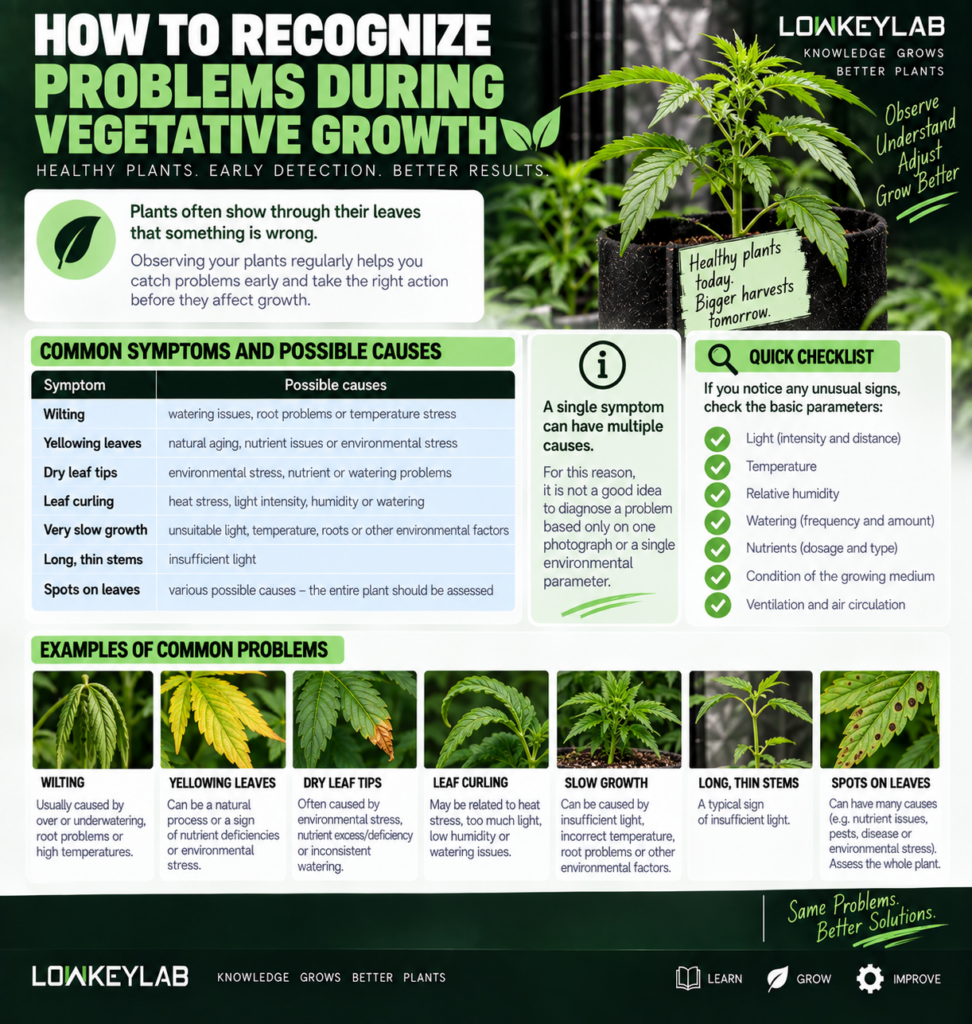
Plants often show through their leaves that something is wrong.
Common Symptoms
| Symptom | Possible Causes |
|---|---|
| Wilting | watering issues, root problems or temperature stress |
| Yellowing leaves | natural aging, nutrient issues or environmental stress |
| Dry leaf tips | environmental stress, nutrient or watering problems |
| Leaf curling | heat stress, light intensity, humidity or watering |
| Very slow growth | unsuitable light, temperature, roots or other environmental factors |
| Long, thin stems | insufficient light |
| Spots on leaves | various possible causes – the entire plant should be assessed |
A single symptom can have multiple causes.
For this reason, it is not a good idea to diagnose a problem based only on one photograph or a single environmental parameter.
Most Common Beginner Mistakes
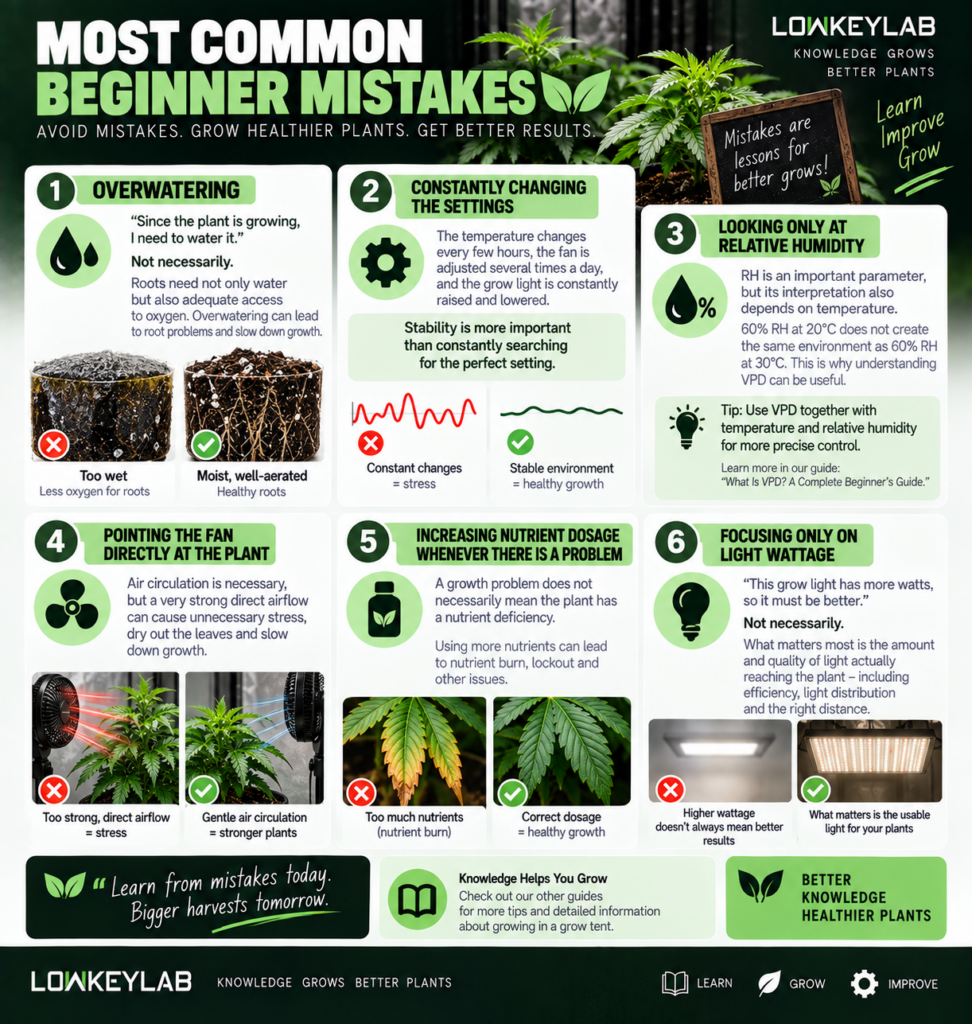
1. Overwatering
“Since the plant is growing, I need to water it.”
Not necessarily.
Roots need not only water but also adequate access to oxygen.
2. Constantly Changing the Settings
The temperature changes every few hours, the fan is adjusted several times a day, and the grow light is constantly raised and lowered.
Stability is more important than constantly searching for the perfect setting.
3. Looking Only at Relative Humidity
RH is an important parameter, but its interpretation also depends on temperature.
This is why understanding VPD can be useful.
4. Pointing the Fan Directly at the Plant
Air circulation is necessary, but a very strong direct airflow can cause unnecessary stress.
5. Increasing Nutrient Dosage Whenever There Is a Problem
A growth problem does not necessarily mean the plant has a nutrient deficiency.
6. Focusing Only on Light Wattage
“This grow light has more watts, so it must be better.”
Not necessarily.
What matters most is the amount and quality of light actually reaching the plant.
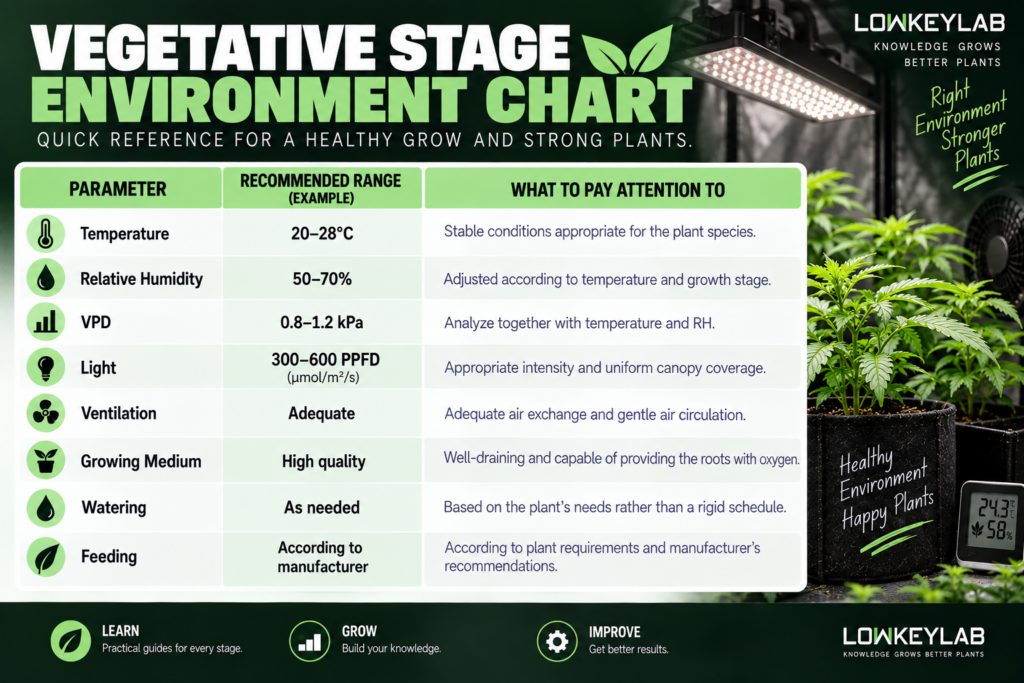
Vegetative Stage Environment Chart
The following table can be used as a quick reference for beginners:
| Parameter | What to Pay Attention To |
|---|---|
| 🌡 Temperature | stable conditions appropriate for the plant species |
| 💧 Relative Humidity | adjusted according to temperature and growth stage |
| 📊 VPD | analyze together with temperature and RH |
| 💡 Light | appropriate intensity and uniform canopy coverage |
| 🌬 Ventilation | adequate air exchange and gentle air circulation |
| 🪴 Growing Medium | well-draining and capable of providing the roots with oxygen |
| 💦 Watering | based on the plant’s needs rather than a rigid schedule |
| 🌱 Feeding | according to plant requirements and manufacturer’s recommendations |
What Does Healthy Vegetative Growth Look Like?
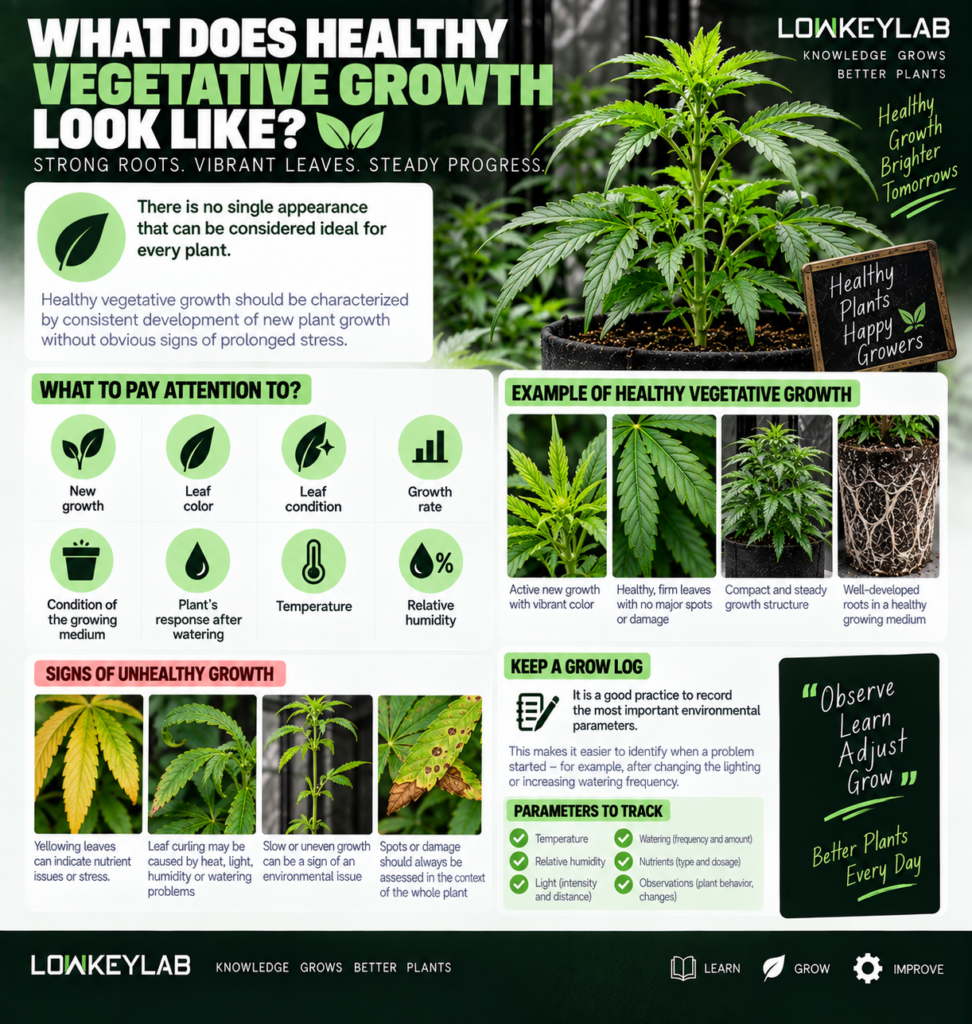
There is no single appearance that can be considered ideal for every plant.
Healthy vegetative growth should, however, be characterized by consistent development of new plant growth without obvious signs of prolonged stress.
Pay particular attention to:
- new growth,
- leaf color,
- leaf condition,
- growth rate,
- condition of the growing medium,
- the plant’s response after watering,
- temperature,
- relative humidity.
It is also good practice to record the most important environmental parameters. This makes it easier to identify when a problem started — for example, after changing the lighting or increasing watering frequency.
Summary
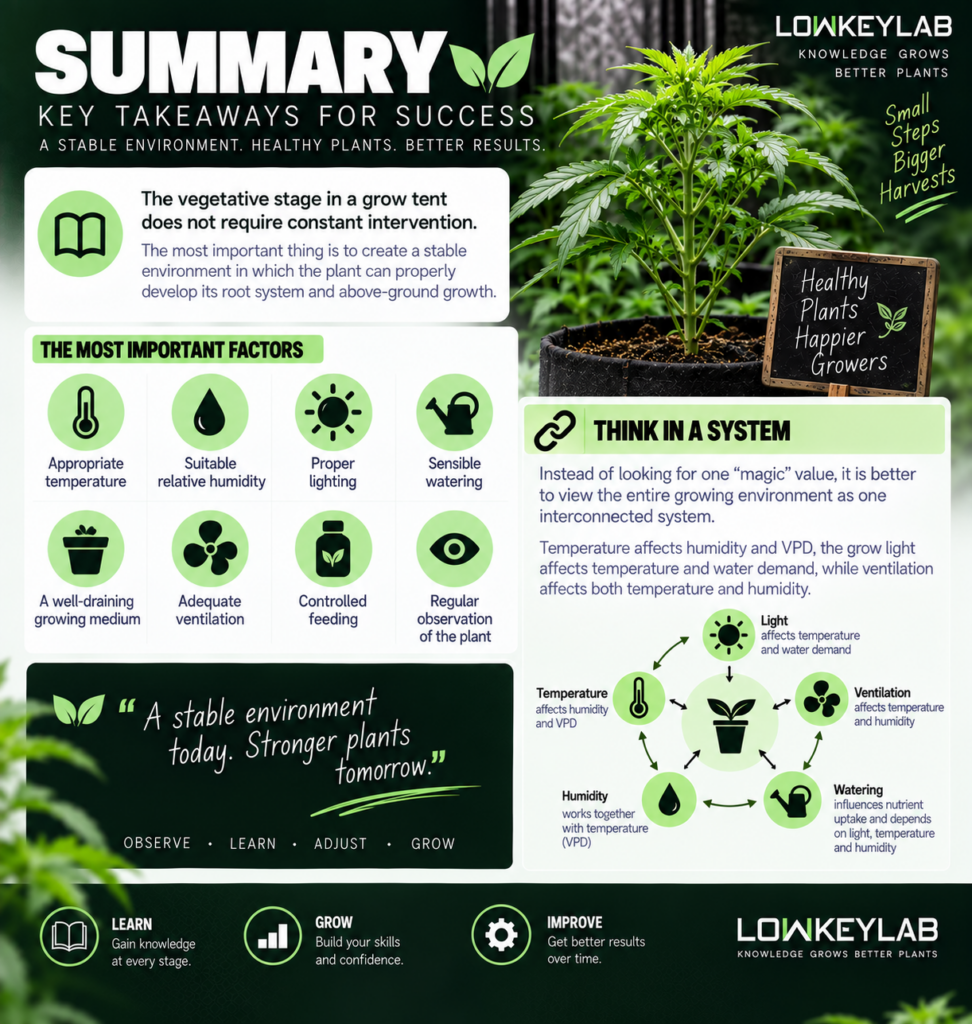
The vegetative stage in a grow tent does not require constant intervention. The most important thing is to create a stable environment in which the plant can properly develop its root system and above-ground growth.
The most important factors include:
- appropriate temperature,
- suitable relative humidity,
- proper lighting,
- sensible watering,
- a well-draining growing medium,
- adequate ventilation,
- controlled feeding,
- regular observation of the plant.
Instead of looking for one “magic” value, it is better to view the entire growing environment as one interconnected system. Temperature affects humidity and VPD, the grow light affects temperature and water demand, while ventilation affects both temperature and humidity.
It is the right combination of these factors that creates stable conditions during the vegetative stage.
FAQ – Frequently Asked Questions
What Is the Vegetative Stage?
The vegetative stage is the period of plant development during which the plant primarily focuses on developing its roots, leaves, stems and new shoots.
How Long Does the Vegetative Stage Last?
There is no single universal duration for the vegetative stage. It depends on the species, cultivar, plant age and environmental conditions.
What Temperature Is Suitable in a Grow Tent During Vegetative Growth?
In general, moderate temperatures are suitable, often around 23–27°C, although the optimal temperature depends on the plant species and the other environmental parameters.
What Humidity Should a Grow Tent Have During the Vegetative Stage?
In many cases, moderate humidity works well, but RH should not be considered separately from temperature. VPD can be a useful additional parameter when managing the growing environment.
What Does VPD Mean?
VPD, or Vapor Pressure Deficit, describes the vapor pressure deficit of the air and helps provide a better understanding of the relationship between temperature, relative humidity and plant transpiration.
How Often Should I Water Plants During the Vegetative Stage?
You should not follow one rigid watering schedule. Watering frequency depends on factors such as plant size, container size, growing medium, temperature, humidity and light intensity.
Does a More Powerful LED Grow Light Mean Faster Growth?
Not necessarily. What matters is not only the power consumption of the grow light but also its efficiency, light distribution and the amount of usable light reaching the plants.
Should a Circulation Fan Blow Directly at the Plant All the Time?
Ventilation and air circulation are important, but strong direct airflow is not necessary. The goal is primarily adequate air exchange and gentle movement of air around the plants.
Why Is My Plant Growing Slowly?
There can be many causes, including unsuitable light, temperature, humidity, watering, root problems, issues with the growing medium or nutrition. It is better to analyze all the basic environmental parameters rather than focus on just one.
Will More Nutrients Make My Plant Grow Faster?
No. Excess nutrients can actually cause problems and plant stress. Feeding should be adjusted to the plant’s needs and the manufacturer’s recommendations.
Is 60% Humidity Good for Plants?
A relative humidity level of 60% alone is not enough to fully assess the growing conditions. Temperature also matters, which is why VPD can be useful when managing the environment more precisely.
Which Parameters Should I Monitor in a Grow Tent?
The basic set includes temperature, relative humidity, lighting conditions and the condition of the growing medium. For more advanced environmental control, you can also monitor VPD.
Check Out Our Other Guides
If you are still setting up your grow tent or looking to improve your growing conditions, be sure to explore our other guides as well: