
The First Days After Germination – A Complete Beginner’s Guide
The first few days after germination are one of the most important stages in the development of a young plant. At this stage, a small seedling is particularly delicate, and it is easy to make mistakes related to watering, lighting, temperature, or the choice of growing medium.
Fortunately, caring for a plant at this stage is not complicated. The most important thing is to provide the young plant with stable conditions and avoid unnecessary interference.
In this guide, we explain what to do with a plant during the first few days after germination, how to water it, how to set up the lighting, what conditions to provide, and when to start feeding and transplanting.
Table of Contents
- What to Do Immediately After Germination?
- How to Properly Plant a Germinated Seed?
- Watering a Young Plant
- Lighting During the First Few Days
- Temperature and Humidity
- Does a Young Plant Need Nutrients?
- When Should You Transplant a Young Plant?
- The Most Common Beginner Mistakes
- How to Identify Problems With a Young Plant
- The First Few Days – Quick Reference Table
- FAQ – Frequently Asked Questions
1. What to Do Immediately After Germination?
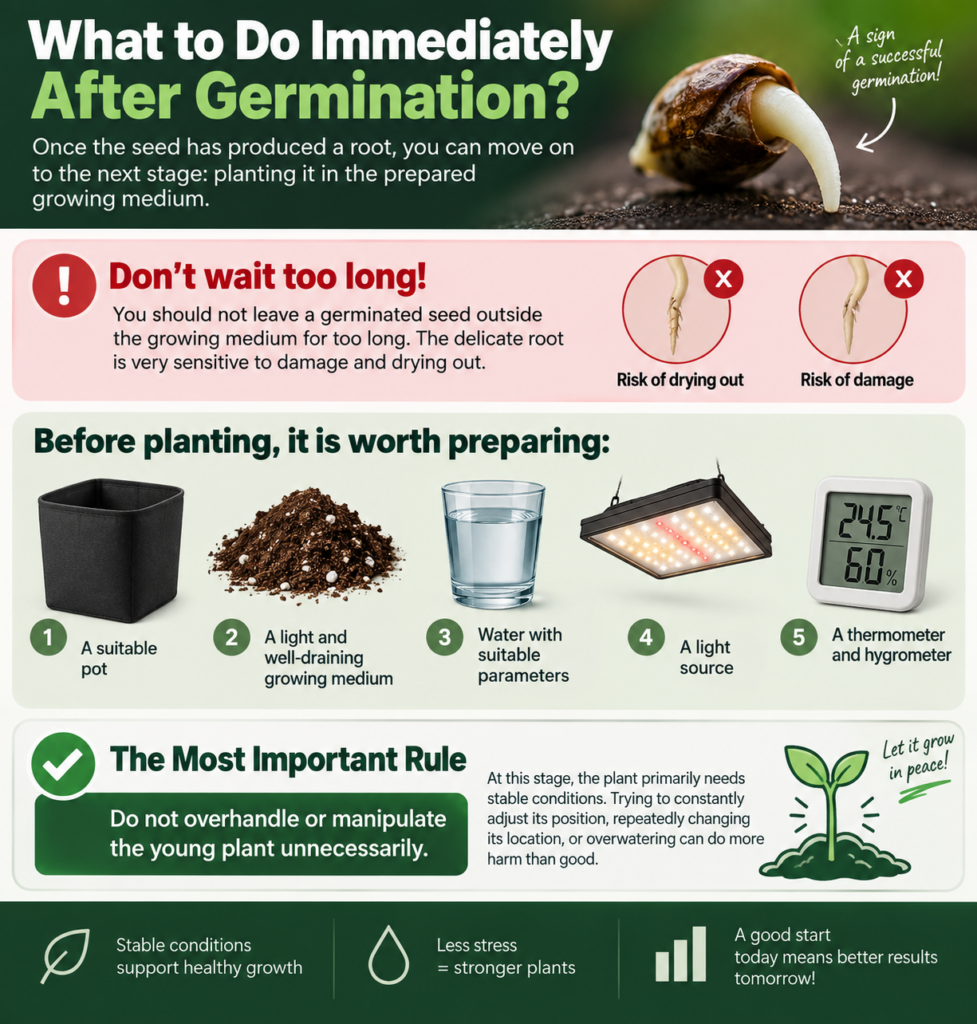
Once the seed has produced a root, you can move on to the next stage: planting it in the prepared growing medium.
You should not leave a germinated seed outside the growing medium for too long. The delicate root is very sensitive to damage and drying out.
Before planting, it is worth preparing:
- a suitable pot,
- a light and well-draining growing medium,
- water with suitable parameters,
- a light source,
- a thermometer and hygrometer.
The Most Important Rule
Do not overhandle or manipulate the young plant unnecessarily.
At this stage, the plant primarily needs stable conditions. Trying to constantly adjust its position, repeatedly changing its location, or overwatering can do more harm than good.
2. How to Properly Plant a Germinated Seed?
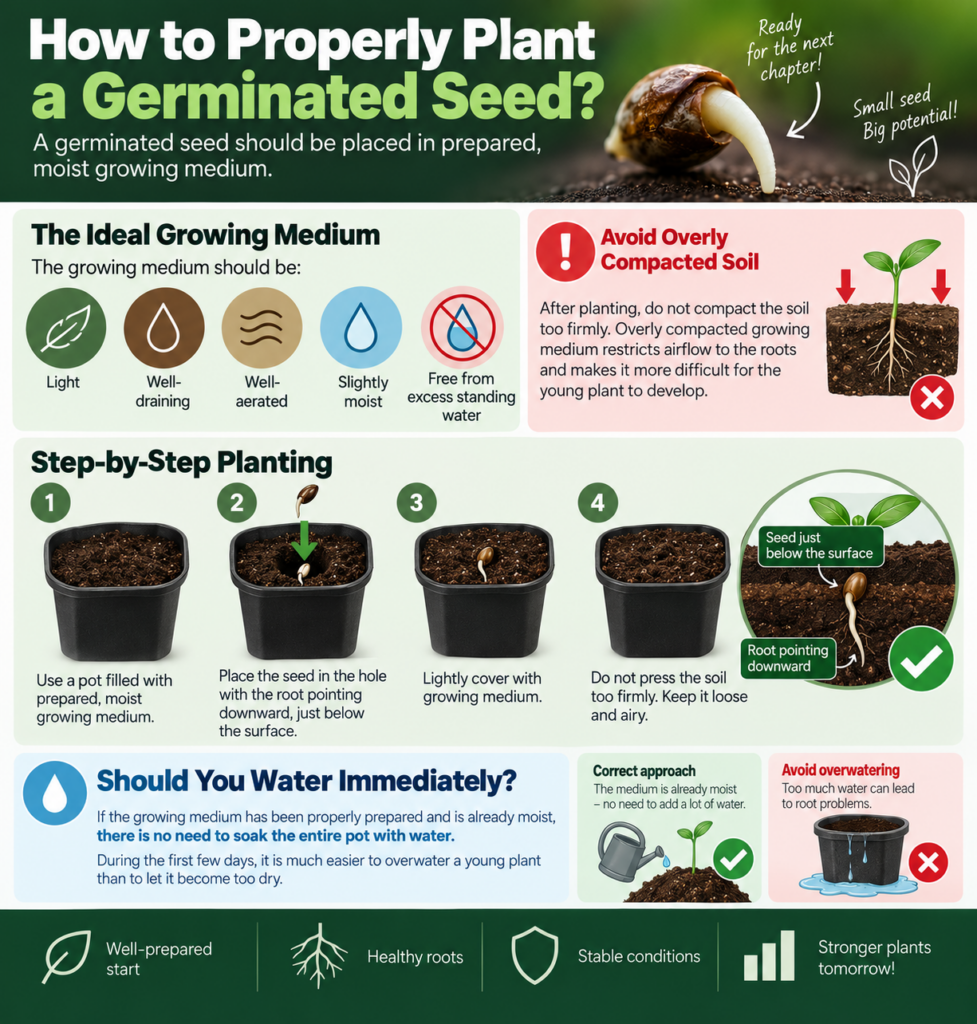
A germinated seed should be placed in prepared, moist growing medium.
The growing medium should be:
- light,
- well-draining,
- well-aerated,
- slightly moist,
- free from excess standing water.
The root should point downward, with the seed placed just below the surface of the growing medium.
After planting, do not compact the soil too firmly. Overly compacted growing medium restricts airflow to the roots and makes it more difficult for the young plant to develop.
Should You Water Immediately?
If the growing medium has been properly prepared and is already moist, there is no need to soak the entire pot with water.
During the first few days, it is much easier to overwater a young plant than to let it become too dry.
3. Watering a Young Plant
This is one of the most common problems for beginners.
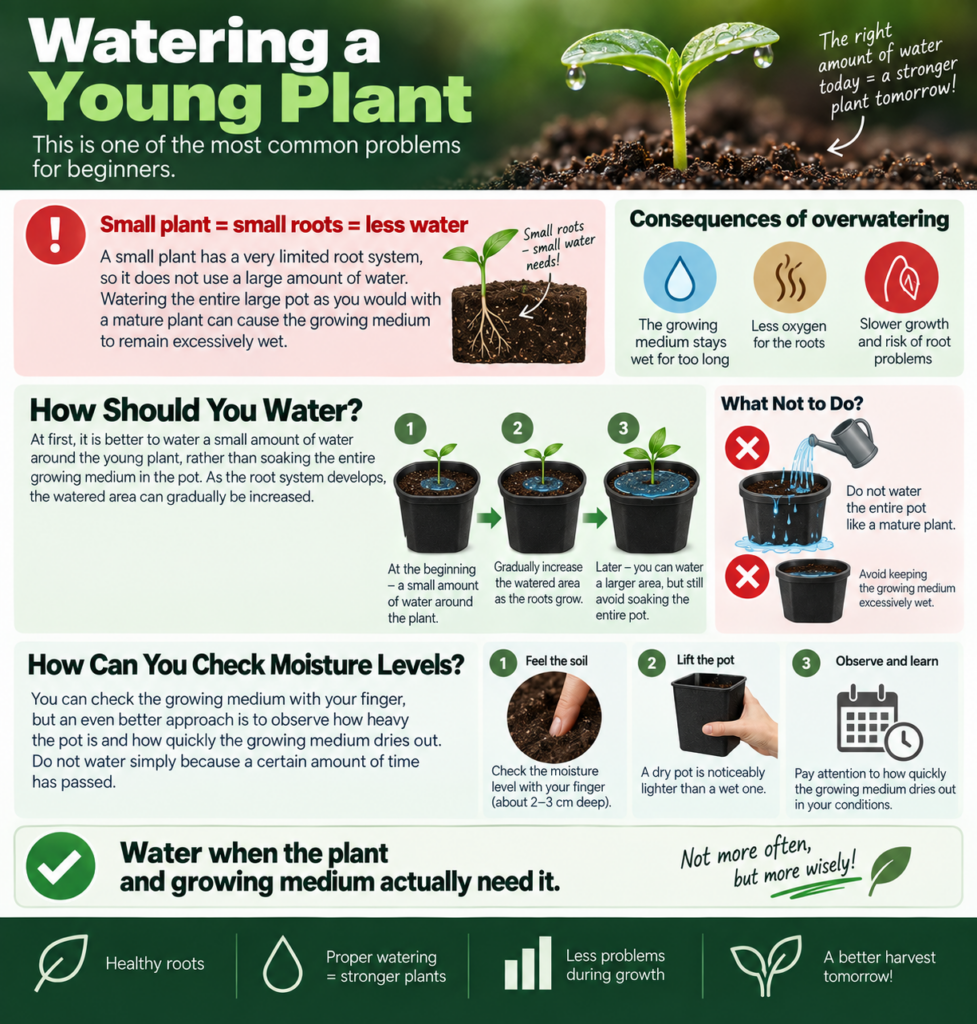
A small plant has a very limited root system, so it does not use a large amount of water. Watering the entire large pot as you would with a mature plant can cause the growing medium to remain excessively wet.
How Should You Water?
At first, it is better to water a small amount of water around the young plant, rather than soaking the entire growing medium in the pot.
As the root system develops, the watered area can gradually be increased.
How Can You Check Moisture Levels?
You can check the growing medium with your finger, but an even better approach is to observe how heavy the pot is and how quickly the growing medium dries out.
Do not water simply because a certain amount of time has passed.
Water when the plant and growing medium actually need it.
4. Lighting During the First Few Days
After germination, the plant needs light to begin growing properly.
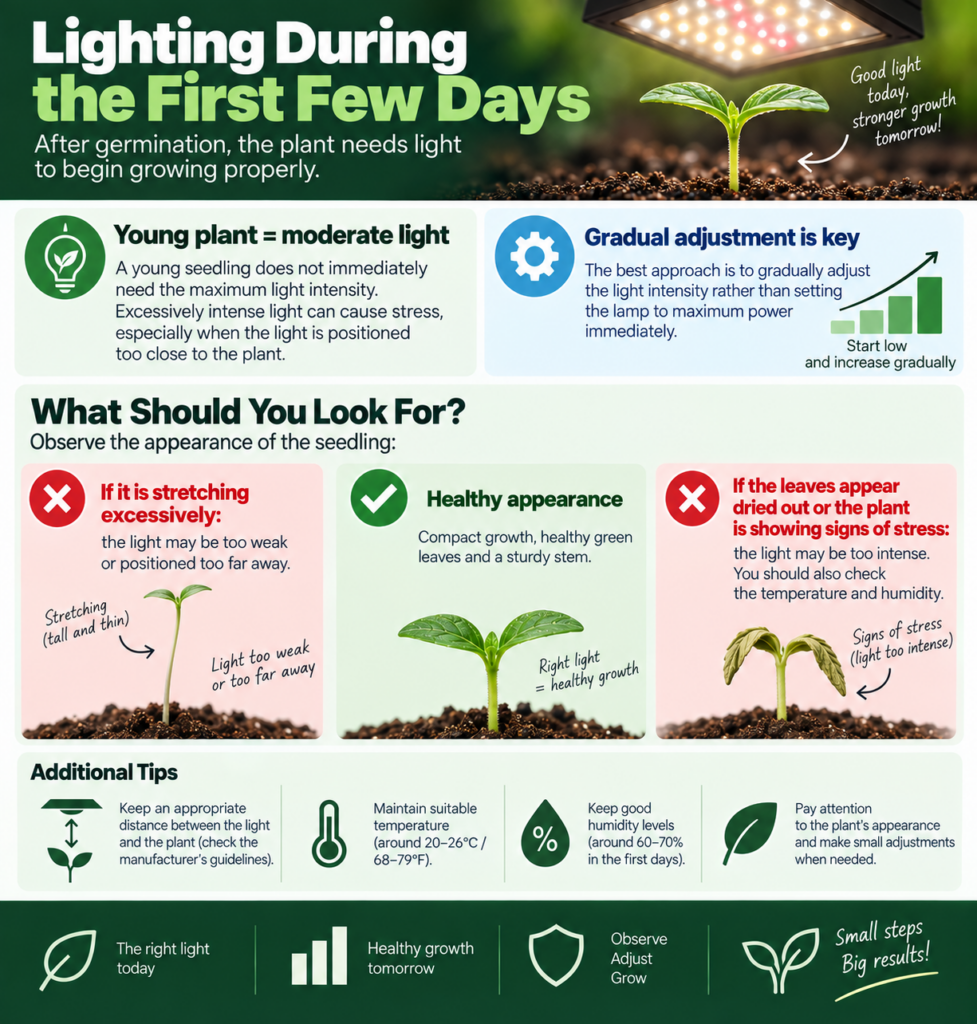
At the same time, a young seedling does not immediately need the maximum light intensity.
Excessively intense light can cause stress, especially when the light is positioned too close to the plant.
What Should You Look For?
Observe the appearance of the seedling:
If it is stretching excessively:
the light may be too weak or positioned too far away.
If the leaves appear dried out or the plant is clearly showing signs of stress:
the light may be too intense. You should also check the temperature and humidity.
The best approach is to gradually adjust the light intensity rather than setting the lamp to maximum power immediately.
5. Temperature and Humidity
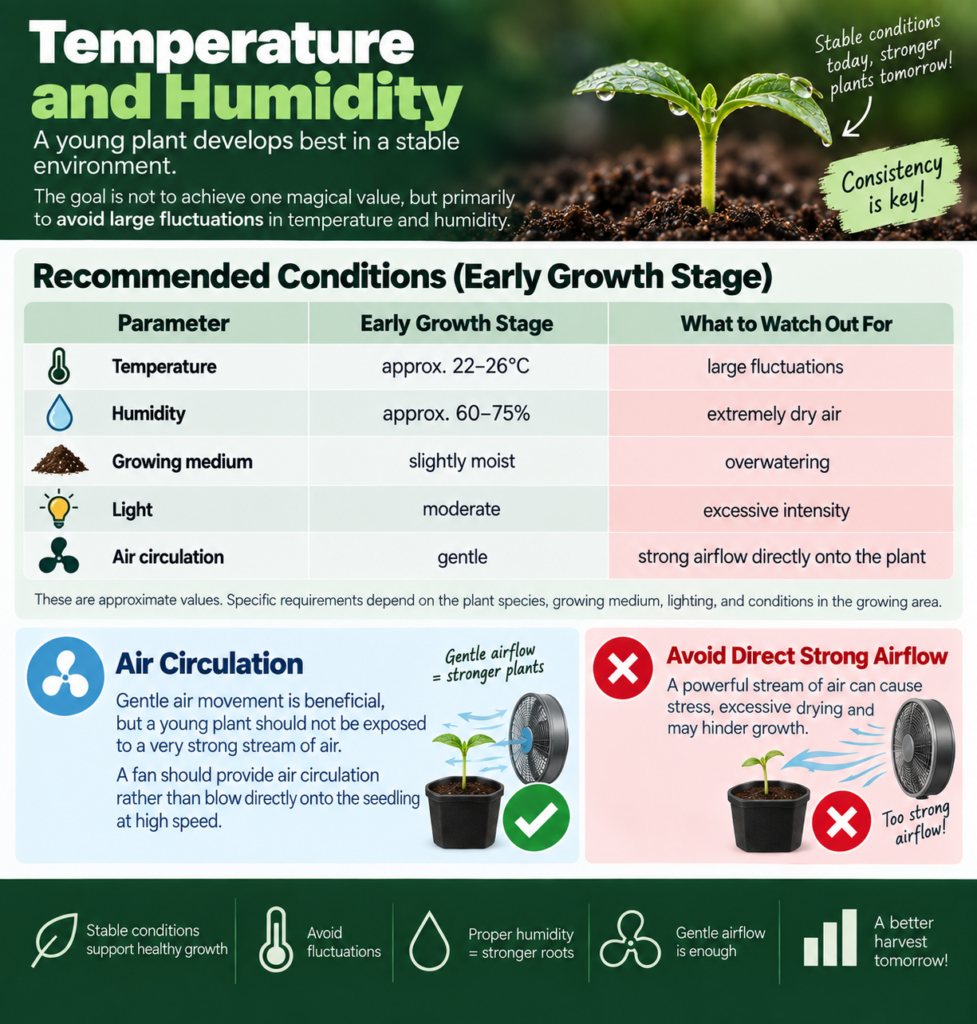
A young plant develops best in a stable environment.
The goal is not to achieve one magical value, but primarily to avoid large fluctuations in temperature and humidity.
| Parameter | Early Growth Stage | What to Watch Out For |
|---|---|---|
| Temperature | approx. 22–26°C | large fluctuations |
| Humidity | approx. 60–75% | extremely dry air |
| Growing medium | slightly moist | overwatering |
| Light | moderate | excessive intensity |
| Air circulation | gentle | strong airflow directly onto the plant |
These are approximate values. Specific requirements depend on the plant species, growing medium, lighting, and conditions in the growing area.
Air Circulation
Gentle air movement is beneficial, but a young plant should not be exposed to a very strong stream of air.
A fan should provide air circulation rather than blow directly onto the seedling at high speed.
6. Does a Young Plant Need Nutrients?
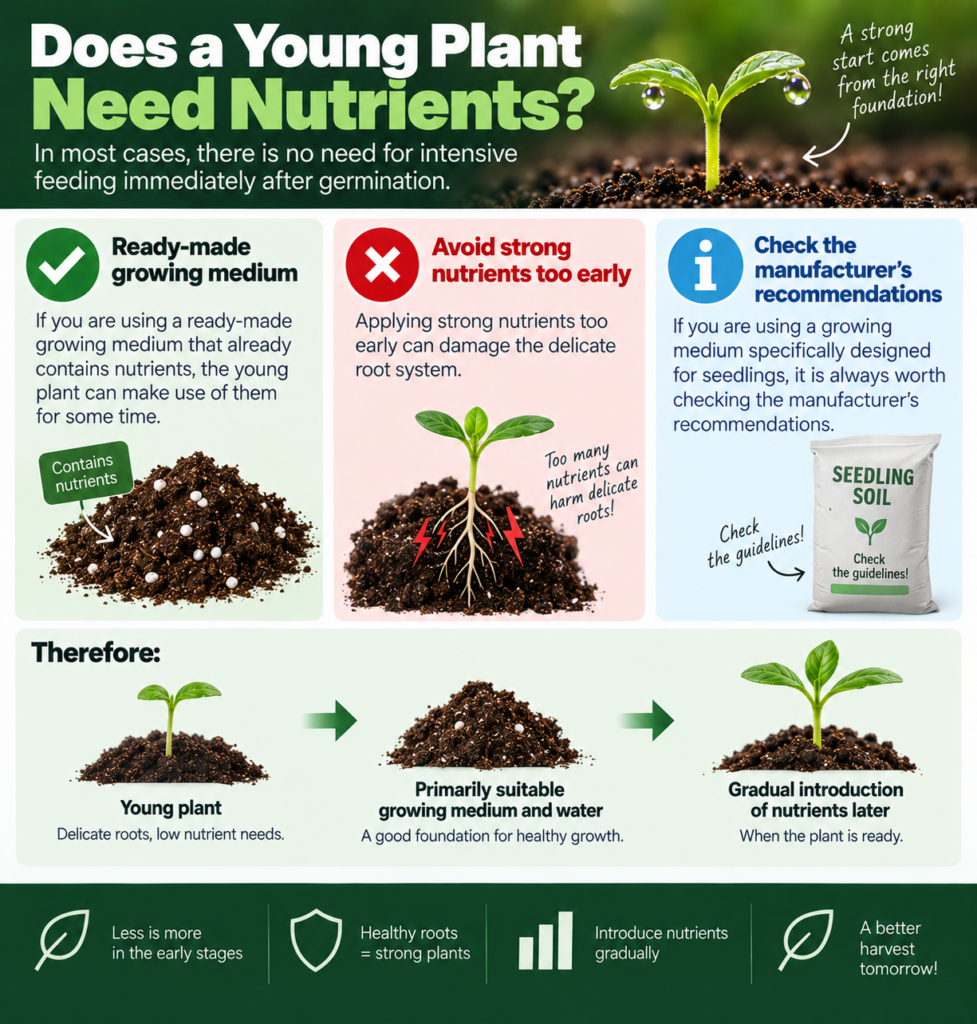
In most cases, there is no need for intensive feeding immediately after germination.
If you are using a ready-made growing medium that already contains nutrients, the young plant can make use of them for some time.
Applying strong nutrients too early can damage the delicate root system.
Therefore:
young plant → primarily suitable growing medium and water → gradual introduction of nutrients later.
If you are using a growing medium specifically designed for seedlings, it is always worth checking the manufacturer’s recommendations.
7. When Should You Transplant a Young Plant?
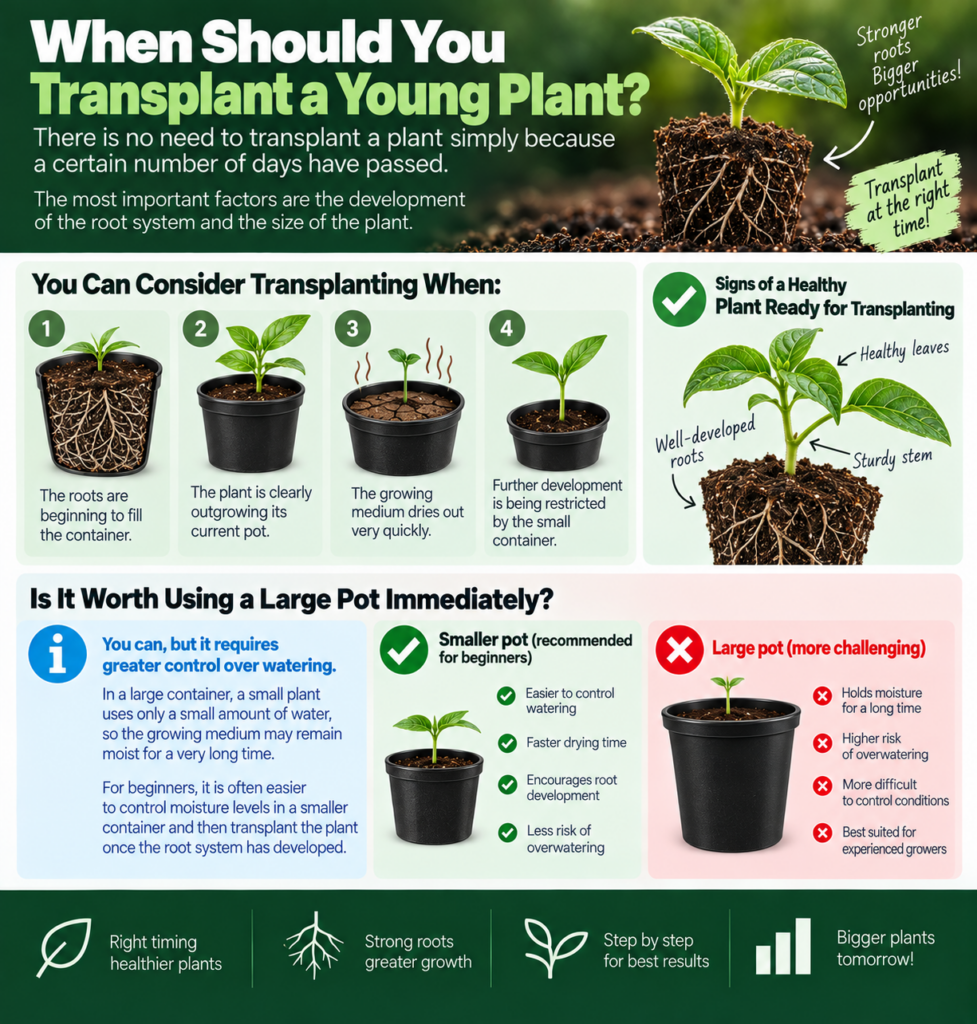
There is no need to transplant a plant simply because a certain number of days have passed.
The most important factors are the development of the root system and the size of the plant.
You can consider transplanting when:
- the roots are beginning to fill the container,
- the plant is clearly outgrowing its current pot,
- the growing medium dries out very quickly,
- further development is being restricted by the small container.
Is It Worth Using a Large Pot Immediately?
You can, but it requires greater control over watering.
In a large container, a small plant uses only a small amount of water, so the growing medium may remain moist for a very long time.
For beginners, it is often easier to control moisture levels in a smaller container and then transplant the plant once the root system has developed.
The Most Common Beginner Mistakes
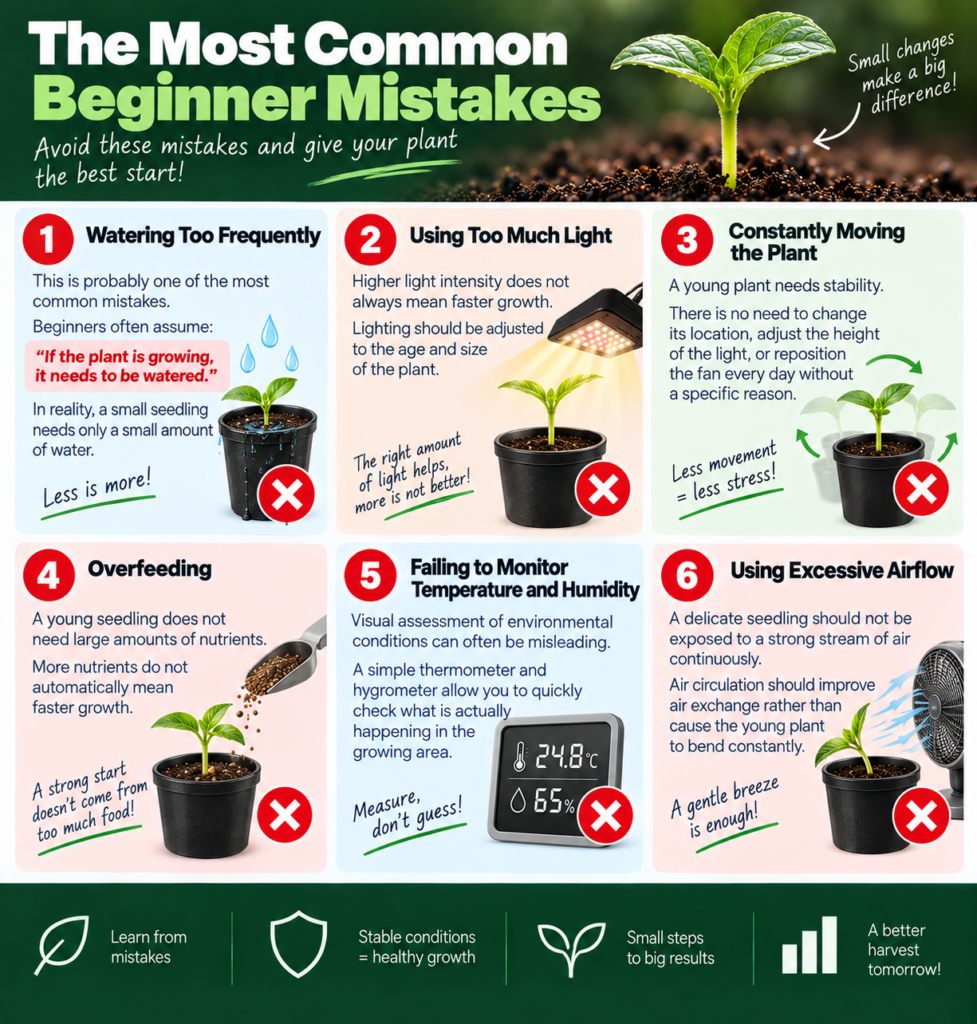
1. Watering Too Frequently
This is probably one of the most common mistakes.
Beginners often assume:
“If the plant is growing, it needs to be watered.”
In reality, a small seedling needs only a small amount of water.
2. Using Too Much Light
Higher light intensity does not always mean faster growth.
Lighting should be adjusted to the age and size of the plant.
3. Constantly Moving the Plant
A young plant needs stability.
There is no need to change its location, adjust the height of the light, or reposition the fan every day without a specific reason.
4. Overfeeding
A young seedling does not need large amounts of nutrients.
More nutrients do not automatically mean faster growth.
5. Failing to Monitor Temperature and Humidity
Visual assessment of environmental conditions can often be misleading.
A simple thermometer and hygrometer allow you to quickly check what is actually happening in the growing area.
6. Using Excessive Airflow
A delicate seedling should not be exposed to a strong stream of air continuously.
Air circulation should improve air exchange rather than cause the young plant to bend constantly.
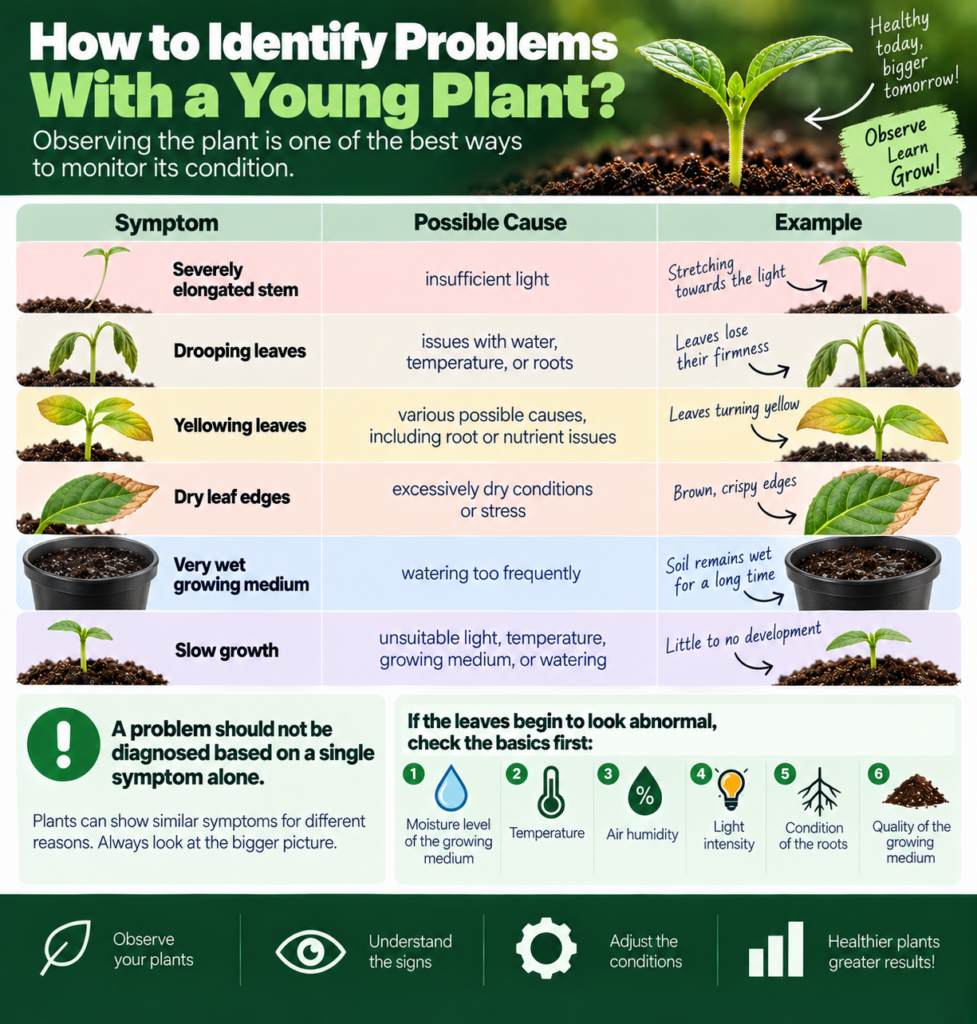
How to Identify Problems With a Young Plant?
Observing the plant is one of the best ways to monitor its condition.
| Symptom | Possible Cause |
|---|---|
| Severely elongated stem | insufficient light |
| Drooping leaves | issues with water, temperature, or roots |
| Yellowing leaves | various possible causes, including root or nutrient issues |
| Dry leaf edges | excessively dry conditions or stress |
| Very wet growing medium | watering too frequently |
| Slow growth | unsuitable light, temperature, growing medium, or watering |
A problem should not be diagnosed based on a single symptom alone.
If the leaves begin to look abnormal, check the basics first:
- moisture level of the growing medium,
- temperature,
- air humidity,
- light intensity,
- condition of the roots,
- quality of the growing medium.
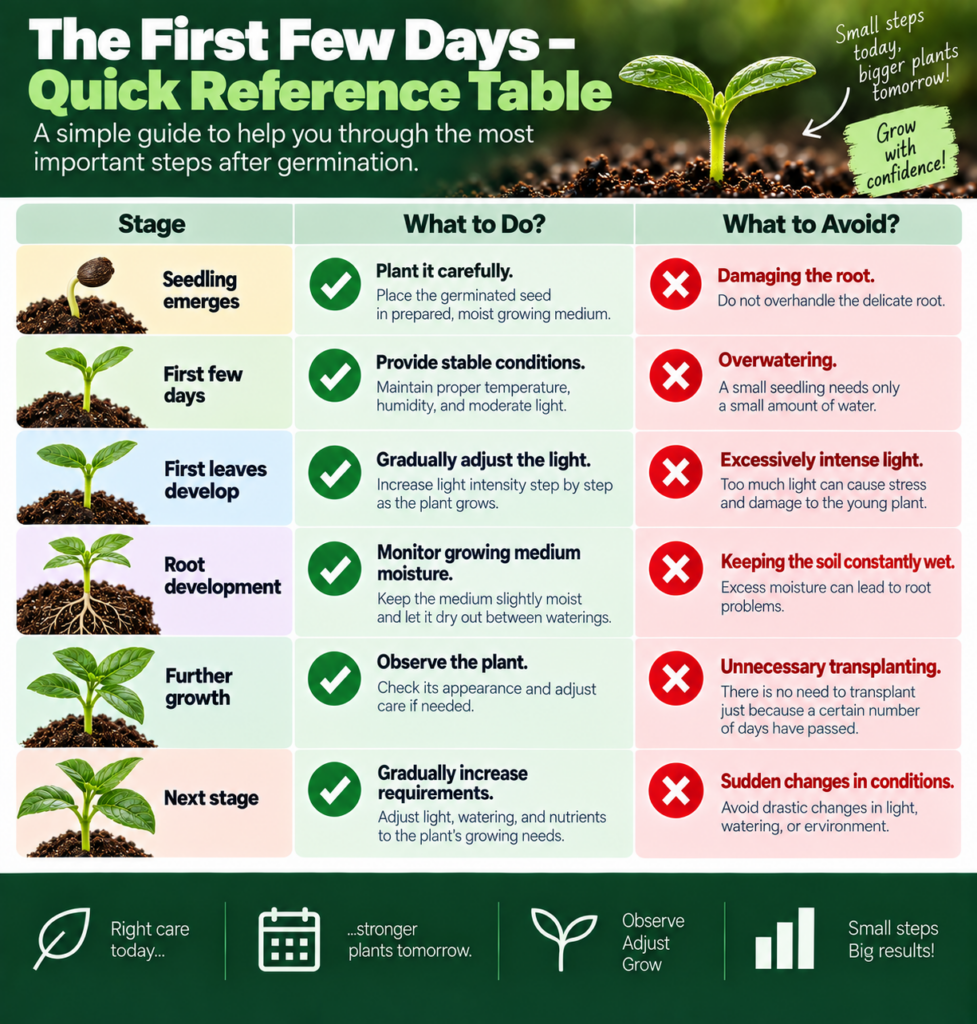
The First Few Days – Quick Reference Table
| Stage | What to Do? | What to Avoid? |
|---|---|---|
| Seedling emerges | Plant it carefully | Damaging the root |
| First few days | Provide stable conditions | Overwatering |
| First leaves develop | Gradually adjust the light | Excessively intense light |
| Root development | Monitor growing medium moisture | Keeping the soil constantly wet |
| Further growth | Observe the plant | Unnecessary transplanting |
| Next stage | Gradually increase requirements | Sudden changes in conditions |
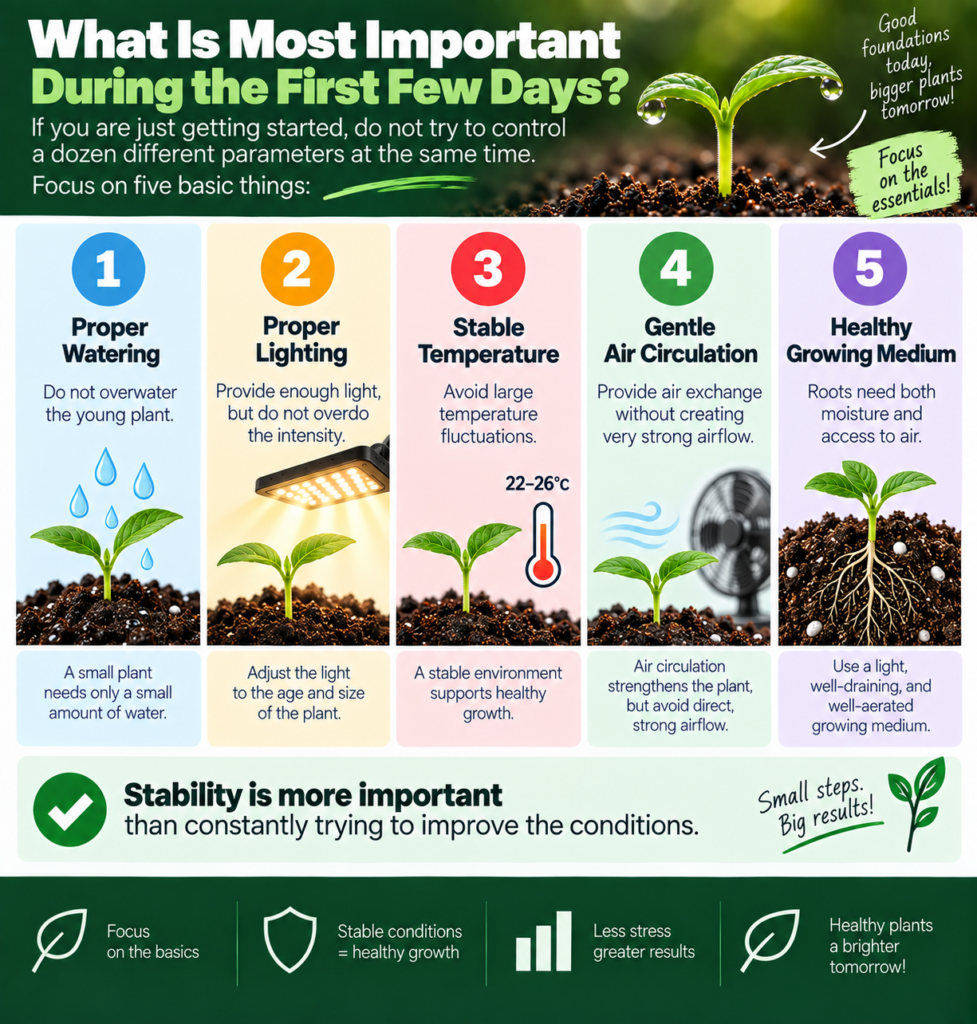
What Is Most Important During the First Few Days?
If you are just getting started, do not try to control a dozen different parameters at the same time.
Focus on five basic things:
💧 1. Proper Watering
Do not overwater the young plant.
💡 2. Proper Lighting
Provide enough light, but do not overdo the intensity.
🌡️ 3. Stable Temperature
Avoid large temperature fluctuations.
💨 4. Gentle Air Circulation
Provide air exchange without creating very strong airflow.
🌱 5. Healthy Growing Medium
Roots need both moisture and access to air.
Stability is more important than constantly trying to improve the conditions.
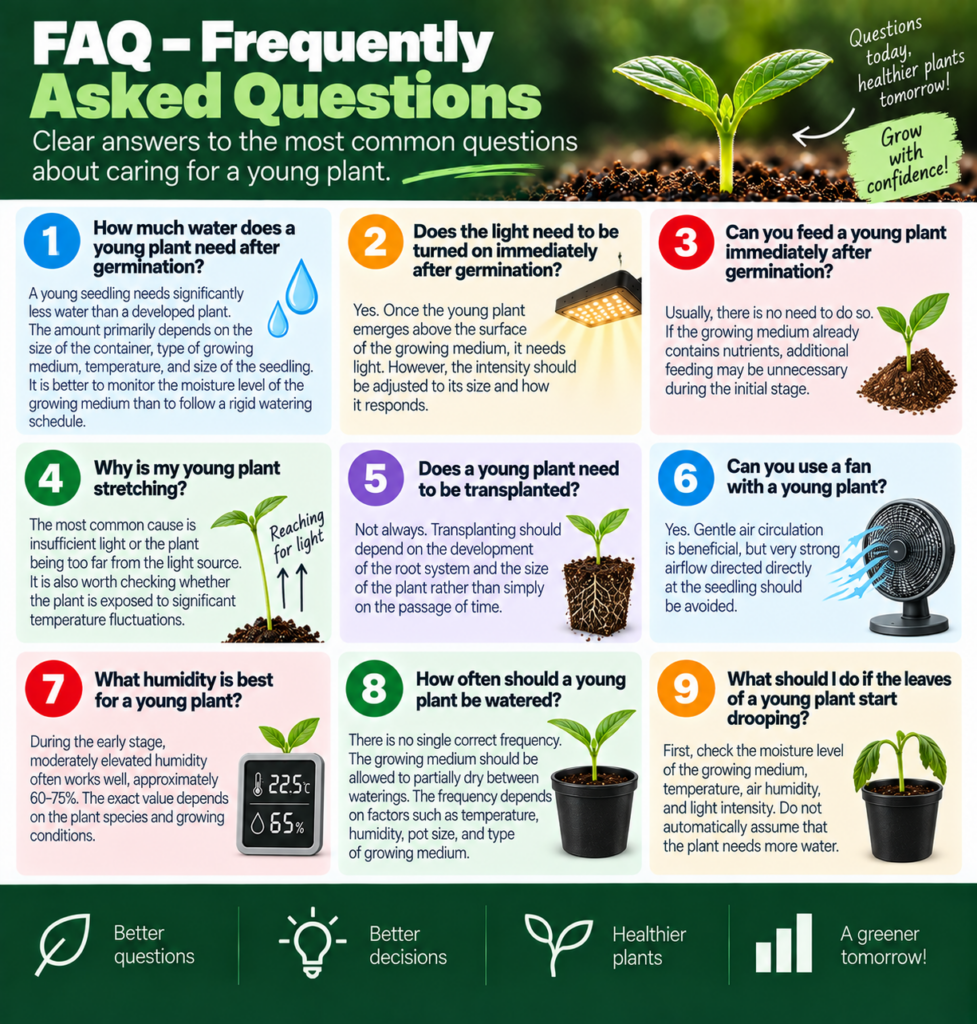
FAQ – Frequently Asked Questions
How much water does a young plant need after germination?
A young seedling needs significantly less water than a developed plant. The amount primarily depends on the size of the container, type of growing medium, temperature, and size of the seedling. It is better to monitor the moisture level of the growing medium than to follow a rigid watering schedule.
Does the light need to be turned on immediately after germination?
Yes. Once the young plant emerges above the surface of the growing medium, it needs light. However, the intensity should be adjusted to its size and how it responds.
Can you feed a young plant immediately after germination?
Usually, there is no need to do so. If the growing medium already contains nutrients, additional feeding may be unnecessary during the initial stage.
Why is my young plant stretching?
The most common cause is insufficient light or the plant being too far from the light source. It is also worth checking whether the plant is exposed to significant temperature fluctuations.
Does a young plant need to be transplanted?
Not always. Transplanting should depend on the development of the root system and the size of the plant rather than simply on the passage of time.
Can you use a fan with a young plant?
Yes. Gentle air circulation is beneficial, but very strong airflow directed directly at the seedling should be avoided.
What humidity is best for a young plant?
During the early stage, moderately elevated humidity often works well, approximately 60–75%. The exact value depends on the plant species and growing conditions.
How often should a young plant be watered?
There is no single correct frequency. The growing medium should be allowed to partially dry between waterings. The frequency depends on factors such as temperature, humidity, pot size, and type of growing medium.
What should I do if the leaves of a young plant start drooping?
First, check the moisture level of the growing medium, temperature, air humidity, and light intensity. Do not automatically assume that the plant needs more water.
Summary
The first few days after germination do not require complicated procedures. The most important thing is to provide the young plant with a stable environment, appropriate lighting, moderate growing-medium moisture, a suitable temperature, and gentle air circulation.
One of the biggest mistakes beginners make is often doing too much rather than too little. A young plant needs time to develop its roots and begin vigorous growth.
Observe the plant, monitor the basic parameters, and respond to its actual needs rather than following a rigid schedule.