How to Store Cannabis Flower: A Complete Guide for Beginners
Properly storing cannabis flower is important for preserving its aroma, quality, and chemical stability. Even well-dried plant material changes gradually over time. The main factors affecting the rate of these changes are temperature, light, oxygen exposure, and humidity.
Many beginners focus on drying and forget that improper storage can undo some of the work they have already put in. A clear glass jar left in direct sunlight, an airtight container that does not seal properly, or sealing material that has not dried sufficiently can all lead to a decline in quality and, in some circumstances, mold growth.
That does not mean storage requires expensive equipment. The key is understanding a few basic parameters and avoiding mistakes that can cause irreversible changes.
This guide covers specific temperatures, relative humidity, water activity, container types, and the shelf life of cannabis flower. You will also find comparisons, a table of the most important parameters, and answers to frequently asked questions.
Table of Contents
Why Is Proper Cannabis Flower Storage Important?
What Affects Cannabis Flower Quality?
What Is the Best Temperature for Storing Cannabis Flower?
What Humidity Level Is Appropriate?
What Is the Difference Between RH, Moisture Content, and Water Activity?
How Long Can Cannabis Flower Be Stored?
Which Containers Are Best for Storage?
How Do Light and Oxygen Affect Cannabis Flower?
Are Humidity-Control Packs Necessary?
Can Cannabis Flower Be Stored in a Refrigerator or Freezer?
How Can You Recognize Mold on Cannabis Flower?
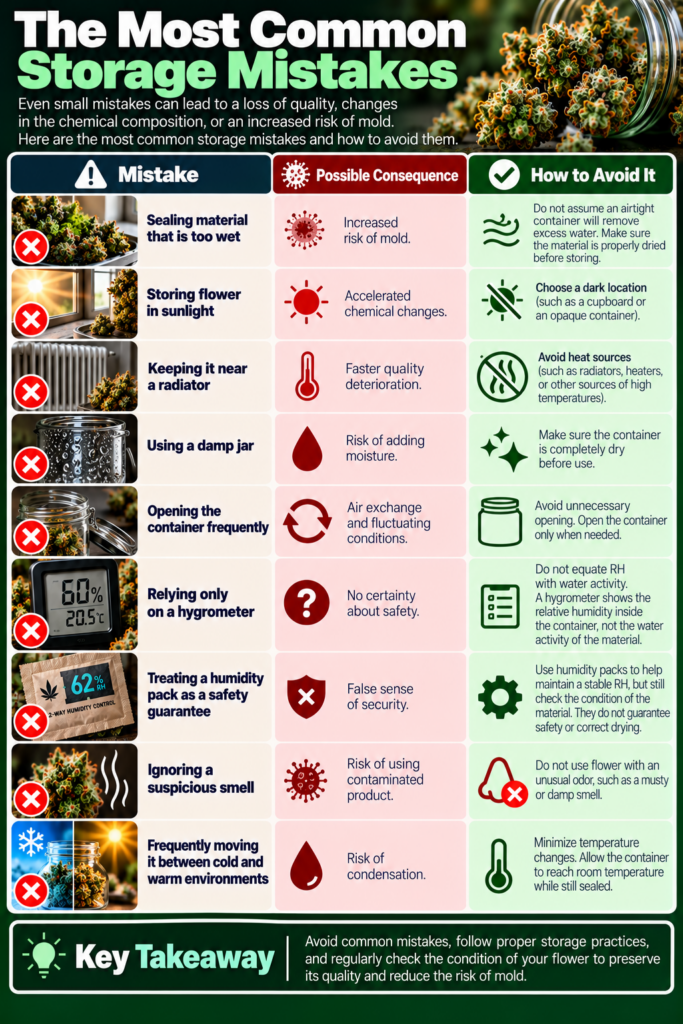
The Most Common Storage Mistakes
How to Store Cannabis Safely at Home
FAQ – Frequently Asked Questions
Summary
1. Why Is Proper Cannabis Flower Storage Important?
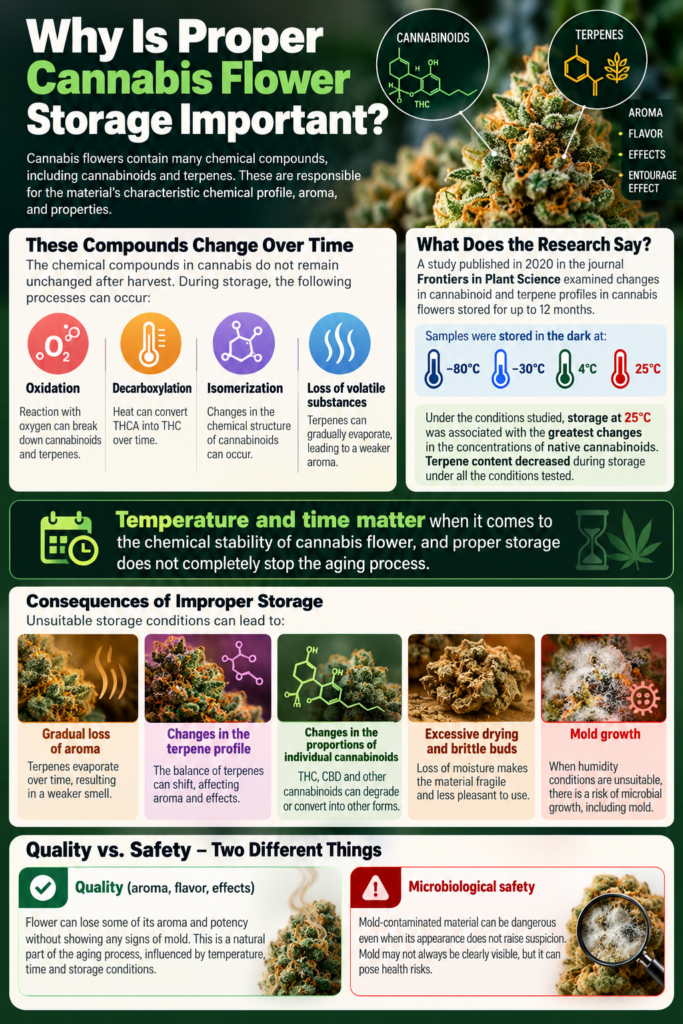
Cannabis flowers contain many chemical compounds, including cannabinoids and terpenes. These are responsible for the material’s characteristic chemical profile, aroma, and properties.
These compounds do not remain unchanged after harvest. Oxidation, decarboxylation, isomerization, and the loss of volatile substances can occur during storage.
A study published in 2020 in the journal Frontiers in Plant Science examined changes in cannabinoid and terpene profiles in cannabis flowers stored for up to 12 months. The authors compared samples kept in the dark at −80°C, −30°C, 4°C, and 25°C.
Under the conditions studied, storage at 25°C was associated with the greatest changes in the concentrations of native cannabinoids. At the same time, terpene content decreased during storage under all the conditions tested.
The findings show that temperature and time matter when it comes to the chemical stability of cannabis flower, and that proper storage does not completely stop the aging process.
In practice, unsuitable storage conditions can lead to:
Gradual loss of aroma.
Changes in the terpene profile.
Changes in the proportions of individual cannabinoids.
Excessive drying and brittle buds.
Mold growth when humidity conditions are unsuitable.
It is important to distinguish between two things: preserving quality and microbiological safety.
Flower can lose some of its aroma without showing signs of mold. Conversely, mold-contaminated material can be dangerous even when its appearance does not raise suspicion.
2. What Affects Cannabis Flower Quality?
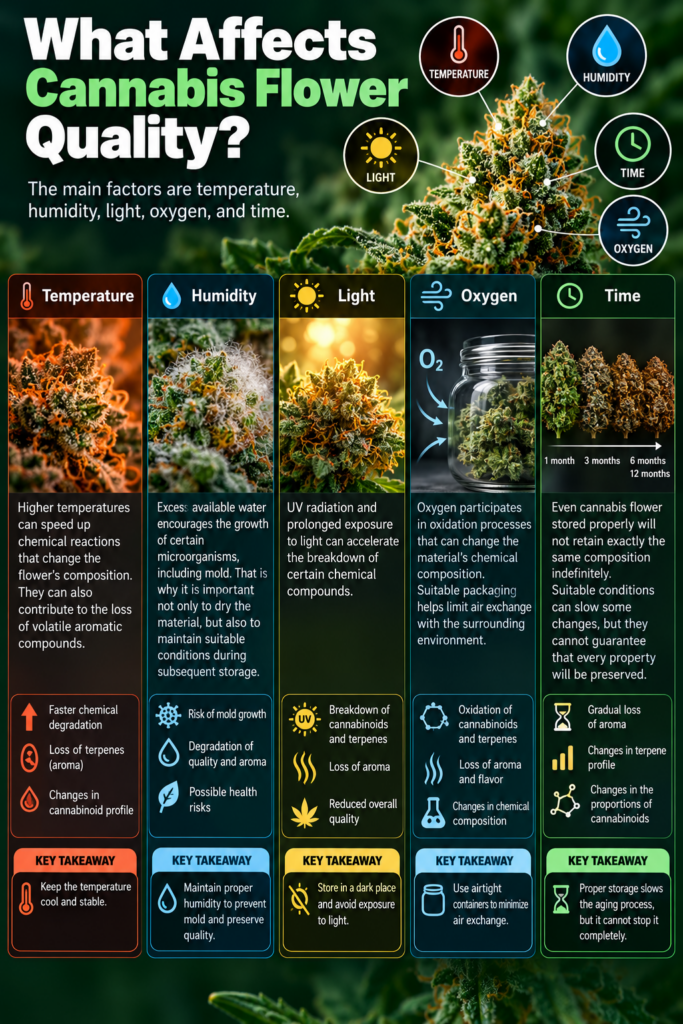
The main factors are temperature, humidity, light, oxygen, and time.
Temperature
Higher temperatures can speed up chemical reactions that change the flower’s composition. They can also contribute to the loss of volatile aromatic compounds.
Humidity
Excess available water encourages the growth of certain microorganisms, including mold. That is why it is important not only to dry the material, but also to maintain suitable conditions during subsequent storage.
Light
UV radiation and prolonged exposure to light can accelerate the breakdown of certain chemical compounds.
Oxygen
Oxygen participates in oxidation processes that can change the material’s chemical composition. Suitable packaging helps limit air exchange with the surrounding environment.
Time
Even cannabis flower stored properly will not retain exactly the same composition indefinitely.
Suitable conditions can slow some changes, but they cannot guarantee that every property will be preserved.
3. What Is the Best Temperature for Storing Cannabis Flower?
Temperature is one of the best-documented factors affecting the chemical stability of cannabis.
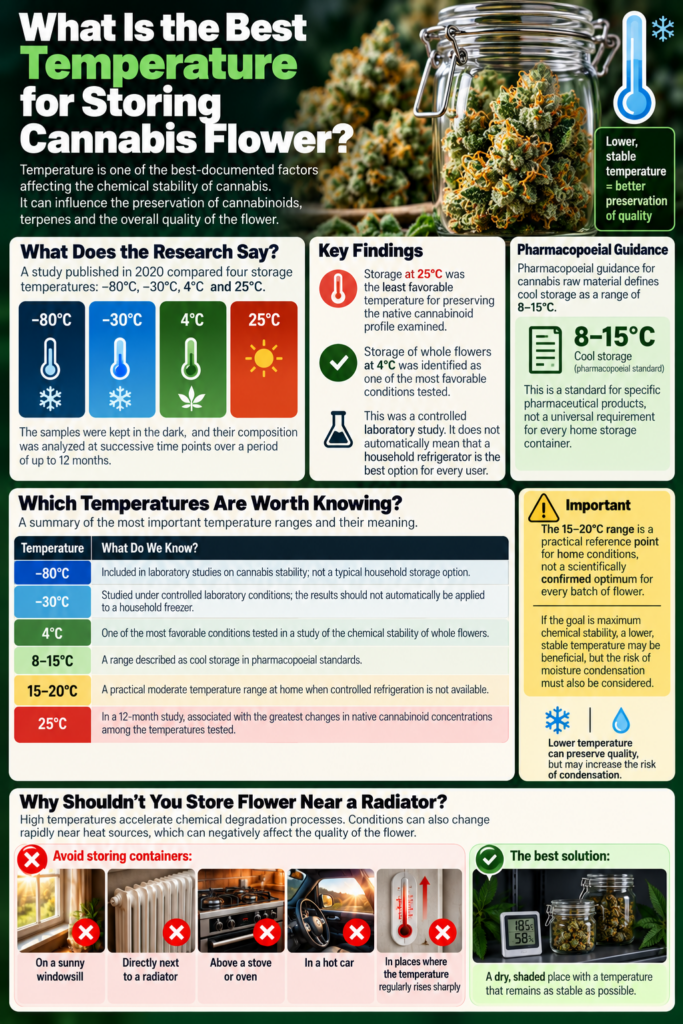
A study published in 2020 compared four storage temperatures: −80°C, −30°C, 4°C, and 25°C.
The samples were kept in the dark, and their composition was analyzed at successive time points over a period of up to 12 months.
The results indicated that 25°C was the least favorable temperature for preserving the cannabinoid profile examined. The authors identified storage of whole flowers at 4°C as one of the most favorable conditions tested.
However, it is important to remember that this was a controlled laboratory study. It does not automatically mean that a household refrigerator is the best option for every user.
Which Temperatures Are Worth Knowing?
Pharmacopoeial guidance for cannabis raw material defines cool storage as a range of 8–15°C. This is a standard for specific pharmaceutical products, not a universal requirement for every home storage container.
For home storage, the most important thing is to avoid prolonged exposure to high temperatures and major fluctuations in conditions.
| Temperature | What Do We Know? |
|---|---|
| −80°C | Included in laboratory studies on cannabis stability; not a typical household storage option. |
| −30°C | Studied under controlled laboratory conditions; the results should not automatically be applied to a household freezer. |
| 4°C | One of the most favorable conditions tested in a study of the chemical stability of whole flowers. |
| 8–15°C | A range described as cool storage in pharmacopoeial standards. |
| 15–20°C | A practical moderate temperature range at home when controlled refrigeration is not available. |
| 25°C | In a 12-month study, associated with the greatest changes in native cannabinoid concentrations among the temperatures tested. |
Important: The 15–20°C range is a practical reference point for home conditions, not a scientifically confirmed optimum for every batch of flower. If the goal is maximum chemical stability, a lower, stable temperature may be beneficial, but the risk of moisture condensation must also be considered.
Why Shouldn’t You Store Flower Near a Radiator?
High temperatures accelerate some degradation processes. Conditions can also change rapidly near heat sources.
Avoid storing containers:
On a sunny windowsill.
Directly next to a radiator.
Above a stove or oven.
In a hot car.
In places where the temperature regularly rises sharply.
The simplest solution is a dry, shaded place with a temperature that remains as stable as possible.
4. What Humidity Level Is Appropriate?
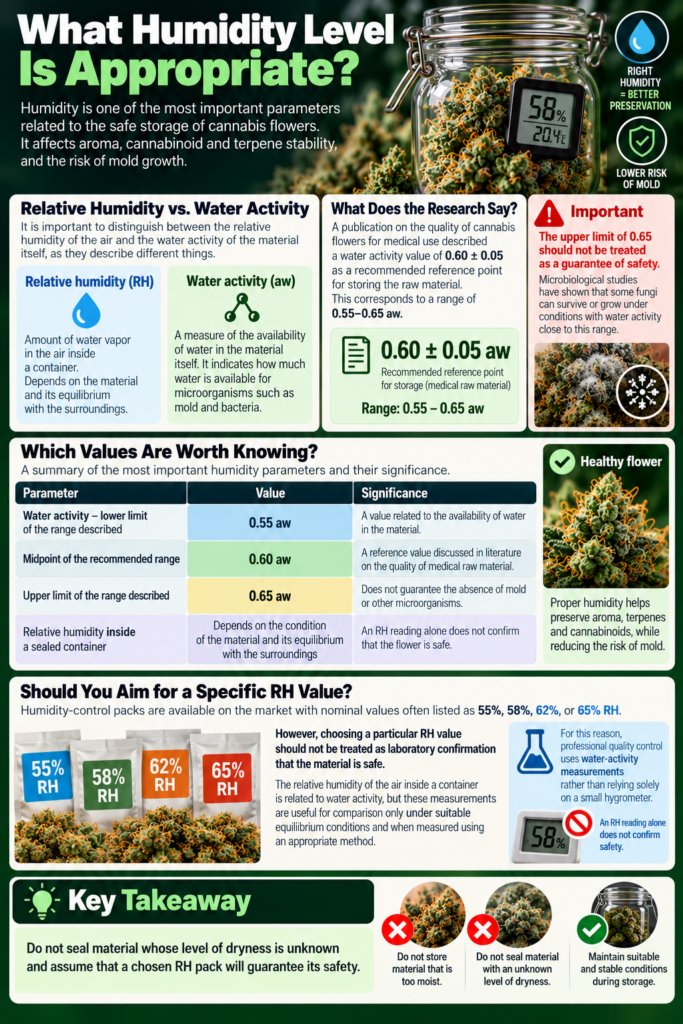
Humidity is one of the most important parameters related to the safe storage of cannabis flowers.
However, it is worth distinguishing between the relative humidity of the air and the water activity of the material itself.
A publication on the quality of cannabis flowers for medical use described a water activity value of 0.60 ± 0.05 as a recommended reference point for storing the raw material.
This corresponds to a range of 0.55–0.65 aw.
However, the upper limit of 0.65 should not be treated as a guarantee of safety. Microbiological studies have shown that some fungi can survive or grow under conditions with water activity close to this range.
Which Values Are Worth Knowing?
| Parameter | Value | Significance |
|---|---|---|
| Water activity – lower limit of the range described | 0.55 aw | A value related to the availability of water in the material. |
| Midpoint of the recommended range | 0.60 aw | A reference value discussed in literature on the quality of medical raw material. |
| Upper limit of the range described | 0.65 aw | Does not guarantee the absence of mold or other microorganisms. |
| Relative humidity inside a sealed container | Depends on the condition of the material and its equilibrium with the surroundings | An RH reading alone does not confirm that the flower is safe. |
Should You Aim for a Specific RH Value?
Humidity-control packs are available on the market with nominal values often listed as 55%, 58%, 62%, or 65% RH.
However, choosing a particular RH value should not be treated as laboratory confirmation that the material is safe.
The relative humidity of the air inside a container is related to water activity, but these measurements are useful for comparison only under suitable equilibrium conditions and when measured using an appropriate method.
For this reason, professional quality control uses water-activity measurements rather than relying solely on a small hygrometer.
The key takeaway: Do not seal material whose level of dryness is unknown and assume that a chosen RH pack will guarantee its safety.
5. What Is the Difference Between RH, Moisture Content, and Water Activity?
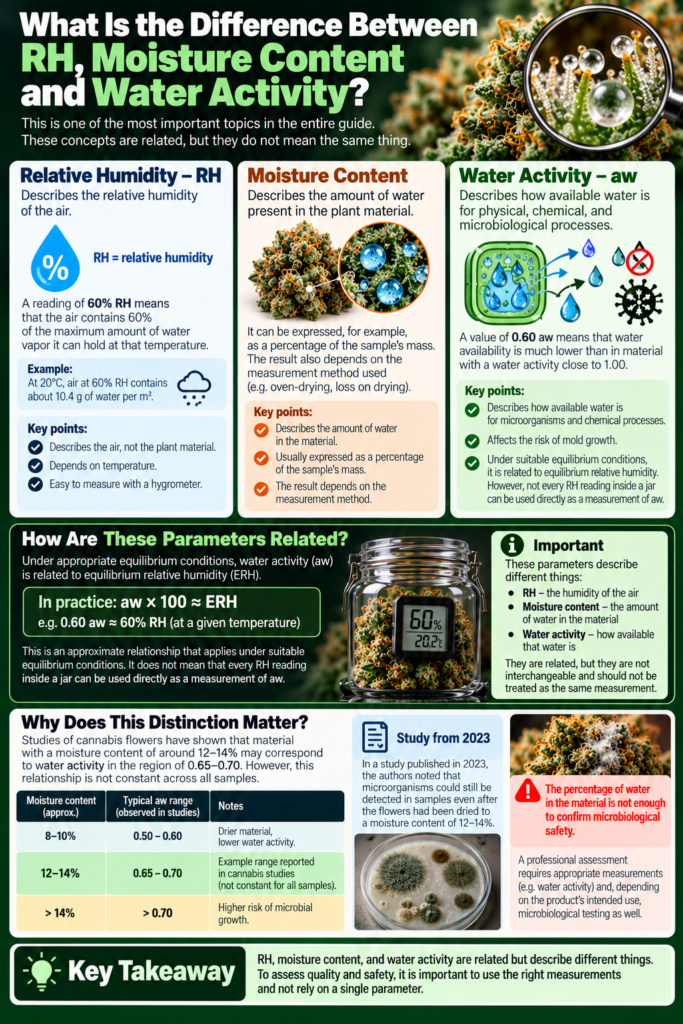
This is one of the most important topics in the entire guide.
These concepts are related, but they do not mean the same thing.
Relative Humidity – RH
RH stands for relative humidity and describes the relative humidity of the air.
For example, a reading of 60% RH means that the air contains 60% of the maximum amount of water vapor it can hold at that temperature.
Moisture Content
Moisture content describes the amount of water present in the plant material.
It can be expressed, for example, as a percentage of the sample’s mass. The result also depends on the measurement method used.
Water Activity – aw
Water activity describes how available water is for physical, chemical, and microbiological processes.
Put simply, a value of 0.60 aw means that water availability is much lower than in material with a water activity close to 1.00.
Under appropriate equilibrium conditions, water activity is related to equilibrium relative humidity. However, that does not mean that every RH reading taken inside a jar can be used directly as a measurement of aw.
Why Does This Distinction Matter?
Studies of cannabis flowers have shown that material with a moisture content of around 12–14% may correspond to water activity in the region of 0.65–0.70. However, this relationship is not constant across all samples.
In a study published in 2023, the authors noted that microorganisms could still be detected in samples even after the flowers had been dried to this moisture range.
Therefore, the percentage of water in the material is not enough to confirm microbiological safety.
A professional assessment requires appropriate measurements and, depending on the product’s intended use, microbiological testing as well.
6. How Long Can Cannabis Flower Be Stored?
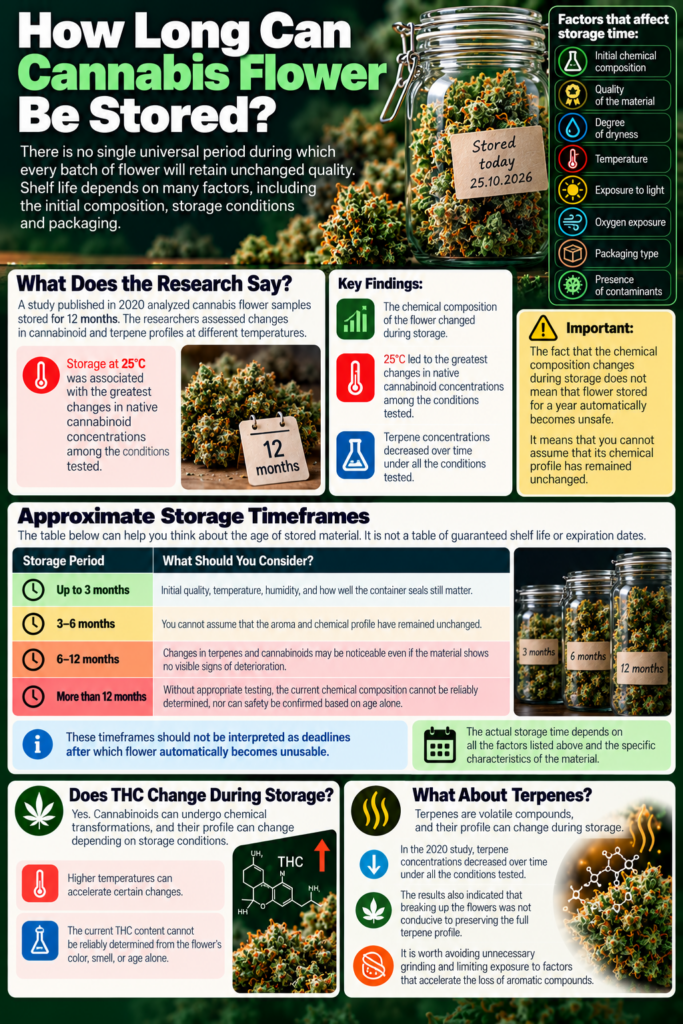
There is no single universal period during which every batch of flower will retain unchanged quality.
Shelf life depends on factors including:
The initial chemical composition.
The quality of the material.
The degree of dryness.
Temperature.
Exposure to light.
Oxygen exposure.
Packaging type.
The presence of contaminants.
A study published in 2020 analyzed cannabis flower samples stored for 12 months. The researchers assessed changes in cannabinoid and terpene profiles at different temperatures.
The results showed that the chemical composition changed during storage, and that 25°C was associated with the greatest changes in native cannabinoid concentrations among the conditions tested.
This does not mean that flower stored for a year automatically becomes unsafe. It means that you cannot assume its chemical profile has remained unchanged.
Approximate Storage Timeframes
The table below can help you think about the age of stored material. It is not a table of guaranteed shelf life or expiration dates.
| Storage Period | What Should You Consider? |
|---|---|
| Up to 3 months | Initial quality, temperature, humidity, and how well the container seals still matter. |
| 3–6 months | You cannot assume that the aroma and chemical profile have remained unchanged. |
| 6–12 months | Changes in terpenes and cannabinoids may be noticeable even if the material shows no visible signs of deterioration. |
| More than 12 months | Without appropriate testing, the current chemical composition cannot be reliably determined, nor can safety be confirmed based on age alone. |
These timeframes should not be interpreted as deadlines after which flower automatically becomes unusable.
Does THC Change During Storage?
Yes. Cannabinoids can undergo chemical transformations, and their profile can change depending on storage conditions.
Laboratory studies indicate that higher temperatures can accelerate certain changes.
However, the current THC content cannot be reliably determined from the flower’s color, smell, or age alone.
What About Terpenes?
Terpenes are volatile compounds, and their profile can change during storage.
In the 2020 study, terpene concentrations decreased over time under all the conditions tested. The results also indicated that breaking up the flowers was not conducive to preserving the full terpene profile.
That is why it is worth avoiding unnecessary grinding and limiting exposure to factors that accelerate the loss of aromatic compounds.
7. Which Containers Are Best for Storage?
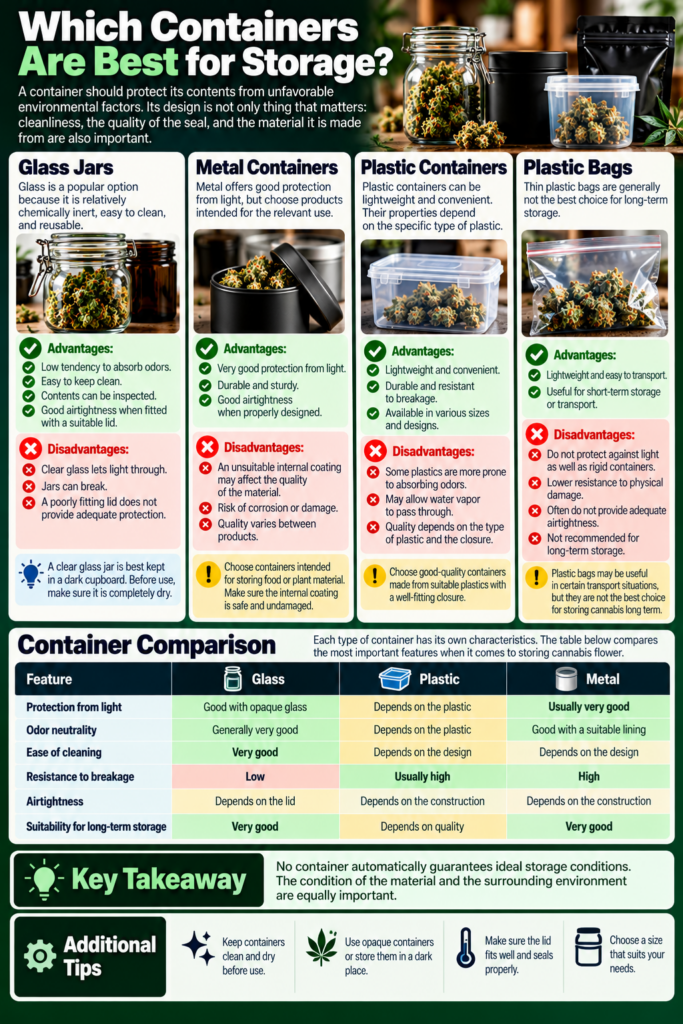
A container should protect its contents from unfavorable environmental factors. Its design is not the only thing that matters: cleanliness, the quality of the seal, and the material it is made from are also important.
Glass Jars
Glass is a popular option because it is relatively chemically inert, easy to clean, and reusable.
Advantages:
Low tendency to absorb odors.
Easy to keep clean.
Contents can be inspected.
Good airtightness when fitted with a suitable lid.
Disadvantages:
Clear glass lets light through.
Jars can break.
A poorly fitting lid does not provide adequate protection.
A clear glass jar is best kept in a dark cupboard. Before use, make sure it is completely dry.
Metal Containers
Metal offers good protection from light, but choose products intended for the relevant use.
An unsuitable internal coating, corrosion, or damage may affect the quality of the stored material.
Plastic Containers
Plastic containers can be lightweight and convenient. Their properties depend on the specific type of plastic.
Some plastics are more prone to absorbing odors and allowing water vapor to pass through. Choose good-quality containers with a well-fitting closure.
Plastic Bags
Thin plastic bags are generally not the best choice for long-term storage.
They may be useful for certain transport situations, but often do not protect against light, physical damage, and changing conditions as well as a suitable rigid container.
Container Comparison
| Feature | Glass | Plastic | Metal |
|---|---|---|---|
| Protection from light | Good with opaque glass | Depends on the plastic | Usually very good |
| Odor neutrality | Generally very good | Depends on the plastic | Good with a suitable lining |
| Ease of cleaning | Very good | Depends on the design | Depends on the design |
| Resistance to breakage | Low | Usually high | High |
| Airtightness | Depends on the lid | Depends on the construction | Depends on the construction |
| Suitability for long-term storage | Very good | Depends on quality | Very good |
No container automatically guarantees ideal storage conditions. The condition of the material and the surrounding environment are equally important.
8. How Do Light and Oxygen Affect Cannabis Flower?
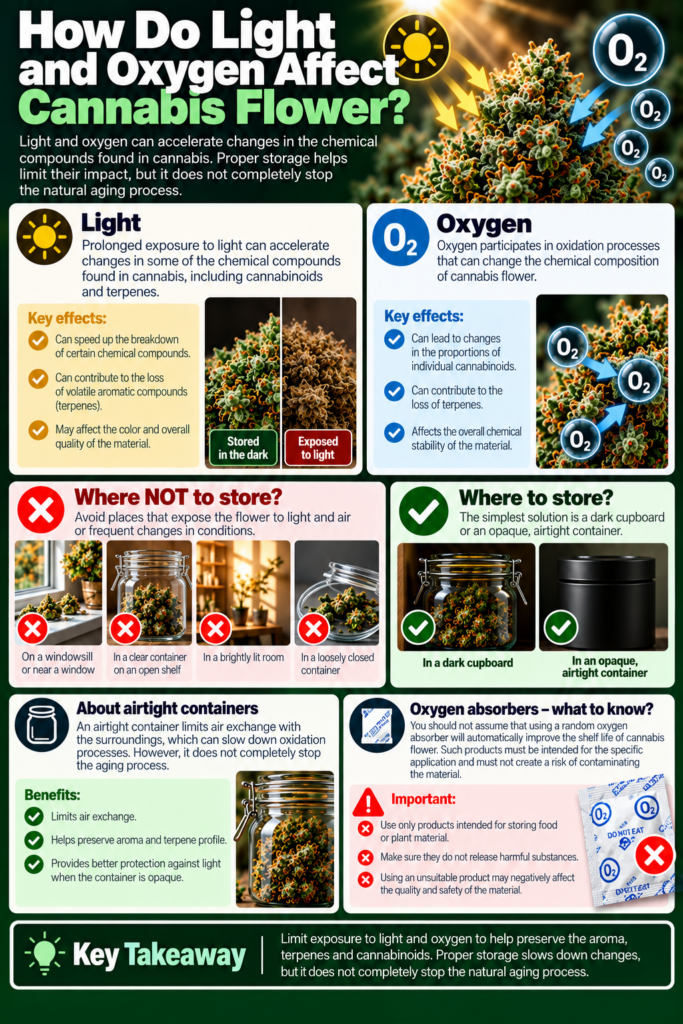
Light
Prolonged exposure to light can accelerate changes in some of the chemical compounds found in cannabis.
For this reason, avoid storing flower on a windowsill, near a window, or in a clear container left on an open shelf.
The simplest solution is a dark cupboard or an opaque container.
Oxygen
Oxygen participates in oxidation processes that can change the chemical composition.
An airtight container limits air exchange with the surroundings, but it does not completely stop the aging process.
You should also not assume that using a random oxygen absorber will automatically improve the shelf life of cannabis flower. Such products must be intended for the specific application and must not create a risk of contaminating the material.
9. Are Humidity-Control Packs Necessary?
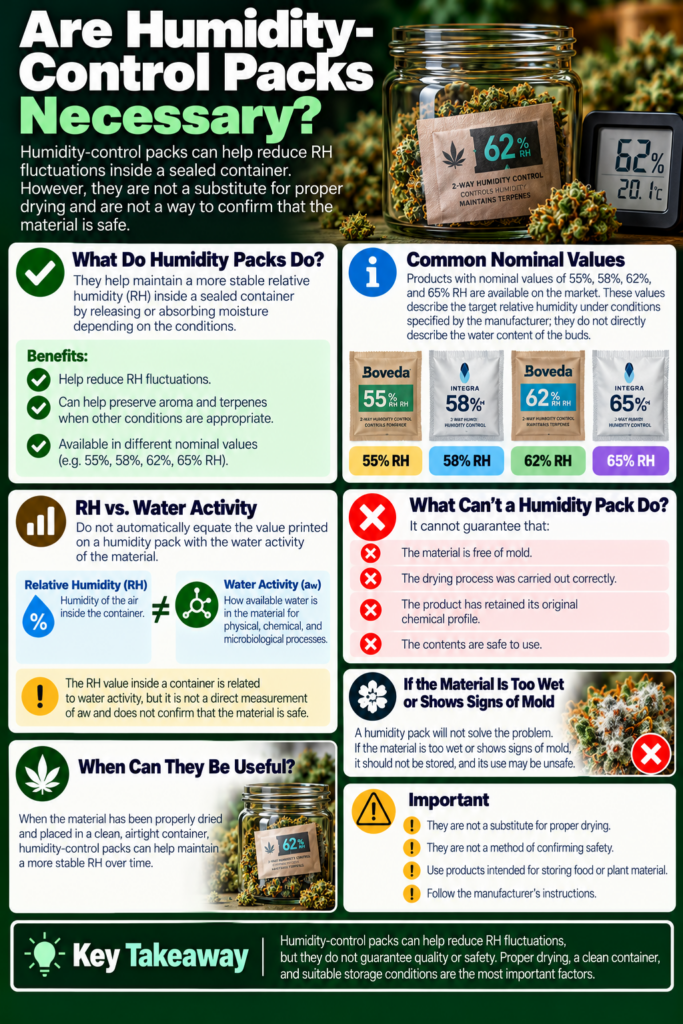
Humidity-control packs can help reduce RH fluctuations inside a sealed container.
However, they are not a substitute for proper drying and are not a way to confirm that the material is safe.
Products with nominal values of 55%, 58%, 62%, and 65% RH are available on the market. These values describe the target relative humidity under conditions specified by the manufacturer; they do not directly describe the water content of the buds.
Do not automatically equate the value printed on a humidity pack with the water activity of the material.
What Can’t a Humidity Pack Do?
It cannot guarantee that:
The material is free of mold.
The drying process was carried out correctly.
The product has retained its original chemical profile.
The contents are safe to use.
If the material is too wet or shows signs of mold, a humidity pack will not solve the problem.
10. Can Cannabis Flower Be Stored in a Refrigerator or Freezer?
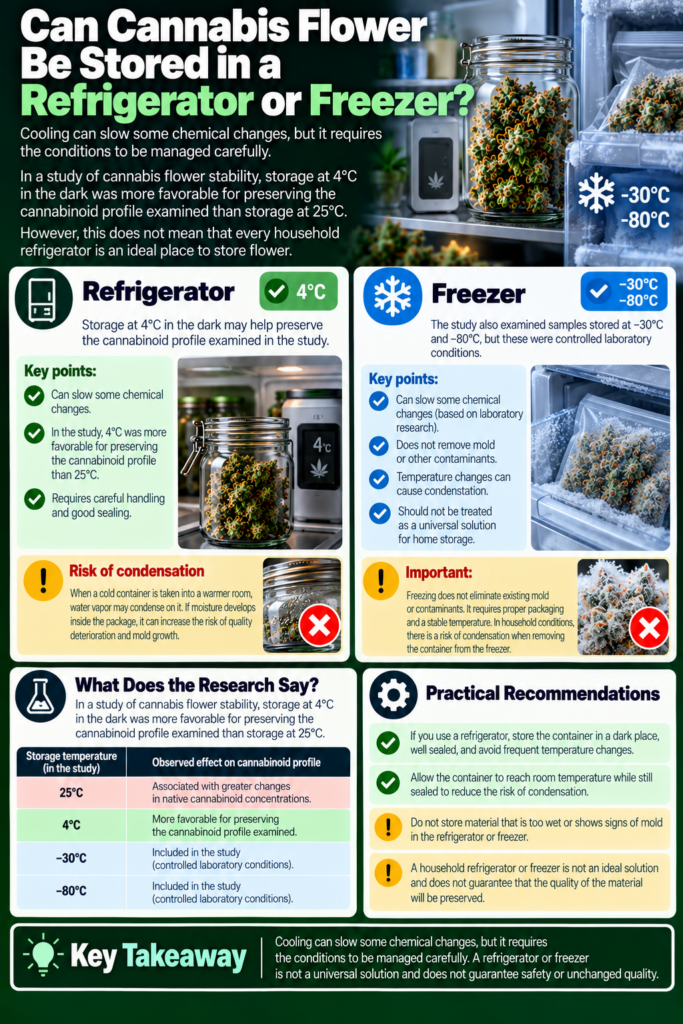
Cooling can slow some chemical changes, but it requires the conditions to be managed carefully.
In a study of cannabis flower stability, storage at 4°C in the dark was more favorable for preserving the cannabinoid profile examined than storage at 25°C.
However, this does not mean that every household refrigerator is an ideal place to store flower.
Refrigerator
When a cold container is taken into a warmer room, water vapor may condense on it.
If moisture develops inside the package, it can increase the risk of quality deterioration and mold growth.
Freezer
The study also examined samples stored at −30°C and −80°C, but these were controlled laboratory conditions.
For home storage, remember that freezing does not remove mold or other contaminants. Temperature changes can also cause condensation.
For this reason, a freezer should not be treated as a universal solution.
11. How Can You Recognize Mold on Cannabis Flower?
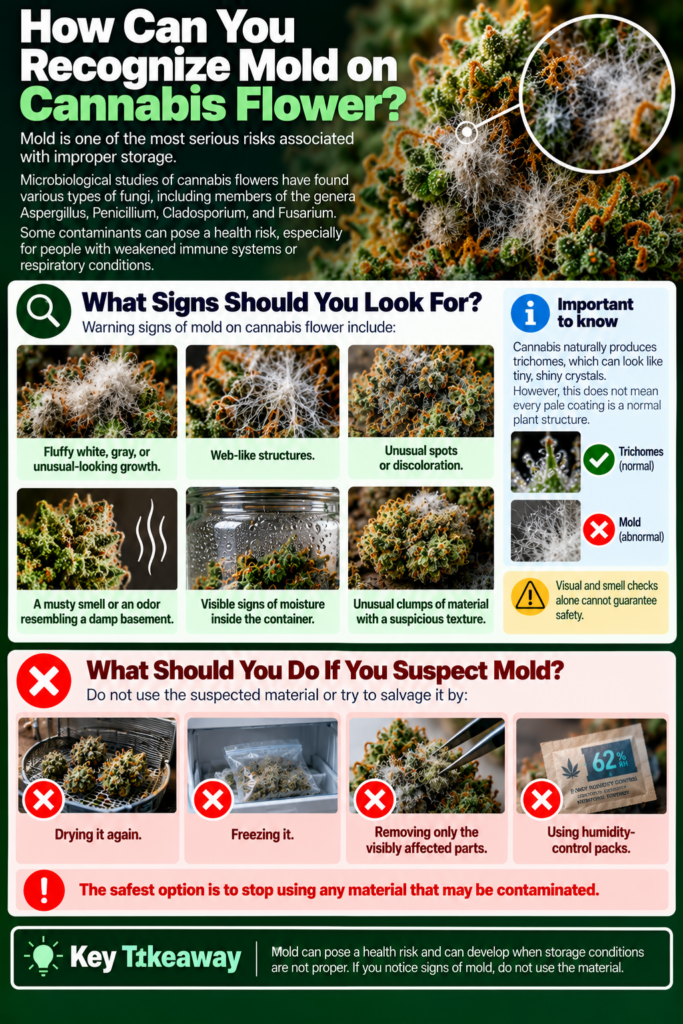
Mold is one of the most serious risks associated with improper storage.
Microbiological studies of cannabis flowers have found various types of fungi, including members of the genera Aspergillus, Penicillium, Cladosporium, and Fusarium.
Some contaminants can pose a health risk, especially for people with weakened immune systems or respiratory conditions.
What Signs Should You Look For?
Warning signs include:
Fluffy white, gray, or unusual-looking growth.
Web-like structures.
Unusual spots or discoloration.
A musty smell or an odor resembling a damp basement.
Visible signs of moisture inside the container.
Unusual clumps of material with a suspicious texture.
Cannabis naturally produces trichomes, which can look like tiny, shiny crystals. However, this does not mean every pale coating is a normal plant structure.
Visual and smell checks alone cannot guarantee safety.
What Should You Do If You Suspect Mold?
Do not use the suspected material or try to salvage it by:
Drying it again.
Freezing it.
Removing only the visibly affected parts.
Using humidity-control packs.
The safest option is to stop using any material that may be contaminated.
12. The Most Common Storage Mistakes
| Mistake | Possible Consequence | How to Avoid It |
|---|---|---|
| Sealing material that is too wet | Increased risk of mold | Do not assume an airtight container will remove excess water |
| Storing flower in sunlight | Accelerated chemical changes | Choose a dark location |
| Keeping it near a radiator | Faster quality deterioration | Avoid heat sources |
| Using a damp jar | Risk of adding moisture | Make sure the container is completely dry |
| Opening the container frequently | Air exchange and fluctuating conditions | Avoid unnecessary opening |
| Relying only on a hygrometer | No certainty about safety | Do not equate RH with water activity |
| Treating a humidity pack as a safety guarantee | False sense of security | Check the condition of the material |
| Ignoring a suspicious smell | Risk of using contaminated product | Do not use suspicious flower |
| Frequently moving it between cold and warm environments | Risk of condensation | Av |
13. How to Store Cannabis Safely at Home
Alongside material quality, household safety is important.
Cannabis flower should be kept in a closed, secure place that is inaccessible to children and pets.
Make sure that:
The container can be securely closed.
The contents are clearly labeled.
The material is inaccessible to children.
The container is not left in a publicly accessible area.
The flower is not stored near food.
Storage complies with applicable law.
Germany has specific rules intended to protect children and young people from access to cannabis. Check the current legal requirements and make sure the material is securely stored.

14. FAQ – Frequently Asked Questions
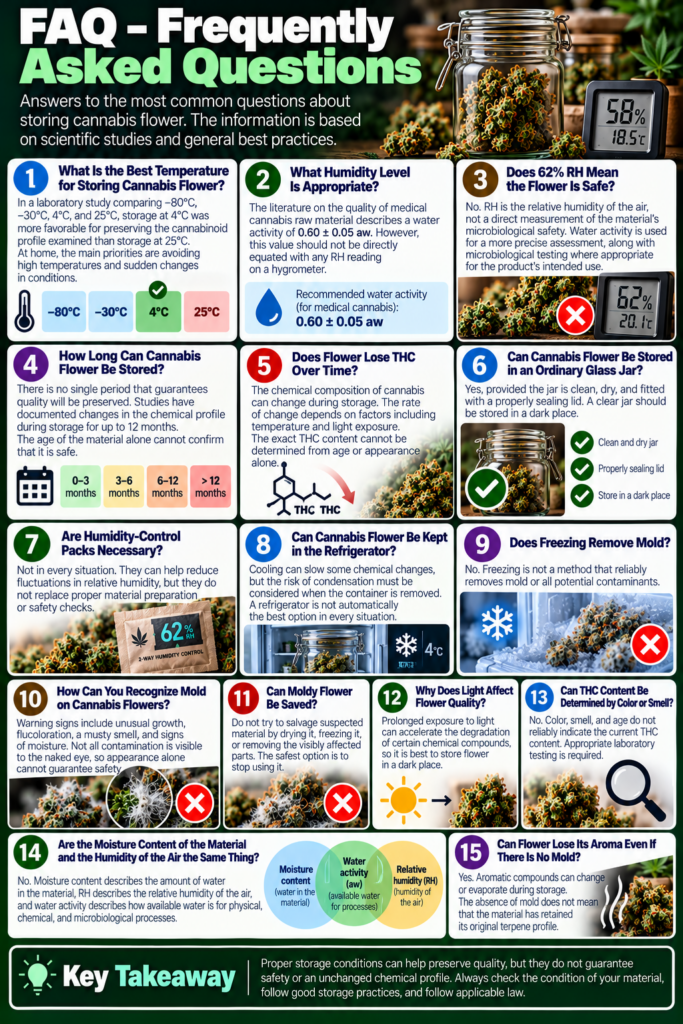
1. What Is the Best Temperature for Storing Cannabis Flower?
In a laboratory study comparing −80°C, −30°C, 4°C, and 25°C, storage at 4°C was more favorable for preserving the cannabinoid profile examined than storage at 25°C. At home, the main priorities are avoiding high temperatures and sudden changes in conditions.
2. What Humidity Level Is Appropriate?
Literature on the quality of medical cannabis raw material describes a water activity of 0.60 ± 0.05 aw. However, this value should not be directly equated with any RH reading on a hygrometer.
3. Does 62% RH Mean the Flower Is Safe?
No. RH is the relative humidity of the air, not a direct measurement of the material’s microbiological safety. Water activity is used for a more precise assessment, along with microbiological testing where appropriate for the product’s intended use.
4. How Long Can Cannabis Flower Be Stored?
There is no single period that guarantees quality will be preserved. Studies have documented changes in the chemical profile during storage for up to 12 months. The age of the material alone cannot confirm that it is safe.
5. Does Flower Lose THC Over Time?
The chemical composition of cannabis can change during storage. The rate of change depends on factors including temperature and light exposure. The exact THC content cannot be determined from age or appearance alone.
6. Can Cannabis Flower Be Stored in an Ordinary Glass Jar?
Yes, provided the jar is clean, dry, and fitted with a properly sealing lid. A clear jar should be stored in a dark place.
7. Are Humidity-Control Packs Necessary?
Not in every situation. They can help reduce fluctuations in relative humidity, but they do not replace proper material preparation or safety checks.
8. Can Cannabis Flower Be Kept in the Refrigerator?
Cooling can slow some chemical changes, but the risk of condensation must be considered when the container is removed. A refrigerator is not automatically the best option in every situation.
9. Does Freezing Remove Mold?
No. Freezing is not a method that reliably removes mold or all potential contaminants.
10. How Can You Recognize Mold on Cannabis Flowers?
Warning signs include unusual growth, discoloration, a musty smell, and signs of moisture. Not all contamination is visible to the naked eye, so appearance alone cannot guarantee safety.
11. Can Moldy Flower Be Saved?
Do not try to salvage suspected material by drying it, freezing it, or removing the visibly affected parts. The safest option is to stop using it.
12. Why Does Light Affect Flower Quality?
Prolonged exposure to light can accelerate the degradation of certain chemical compounds, so it is best to store flower in a dark place.
13. Can THC Content Be Determined by Color or Smell?
No. Color, smell, and age do not reliably indicate the current THC content. Appropriate laboratory testing is required.
14. Are the Moisture Content of the Material and the Humidity of the Air the Same Thing?
No. Moisture content describes the amount of water in the material, RH describes the relative humidity of the air, and water activity describes how available water is for physical, chemical, and microbiological processes.
15. Can Flower Lose Its Aroma Even If There Is No Mold?
Yes. Aromatic compounds can change or evaporate during storage. The absence of mold does not mean that the material has retained its original terpene profile.